Department of Radiological Sciences, Oncology and Pathology, "Sapienza" University of Rome, I.C.O.T. Hospital, Via Franco Faggiana, 1668, 04100, Latina, Italy.
Department of Radiological Sciences, Oncology and Pathology, "Sapienza" University of Rome, I.C.O.T. Hospital, Via Franco Faggiana, 1668, 04100, Latina, Italy.
Radiography (Lond). 2021 Nov;27(4):1078-1084. doi: 10.1016/j.radi.2021.04.010. Epub 2021 Apr 30.
A more structured role of radiographers is advisable to speed up the management of patients with suspected COVID-19. The purpose of our study was to evaluate the diagnostic performance of radiographers in the detection of COVID-19 pneumonia on chest CT using CO-RADS descriptors.
CT images of patients who underwent RT-PCR and chest CT due to COVID-19 suspicion between March and July 2020 were analysed retrospectively. Six readers, including two radiologists, two highly experienced radiographers and two less experienced radiographers, independently scored each CT using the CO-RADS lexicon. ROC curves were used to investigate diagnostic accuracy, and Fleiss'κ statistics to evaluate inter-rater agreement.
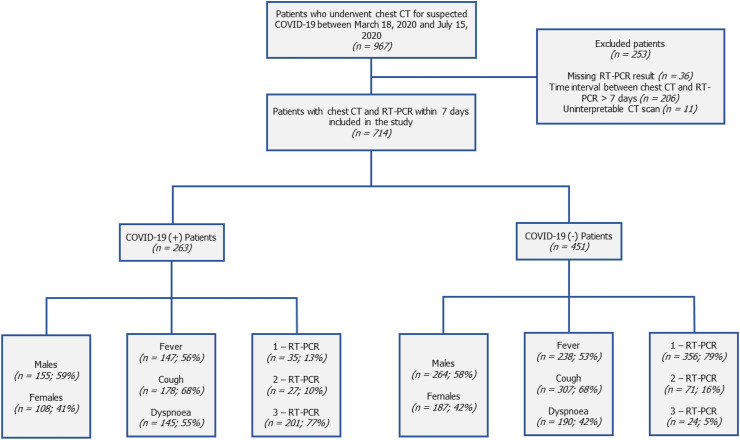
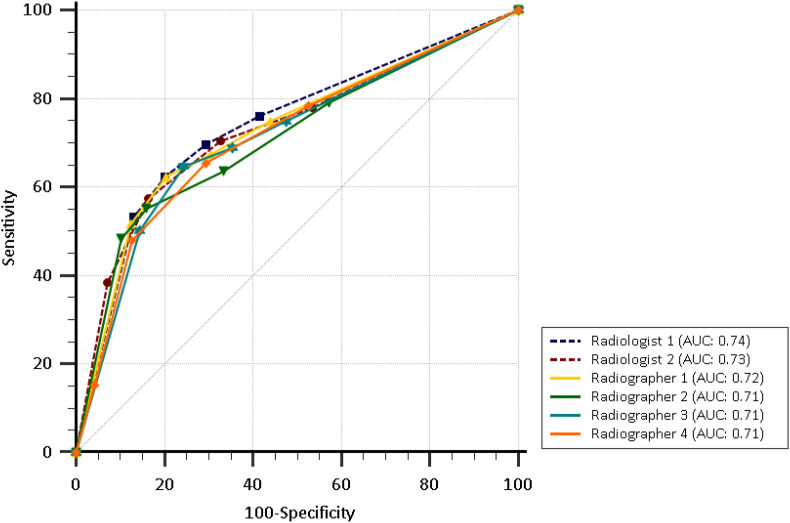
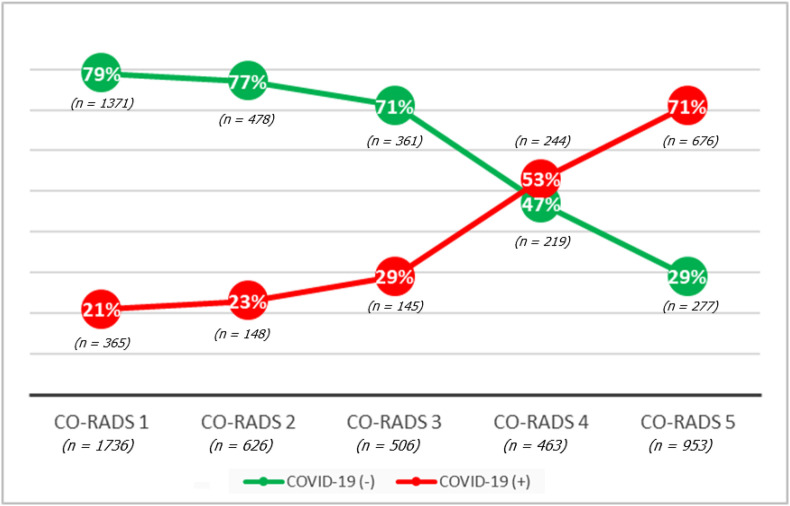
714 patients (419 men; 295 women; mean age: 64 years ±19SD) were evaluated. CO-RADS> 3 was identified as optimal diagnostic threshold. Highly experienced radiographers achieved an average sensitivity of 58.7% (95%CI: 52.5-64.7), an average specificity of 81.8% (95%CI: 77.9-85.2), and a mean AUC of 0.72 (95%CI: 0.68-0.75). Among less experienced radiographers, an average sensitivity of 56.3% (95%CI: 50.1-62.2) and an average specificity of 81.5% (95%CI: 77.6-84.9) were observed, with a mean AUC of 0.71 (95%CI: 0.68-0.74). Consultant radiologists achieved an average sensitivity of 60.0% (95%CI: 53.7-65.8), an average specificity of 81.7% (95%CI: 77.8-85.1), and a mean AUC of 0.73 (95%CI: 0.70-0.77).
Radiographers can adequately recognise the classic appearances of COVID-19 on CT, as described by the CO-RADS assessment scheme, in a way comparable to expert radiologists.
Radiographers, as the first healthcare professionals to evaluate CT images in patients with suspected SARS-CoV-2 infection, could diagnose COVID-19 pneumonia by means of a categorical reporting scheme at CT in a reliable way, hence playing a primary role in the early management of these patients.
为了加快疑似 COVID-19 患者的管理,建议放射技师发挥更具结构化的作用。本研究的目的是使用 CO-RADS 描述符评估放射技师在检测胸部 CT 中 COVID-19 肺炎方面的诊断性能。
回顾性分析 2020 年 3 月至 7 月期间因 COVID-19 疑似病例而行 RT-PCR 和胸部 CT 的患者的 CT 图像。六位读者(包括两位放射科医生、两位经验丰富的放射技师和两位经验较少的放射技师)分别使用 CO-RADS 词汇表对每位 CT 进行评分。使用 ROC 曲线研究诊断准确性,使用 Fleiss'κ 统计评估组内一致性。
共评估了 714 名患者(419 名男性;295 名女性;平均年龄:64 岁±19 岁)。CO-RADS>3 被确定为最佳诊断阈值。经验丰富的放射技师平均灵敏度为 58.7%(95%CI:52.5-64.7),平均特异性为 81.8%(95%CI:77.9-85.2),平均 AUC 为 0.72(95%CI:0.68-0.75)。经验较少的放射技师平均灵敏度为 56.3%(95%CI:50.1-62.2),平均特异性为 81.5%(95%CI:77.6-84.9),平均 AUC 为 0.71(95%CI:0.68-0.74)。顾问放射科医生平均灵敏度为 60.0%(95%CI:53.7-65.8),平均特异性为 81.7%(95%CI:77.8-85.1),平均 AUC 为 0.73(95%CI:0.70-0.77)。
放射技师可以通过 CO-RADS 评估方案充分识别 CT 上 COVID-19 的典型表现,与专家放射科医生的表现相当。
放射技师作为评估疑似 SARS-CoV-2 感染患者 CT 图像的首批医疗保健专业人员,可以通过 CT 上的分类报告方案可靠地诊断 COVID-19 肺炎,从而在这些患者的早期管理中发挥主要作用。