Wright Bradley W, Logel Dominic Y, Mirzai Mehdi, Pascovici Dana, Molloy Mark P, Jaschke Paul R
Department of Molecular Sciences, Macquarie University, Sydney, NSW, Australia.
Australian Proteome Analysis Facility (APAF), Macquarie University, Sydney, NSW, Australia.
mSystems. 2021 May 11;6(3):e00046-21. doi: 10.1128/mSystems.00046-21.
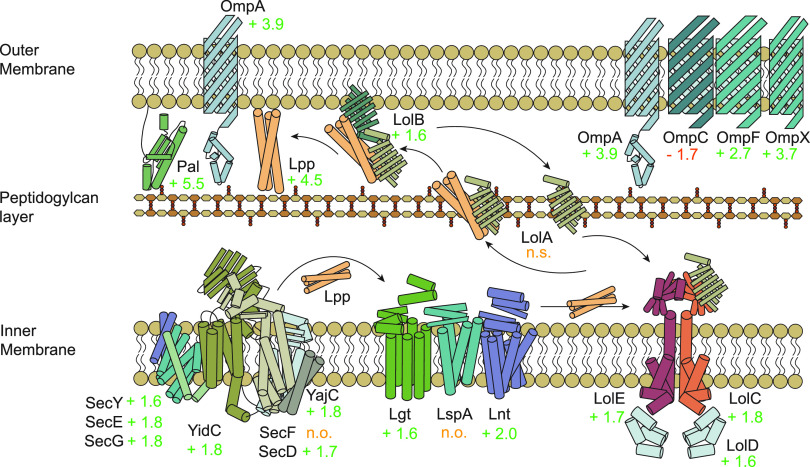
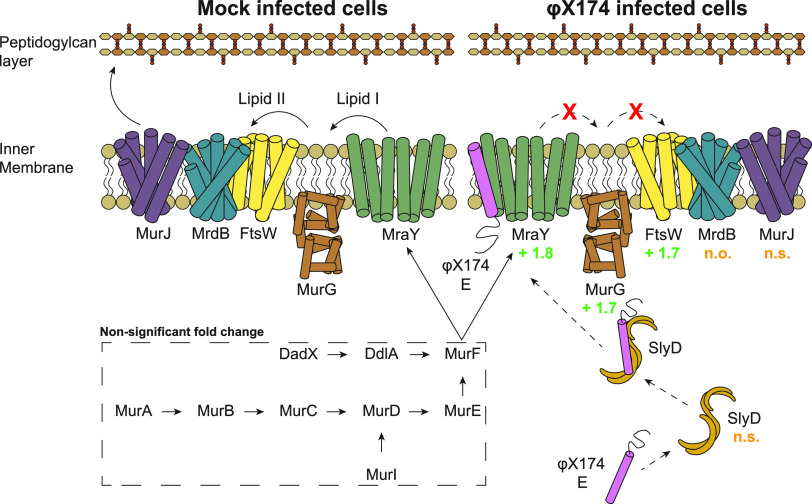
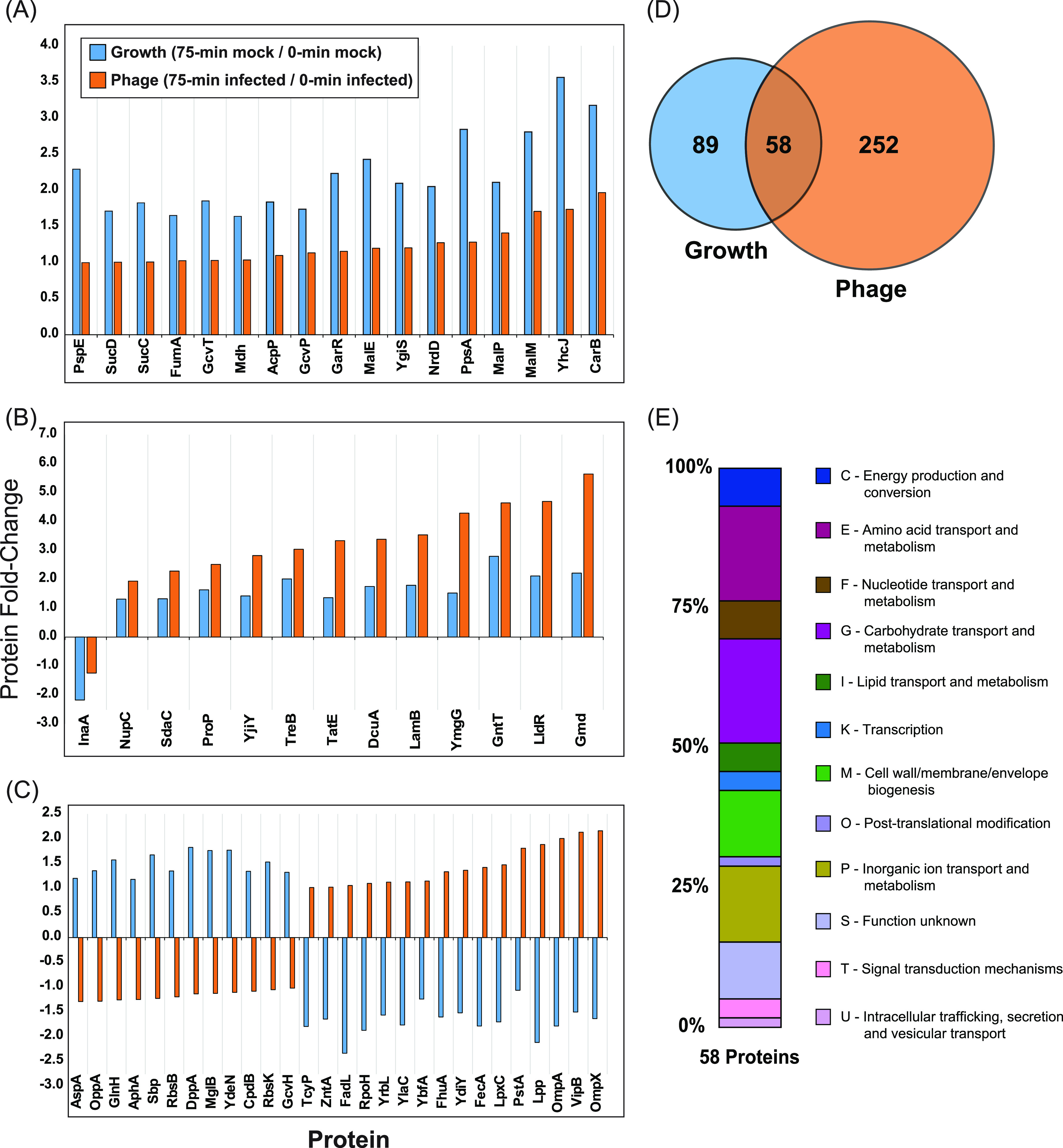
Measuring host-bacteriophage dynamics is an important approach to understanding bacterial survival functions and responses to infection. The model bacteriophage φX174 is endemic to the human gut and has been studied for over 70 years, but the host response to infection has never been investigated in detail. To address this gap in our understanding of this important interaction within our microbiome, we have measured host C proteomic and transcriptomic response to φX174 infection. We used mass spectrometry and RNA sequencing (RNA-seq) to identify and quantify all 11 φX174 proteins and over 1,700 proteins, enabling us to comprehensively map host pathways involved in φX174 infection. Most notably, we see significant host responses centered on membrane damage and remodeling, cellular chaperone and translocon activity, and lipoprotein processing, which we speculate is due to the peptidoglycan-disruptive effects of the φX174 lysis protein E on MraY activity. We also observe the massive upregulation of small heat shock proteins IbpA/B, along with other heat shock pathway chaperones, and speculate on how the specific characteristics of holdase protein activity may be beneficial for viral infections. Together, this study enables us to begin to understand the proteomic and transcriptomic host responses of to infections and contributes insights to the activities of this important model host-phage interaction. A major part of the healthy human gut microbiome is the bacteriophage, exemplified by the model φX174 phage, and their hosts. Although much has been learned from studying φX174 over the last half-century, until this work, the host response to infection has never been investigated in detail. We reveal the proteomic and transcriptomic pathways differentially regulated during the φX174 infection cycle and uncover the details of a coordinated cellular response to membrane damage that results in increased lipoprotein processing and membrane trafficking, likely due to the phage antibiotic-like lysis protein. We also reveal that small heat shock proteins IbpA/B are massively upregulated during infection and that these holdase chaperones are highly conserved across the domains of life, indicating that reliance on them is likely widespread across viruses.
测量宿主与噬菌体的动态关系是理解细菌生存功能及对感染反应的重要途径。模式噬菌体φX174在人类肠道中普遍存在,已被研究了70多年,但宿主对其感染的反应从未被详细研究过。为填补我们对微生物组中这一重要相互作用理解上的空白,我们测量了宿主对φX174感染的蛋白质组和转录组反应。我们使用质谱和RNA测序(RNA-seq)来识别和定量所有11种φX174蛋白以及1700多种蛋白质,从而使我们能够全面描绘参与φX174感染的宿主途径。最值得注意的是,我们看到宿主的显著反应集中在膜损伤与重塑、细胞伴侣和转运体活性以及脂蛋白加工上,我们推测这是由于φX174裂解蛋白E对MraY活性的肽聚糖破坏作用所致。我们还观察到小热休克蛋白IbpA/B以及其他热休克途径伴侣的大量上调,并推测结合蛋白活性的特定特征可能如何有利于病毒感染。总之,这项研究使我们能够开始理解宿主对感染的蛋白质组和转录组反应,并为这一重要的模式宿主 - 噬菌体相互作用的活动提供见解。健康人类肠道微生物组的一个主要部分是噬菌体,以模式φX174噬菌体及其宿主为例。尽管在过去半个世纪里通过研究φX174已经了解了很多,但直到这项工作之前,宿主对感染的反应从未被详细研究过。我们揭示了在φX174感染周期中差异调节的蛋白质组和转录组途径,并揭示了细胞对膜损伤的协调反应细节,这导致脂蛋白加工和膜运输增加,可能是由于噬菌体类似抗生素的裂解蛋白所致。我们还揭示了小热休克蛋白IbpA/B在感染期间大量上调,并且这些结合伴侣在生命域中高度保守,这表明对它们的依赖可能在病毒中广泛存在。