Pontremoli Chiara, Forni Diego, Clerici Mario, Cagliani Rachele, Sironi Manuela
Scientific Institute IRCCS E. MEDEA, Bioinformatics, Bosisio Parini 23842, Italy.
Department of Physiopathology and Transplantation, University of Milan, Milan 20122, Italy.
Virus Evol. 2021 Apr 21;7(1):veab040. doi: 10.1093/ve/veab040. eCollection 2021 Jan.
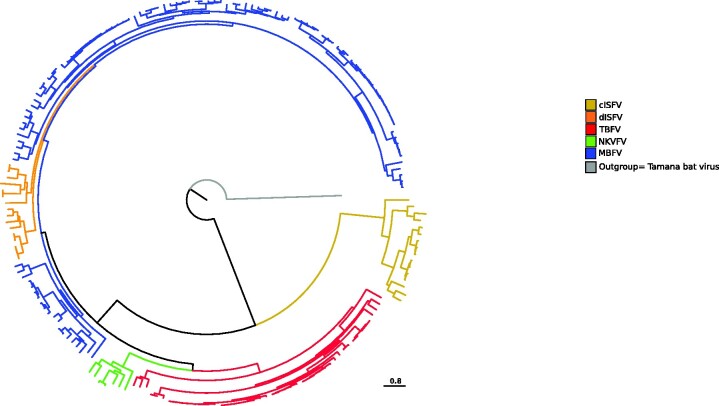
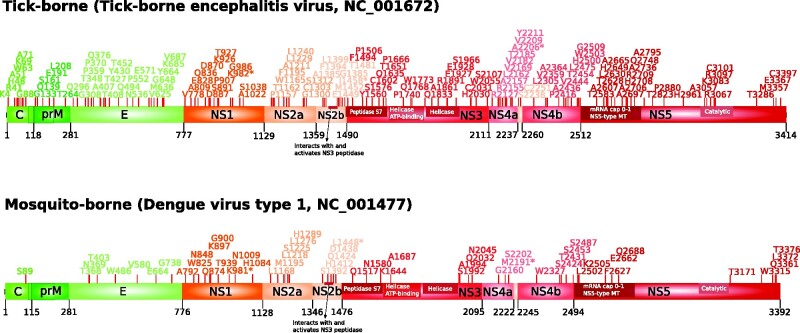
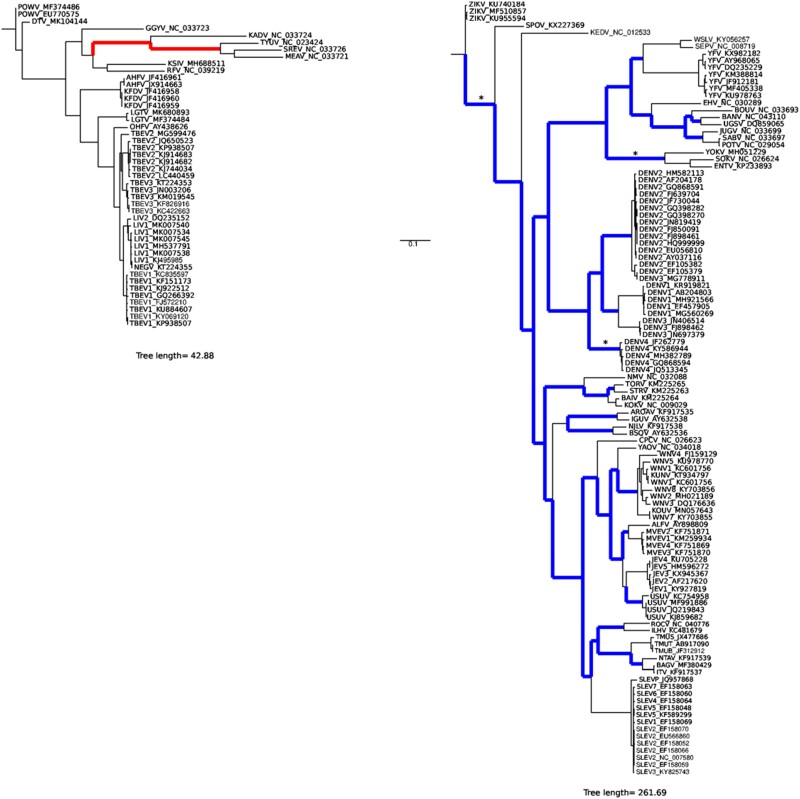
Flaviviruses display diverse epidemiological and ecological features. Tick-borne and mosquito-borne flaviviruses (TBFV and MBFV, respectively) are important human pathogens that alternate replication in invertebrate vectors and vertebrate hosts. The genus also includes insect-specific viruses (ISFVs) and viruses with unknown invertebrate hosts. It is generally accepted that viruses that alternate between taxonomically different hosts evolve slowly and that the evolution of MBFVs and TBFVs is dominated by strong constraints, with limited episodes of positive selection. We exploited the availability of flavivirus genomes to test these hypotheses and to compare their rates and patterns of evolution. We estimated the substitution rates of CFAV and CxFV (two ISFVs) and, by taking into account the time-frame of measurement, compared them with those of other flaviviruses. Results indicated that CFAV and CxFV display relatively different substitution rates. However, these data, together with estimates for single-host members of the family, indicated that MBFVs do not display relatively slower evolution. Conversely, TBFVs displayed some of lowest substitution rates among flaviviruses. Analysis of selective patterns over longer evolutionary time-frames confirmed that MBFVs evolve under strong purifying selection. Interestingly, TBFVs and ISFVs did not show extremely different levels of constraint, although TBFVs alternate among hosts, whereas ISFVs do not. Additional results showed that episodic positive selection drove the evolution of MBFVs, despite their high constraint. Positive selection was also detected on two branches of the TBFVs phylogeny that define the seabird clade. Thus, positive selection was much more common during the evolution of arthropod-borne flaviviruses than previously thought. Overall, our data indicate that flavivirus evolutionary patterns are complex and most likely determined by multiple factors, not limited to the alternation between taxonomically divergent hosts. The frequency of both positive and purifying selection, especially in MBFVs, suggests that a minority of sites in the viral polyprotein experience weak constraint and can evolve to generate new viral phenotypes and possibly promote adaptation to new hosts.
黄病毒呈现出多样的流行病学和生态学特征。蜱传和蚊传黄病毒(分别为TBFV和MBFV)是重要的人类病原体,它们在无脊椎动物媒介和脊椎动物宿主中交替复制。该属还包括昆虫特异性病毒(ISFV)和无脊椎动物宿主未知的病毒。人们普遍认为,在分类学上不同宿主之间交替的病毒进化缓慢,MBFV和TBFV的进化受到强烈限制,正选择事件有限。我们利用黄病毒基因组的可得性来检验这些假设,并比较它们的进化速率和模式。我们估计了CFAV和CxFV(两种ISFV)的替换率,并考虑到测量的时间框架,将它们与其他黄病毒的替换率进行比较。结果表明,CFAV和CxFV显示出相对不同的替换率。然而,这些数据以及对该科单宿主成员的估计表明,MBFV并没有显示出相对较慢的进化。相反,TBFV在黄病毒中显示出一些最低的替换率。对更长进化时间框架内选择模式的分析证实,MBFV在强烈的净化选择下进化。有趣的是,尽管TBFV在宿主之间交替,而ISFV不交替,但TBFV和ISFV并没有显示出极其不同的限制水平。其他结果表明,尽管MBFV受到高度限制,但间歇性正选择推动了其进化。在定义海鸟分支的TBFV系统发育树的两个分支上也检测到了正选择。因此,节肢动物传播的黄病毒在进化过程中正选择比以前认为的更为常见。总体而言,我们的数据表明,黄病毒的进化模式很复杂,很可能由多种因素决定,而不仅限于分类学上不同宿主之间的交替。正选择和净化选择的频率,特别是在MBFV中,表明病毒多聚蛋白中的少数位点受到的限制较弱,并且可以进化以产生新的病毒表型,并可能促进对新宿主的适应。