Biochemistry of Macromolecular Interactions Unit Department of Structural Biology and Chemistry Institut Pasteur CNRS UMR3528 Paris 75015 France.
Université de Paris Sorbonne Paris Cité Paris 75006 France.
Adv Sci (Weinh). 2021 Mar 8;8(9):2003630. doi: 10.1002/advs.202003630. eCollection 2021 May.
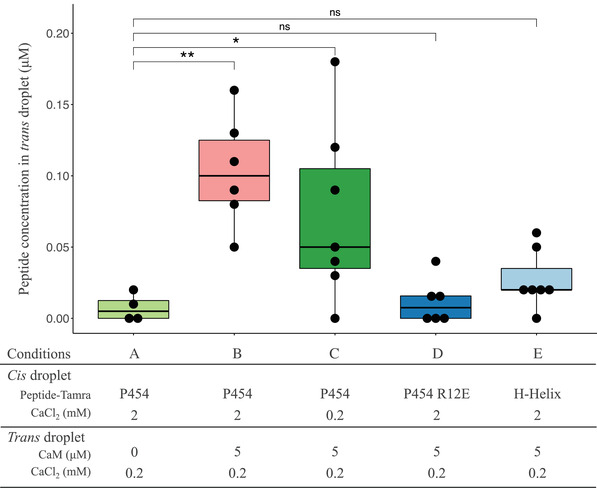
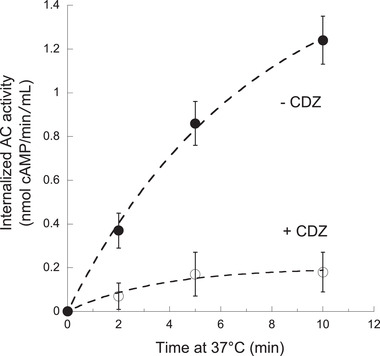
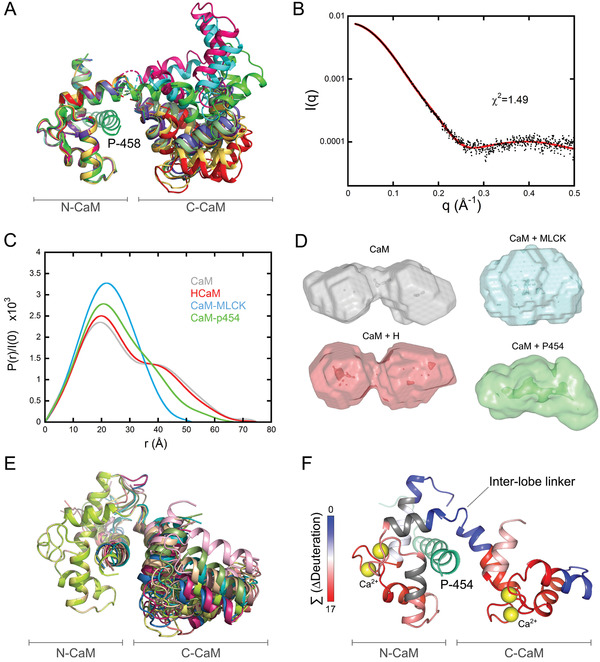
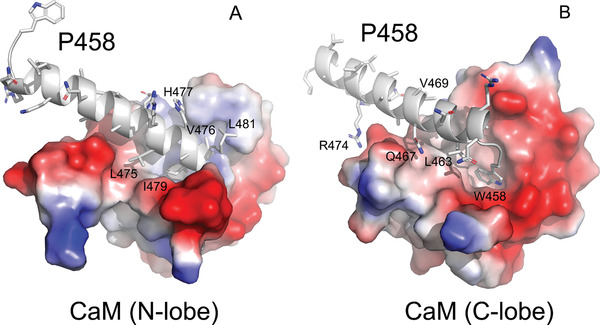
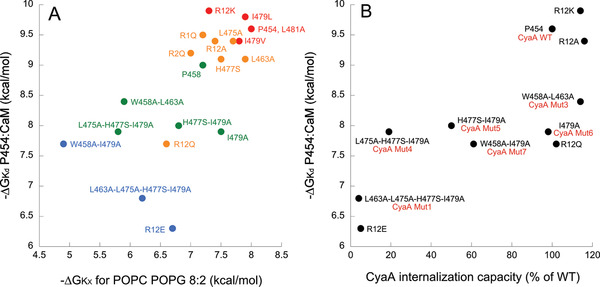
The molecular mechanisms and forces involved in the translocation of bacterial toxins into host cells are still a matter of intense research. The adenylate cyclase (CyaA) toxin from displays a unique intoxication pathway in which its catalytic domain is directly translocated across target cell membranes. The CyaA translocation region contains a segment, P454 (residues 454-484), which exhibits membrane-active properties related to antimicrobial peptides. Herein, the results show that this peptide is able to translocate across membranes and to interact with calmodulin (CaM). Structural and biophysical analyses reveal the key residues of P454 involved in membrane destabilization and calmodulin binding. Mutational analysis demonstrates that these residues play a crucial role in CyaA translocation into target cells. In addition, calmidazolium, a calmodulin inhibitor, efficiently blocks CyaA internalization. It is proposed that after CyaA binding to target cells, the P454 segment destabilizes the plasma membrane, translocates across the lipid bilayer and binds calmodulin. Trapping of CyaA by the CaM:P454 interaction in the cytosol may assist the entry of the N-terminal catalytic domain by converting the stochastic motion of the polypeptide chain through the membrane into an efficient vectorial chain translocation into host cells.
细菌毒素向宿主细胞转位涉及的分子机制和力仍然是一个研究热点。 展示了一种独特的毒素中毒途径,其催化结构域直接穿过靶细胞膜转位。 CyaA 转位区包含一个含有 454-484 个残基的 P454 片段,该片段具有与抗菌肽相关的膜活性特性。 本文结果表明,该肽能够穿过膜并与钙调蛋白(CaM)相互作用。 结构和生物物理分析揭示了 P454 中参与膜去稳定和钙调蛋白结合的关键残基。 突变分析表明,这些残基在 CyaA 向靶细胞的转位中起关键作用。 此外,钙调蛋白抑制剂 calmidazolium 可有效阻断 CyaA 的内化。 推测在 CyaA 与靶细胞结合后,P454 片段使质膜不稳定,穿过脂质双层并与钙调蛋白结合。 CyaA 与 CaM:P454 相互作用在细胞质中的捕获可能通过将多肽链穿过膜的随机运动转化为进入宿主细胞的有效矢量链转位,来协助 N 端催化结构域的进入。