Institut Pasteur, Biochemistry of Macromolecular Interactions Unit, UMR CNRS 3528, Structural Biology and Chemistry Department, 28 rue du Docteur Roux, 75724 Paris CEDEX 15, France.
Toxins (Basel). 2018 Jul 20;10(7):302. doi: 10.3390/toxins10070302.
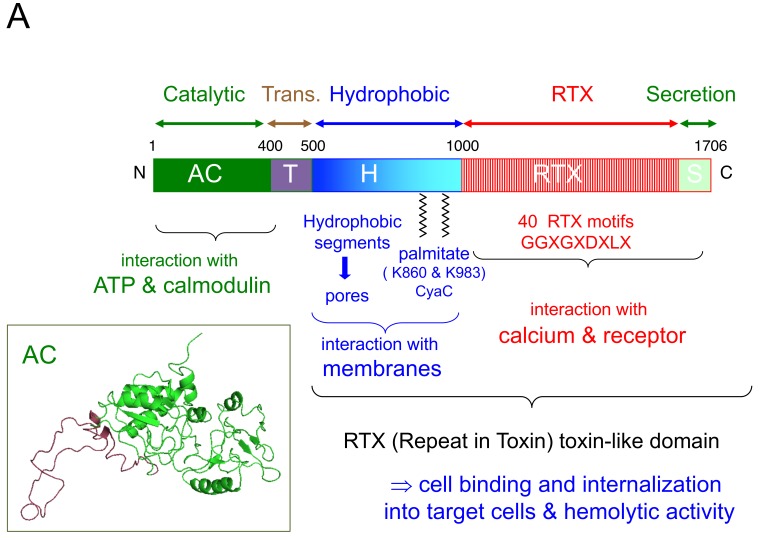
The adenylate cyclase toxin (CyaA) is one of the major virulence factors of , the causative agent of whooping cough. CyaA is able to invade eukaryotic cells where, upon activation by endogenous calmodulin, it synthesizes massive amounts of cAMP that alters cellular physiology. The CyaA toxin is a 1706 residues-long bifunctional protein: the catalytic domain is located in the 400 amino-proximal residues, whereas the carboxy-terminal 1306 residues are implicated in toxin binding to the cellular receptor, the αβ₂ (CD11b/CD18) integrin, and subsequently in the translocation of the catalytic domain across the cytoplasmic membrane of the target cells. Indeed, this protein is endowed with the unique capability of delivering its N-terminal catalytic domain directly across the plasma membrane of eukaryotic target cells. These properties have been exploited to engineer the CyaA toxin as a potent non-replicating vector able to deliver antigens into antigen presenting cells and elicit specific cell-mediated immune responses. Antigens of interest can be inserted into the CyaA protein to yield recombinant molecules that are targeted in vivo to dendritic cells, where the antigens are processed and presented by the major class I and class II histocompatibility complexes (MHC-I and II). CyaA turned out to be a remarkably effective and versatile vaccine vector capable of inducing all the components of the immune response (T-CD4, T-CD8, and antibody). In this chapter, we summarize the basic knowledge on the adenylate cyclase toxin and then describe the application of CyaA in vaccinology, including some recent results of clinical trials of immunotherapy using a recombinant CyaA vaccine.
腺苷酸环化酶毒素(CyaA)是百日咳杆菌的主要毒力因子之一。CyaA 能够侵入真核细胞,在细胞内钙调蛋白的激活下,它合成大量的 cAMP,改变细胞的生理机能。CyaA 毒素是一种 1706 个残基长的双功能蛋白:催化结构域位于氨基末端的 400 个残基内,而羧基末端的 1306 个残基参与毒素与细胞受体(αβ₂(CD11b/CD18)整合素)的结合,随后穿过靶细胞的细胞质膜将催化结构域转运到细胞质中。事实上,这种蛋白具有独特的能力,能够将其 N 端的催化结构域直接穿过真核靶细胞的质膜。这些特性被用于设计 CyaA 毒素作为一种有效的非复制载体,能够将抗原递呈给抗原呈递细胞,并引发特异性的细胞免疫反应。感兴趣的抗原可以插入到 CyaA 蛋白中,产生重组分子,这些分子在体内被靶向树突状细胞,在树突状细胞中,抗原被主要的 I 类和 II 类组织相容性复合物(MHC-I 和 II)加工和呈递。CyaA 被证明是一种非常有效和多功能的疫苗载体,能够诱导免疫反应的所有组成部分(T-CD4、T-CD8 和抗体)。在这一章中,我们总结了关于腺苷酸环化酶毒素的基本知识,然后描述了 CyaA 在疫苗学中的应用,包括使用重组 CyaA 疫苗进行免疫治疗的一些最新临床试验结果。