Proutière Alexis, du Merle Laurence, Garcia-Lopez Marta, Léger Corentin, Voegele Alexis, Chenal Alexandre, Harrington Antony, Tal-Gan Yftah, Cokelaer Thomas, Trieu-Cuot Patrick, Dramsi Shaynoor
Institut Pasteur, Université Paris Cité, CNRS UMR6047, Biology of Gram-Positive Pathogens Unit, Paris, France.
Institut Pasteur, Université Paris Cité, CNRS UMR3528, Biochemistry of Macromolecular Interactions Unit, Paris, France.
Microbiol Spectr. 2023 Mar 23;11(2):e0508522. doi: 10.1128/spectrum.05085-22.
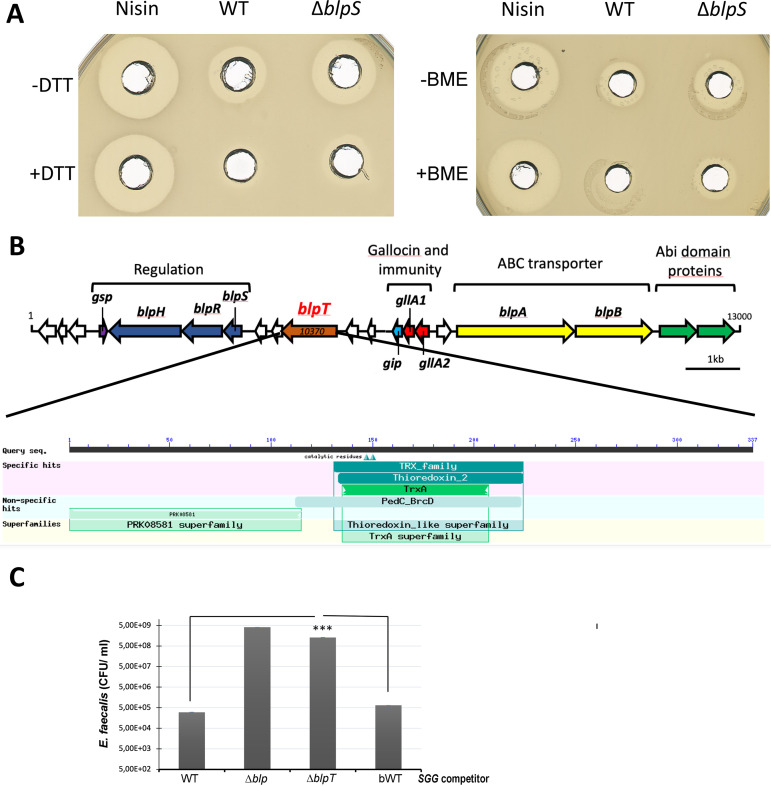
Streptococcus gallolyticus subsp. () is an opportunistic gut pathogen associated with colorectal cancer. We previously showed that colonization of the murine colon by in tumoral conditions was strongly enhanced by the production of gallocin A, a two-peptide bacteriocin. Here, we aimed to characterize the mechanisms of its action and resistance. Using a genetic approach, we demonstrated that gallocin A is composed of two peptides, GllA1 and GllA2, which are inactive alone and act together to kill "target" bacteria. We showed that gallocin A can kill phylogenetically close relatives of the pathogen. Importantly, we demonstrated that gallocin A peptides can insert themselves into membranes and permeabilize lipid bilayer vesicles. Next, we showed that the third gene of the gallocin A operon, , is necessary and sufficient to confer immunity to gallocin A. Structural modeling of GllA1 and GllA2 mature peptides suggested that both peptides form alpha-helical hairpins stabilized by intramolecular disulfide bridges. The presence of a disulfide bond in GllA1 and GllA2 was confirmed experimentally. Addition of disulfide-reducing agents abrogated gallocin A activity. Likewise, deletion of a gene encoding a surface protein with a thioredoxin-like domain impaired the ability of gallocin A to kill Enterococcus faecalis. Structural modeling of GIP revealed a hairpin-like structure strongly resembling those of the GllA1 and GllA2 mature peptides, suggesting a mechanism of immunity by competition with GllA1/2. Finally, identification of other class IIb bacteriocins exhibiting a similar alpha-helical hairpin fold stabilized with an intramolecular disulfide bridge suggests the existence of a new subclass of class IIb bacteriocins. Streptococcus gallolyticus subsp. (), previously named Streptococcus bovis biotype I, is an opportunistic pathogen responsible for invasive infections (septicemia, endocarditis) in elderly people and is often associated with colon tumors. is one of the first bacteria to be associated with the occurrence of colorectal cancer in humans. Previously, we showed that tumor-associated conditions in the colon provide with an ideal environment to proliferate at the expense of phylogenetically and metabolically closely related commensal bacteria such as enterococci (1). takes advantage of CRC-associated conditions to outcompete and substitute commensal members of the gut microbiota using a specific bacteriocin named gallocin, recently renamed gallocin A following the discovery of gallocin D in a peculiar isolate. Here, we showed that gallocin A is a two-peptide bacteriocin and that both GllA1 and GllA2 peptides are required for antimicrobial activity. Gallocin A was shown to permeabilize bacterial membranes and kill phylogenetically closely related bacteria such as most streptococci, lactococci, and enterococci, probably through membrane pore formation. GllA1 and GllA2 secreted peptides are unusually long (42 and 60 amino acids long) and have very few charged amino acids compared to well-known class IIb bacteriocins. modeling revealed that both GllA1 and GllA2 exhibit a similar hairpin-like conformation stabilized by an intramolecular disulfide bond. We also showed that the GIP immunity peptide forms a hairpin-like structure similar to GllA1/GllA2. Thus, we hypothesize that GIP blocks the formation of the GllA1/GllA2 complex by interacting with GllA1 or GllA2. Gallocin A may constitute the first class IIb bacteriocin which displays disulfide bridges important for its structure and activity and might be the founding member of a subtype of class IIb bacteriocins.
解没食子酸链球菌亚种()是一种与结直肠癌相关的机会性肠道病原体。我们之前表明,在肿瘤条件下,解没食子酸链球菌在小鼠结肠中的定殖因双肽细菌素没食子酸菌素A的产生而显著增强。在此,我们旨在表征其作用机制和抗性机制。通过遗传学方法,我们证明没食子酸菌素A由两种肽GllA1和GllA2组成,它们单独无活性,共同作用以杀死“靶标”细菌。我们表明没食子酸菌素A可以杀死该病原体在系统发育上的近亲。重要的是,我们证明没食子酸菌素A肽可以插入膜中并使脂质双层囊泡通透。接下来,我们表明没食子酸菌素A操纵子的第三个基因,对没食子酸菌素A具有免疫作用是必要且充分的。GllA1和GllA2成熟肽的结构建模表明,这两种肽均形成由分子内二硫键稳定的α-螺旋发夹结构。通过实验证实了GllA1和GllA2中存在二硫键。添加二硫键还原剂可消除没食子酸菌素A的活性。同样,缺失编码具有硫氧还蛋白样结构域的表面蛋白的基因会损害没食子酸菌素A杀死粪肠球菌的能力。GIP的结构建模揭示了一种类似于GllA1和GllA2成熟肽的发夹样结构,提示了一种通过与GllA1/2竞争的免疫机制。最后,鉴定出其他表现出类似的由分子内二硫键稳定的α-螺旋发夹折叠的IIb类细菌素,表明存在IIb类细菌素的一个新亚类。解没食子酸链球菌亚种(),以前称为牛链球菌I型生物型,是一种机会性病原体,可导致老年人发生侵袭性感染(败血症、心内膜炎),并且常与结肠肿瘤相关。它是最早与人类结直肠癌发生相关的细菌之一。之前,我们表明结肠中与肿瘤相关的条件为解没食子酸链球菌提供了一个理想的增殖环境,其以系统发育和代谢上密切相关的共生细菌如肠球菌为代价(1)。解没食子酸链球菌利用与结直肠癌相关的条件,通过一种名为没食子酸菌素的特定细菌素胜过并替代肠道微生物群的共生成员,在一种特殊的分离株中发现没食子酸菌素D后,最近将其重新命名为没食子酸菌素A。在此,我们表明没食子酸菌素A是一种双肽细菌素,GllA1和GllA2肽对于抗菌活性都是必需的。没食子酸菌素A被证明可使细菌膜通透,并杀死系统发育上密切相关的细菌,如大多数链球菌、乳球菌和肠球菌,可能是通过形成膜孔。与众所周知的IIb类细菌素相比,分泌的GllA1和GllA2肽异常长(分别为42和60个氨基酸长)且带电荷的氨基酸很少。建模显示GllA1和GllA2均呈现由分子内二硫键稳定的类似发夹样构象。我们还表明GIP免疫肽形成类似于GllA1/GllA2的发夹样结构。因此,我们假设GIP通过与GllA1或GllA2相互作用来阻断GllA1/GllA2复合物的形成。没食子酸菌素A可能构成第一种IIb类细菌素,其具有对其结构和活性重要的二硫键,并且可能是IIb类细菌素一个亚型的创始成员。