The Johns Hopkins University School of Medicine, Baltimore, MD, USA.
Johns Hopkins Bloomberg School of Public Health, Baltimore, MD, USA.
J Appl Gerontol. 2021 Sep;40(9):958-962. doi: 10.1177/07334648211013634. Epub 2021 May 12.
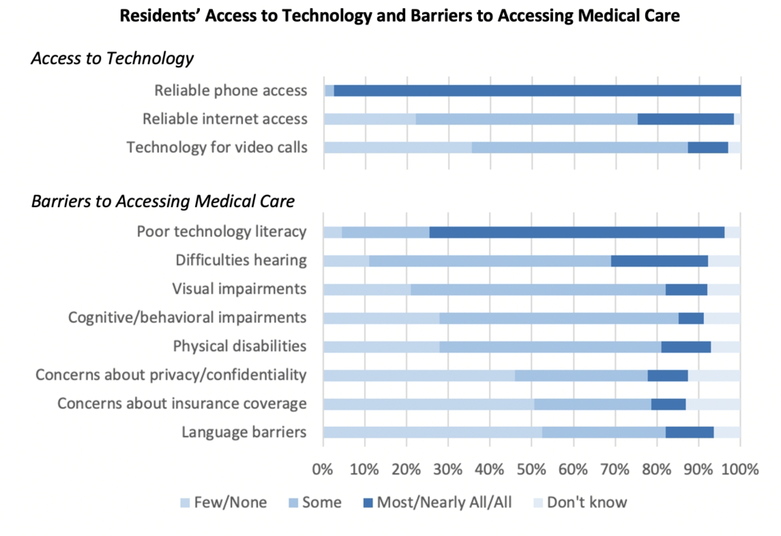
While U.S. adults living in affordable senior housing represent a vulnerable population during the COVID-19 pandemic, affordable housing may provide a foundation for interventions designed to improve technology access to support health. To better understand technology access among residents of affordable senior housing, we surveyed members of a national association of resident service coordinators to assess their experiences working with residents during the pandemic ( = 1,440). While nearly all service coordinators report that most or all residents have reliable phone access, under a quarter report that most or all have reliable internet access; they also report limited access to technology for video calls. Lack of internet access and technology literacy are perceived as barriers to medical visits and food procurement for low-income older adult residents of affordable housing. Policies to expand internet access as well as training and support to enable use of online services are required to overcome these barriers.
虽然在美国,居住在负担得起的老年人住房中的成年人在 COVID-19 大流行期间是一个脆弱的群体,但负担得起的住房可以为旨在改善技术获取以支持健康的干预措施提供基础。为了更好地了解负担得起的老年人住房居民的技术获取情况,我们调查了全国居民服务协调员协会的成员,以评估他们在大流行期间与居民合作的经验(=1440)。虽然几乎所有的服务协调员都报告说,大多数或所有居民都有可靠的电话接入,但只有不到四分之一的人报告说,大多数或所有居民都有可靠的互联网接入;他们还报告说,视频通话的技术手段有限。缺乏互联网接入和技术素养被认为是低收入老年人居民获得医疗访问和采购食品的障碍。需要扩大互联网接入的政策,以及培训和支持,以启用在线服务的使用,以克服这些障碍。