Klaus Federica, Peek Elizabeth, Quynh Avery, Sutherland Ashley N, Selvam Divya, Moore Raeanne C, Depp Colin A, Eyler Lisa T
Department of Psychiatry, UC San Diego, La Jolla, CA, United States.
VA San Diego Healthcare System, Mental Illness Research, Education, and Clinical Center (MIRECC), La Jolla, CA, United States.
Front Digit Health. 2022 Aug 23;4:920706. doi: 10.3389/fdgth.2022.920706. eCollection 2022.
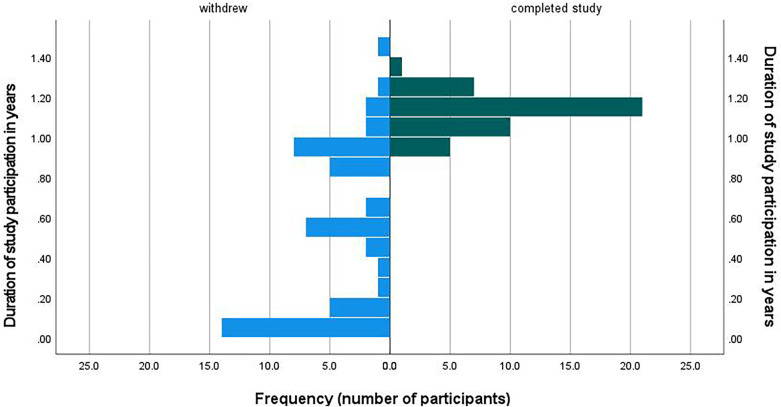
Digital surveys, such as mobile phone ecological momentary assessment (EMA), bear the potential to assess and target individual wellbeing in a personalized, real-time approach and allow for interaction in situations when in-person contact is not possible, such as during the coronavirus pandemic. While the use of digital technology might especially benefit research in older adults who find themselves in circumstances of reduced mobility, little is known about their barriers to adherence. We investigated baseline and structural factors that predict study withdrawal and adherence from daily smartphone EMA self-report surveys in the StayWELL Study. The StayWELL study is a longitudinal, observational study on the relationship between social restrictions during the coronavirus pandemic and mental well-being in 95 community-dwelling older aged adults (67-87 years) who were participants in a randomized clinical trial using EMA. Withdrawal was associated with less research staff changes and less likely in participants that reached the study mid-point. No baseline characteristics predicted withdrawal. Main reasons for withdrawal were communication issues, i.e. staff not being able to contact participants. We found an adherence rate of 82% and no fatigue effects. Adherence was predicted by education status, study participation duration, reaching the study midpoint and time between study start and enrollment. COVID infections or supporting people in the household was not related to adherence. To conclude, it is feasible to conduct an EMA study in older people without impacting engagement during a pandemic. Furthermore, personal characteristics and smartphone operating system (Android vs. iOS) used did not relate to engagement, allowing for a broad distribution of digital health technologies. Our study adds information on single predictive variables relevant for adherence and withdrawal from EMA smartphone surveys in older people that can inform the design of future digital EMA research to maximize engagement and reliability of study results.
数字调查,如手机生态瞬时评估(EMA),有潜力以个性化、实时的方式评估和关注个体幸福感,并能在无法进行面对面接触的情况下实现互动,比如在新冠疫情期间。虽然数字技术的使用可能对行动不便的老年人的研究特别有益,但对于他们在参与研究时的障碍却知之甚少。我们在“保持健康”研究中调查了预测每日智能手机EMA自我报告调查中研究退出和依从性的基线和结构因素。“保持健康”研究是一项纵向观察性研究,旨在探讨新冠疫情期间社交限制与95名社区居住的老年人(67 - 87岁)心理健康之间的关系,这些老年人是一项使用EMA的随机临床试验的参与者。研究退出与研究人员变动较少相关,并且在达到研究中点的参与者中退出的可能性较小。没有基线特征能够预测退出情况。退出的主要原因是沟通问题,即工作人员无法联系到参与者。我们发现依从率为82%,且没有疲劳效应。教育程度、研究参与时长、达到研究中点以及研究开始到入组之间的时间可以预测依从性。新冠感染或家中有人需要照顾与依从性无关。总之,在老年人中进行EMA研究并在疫情期间不影响参与度是可行的。此外,个人特征和所使用的智能手机操作系统(安卓系统与iOS系统)与参与度无关,这使得数字健康技术能够广泛应用。我们的研究增加了与老年人EMA智能手机调查中的依从性和退出相关的单一预测变量的信息,可为未来数字EMA研究的设计提供参考,以最大限度地提高研究结果的参与度和可靠性。