Cardani L, Valenti F, Casali N, Catelani G, Charpentier T, Clemenza M, Colantoni I, Cruciani A, D'Imperio G, Gironi L, Grünhaupt L, Gusenkova D, Henriques F, Lagoin M, Martinez M, Pettinari G, Rusconi C, Sander O, Tomei C, Ustinov A V, Weber M, Wernsdorfer W, Vignati M, Pirro S, Pop I M
INFN Sezione di Roma, Roma, Italy.
PHI, Karlsruhe Institute of Technology, Karlsruhe, Germany.
Nat Commun. 2021 May 12;12(1):2733. doi: 10.1038/s41467-021-23032-z.
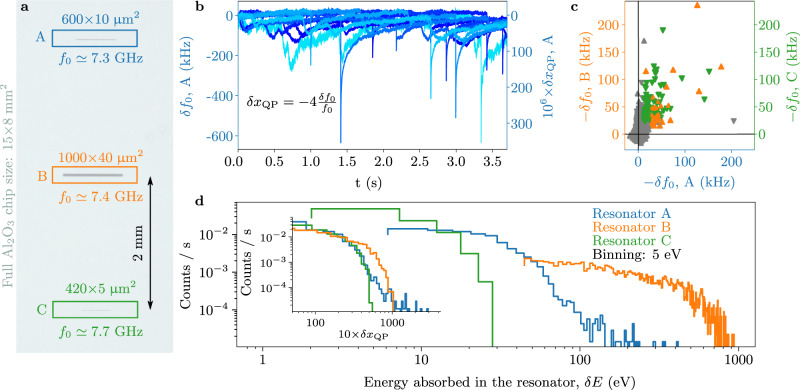
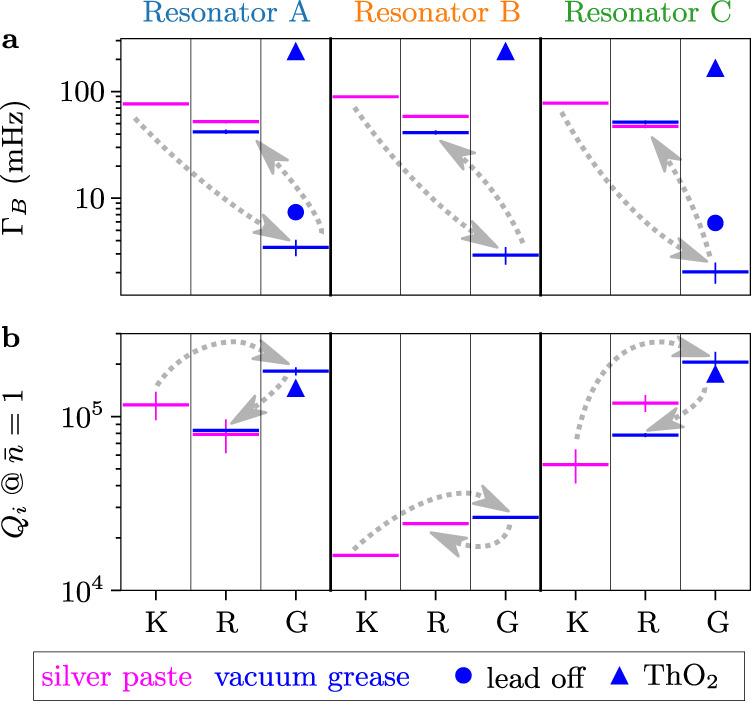
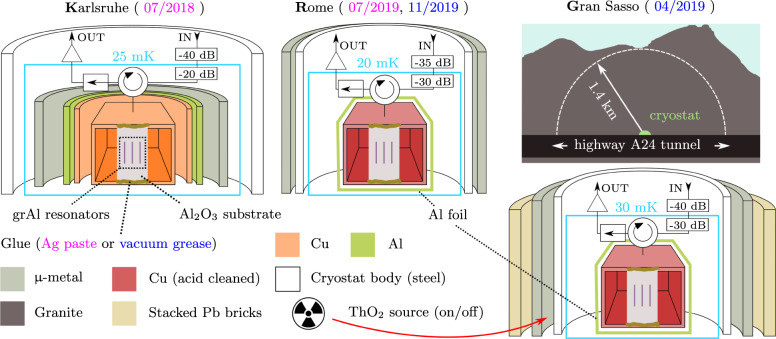
As quantum coherence times of superconducting circuits have increased from nanoseconds to hundreds of microseconds, they are currently one of the leading platforms for quantum information processing. However, coherence needs to further improve by orders of magnitude to reduce the prohibitive hardware overhead of current error correction schemes. Reaching this goal hinges on reducing the density of broken Cooper pairs, so-called quasiparticles. Here, we show that environmental radioactivity is a significant source of nonequilibrium quasiparticles. Moreover, ionizing radiation introduces time-correlated quasiparticle bursts in resonators on the same chip, further complicating quantum error correction. Operating in a deep-underground lead-shielded cryostat decreases the quasiparticle burst rate by a factor thirty and reduces dissipation up to a factor four, showcasing the importance of radiation abatement in future solid-state quantum hardware.
随着超导电路的量子相干时间从纳秒增加到数百微秒,它们目前是量子信息处理的领先平台之一。然而,相干性需要进一步提高几个数量级,以减少当前纠错方案中过高的硬件开销。实现这一目标取决于降低所谓的准粒子(即破裂的库珀对)的密度。在此,我们表明环境放射性是不平衡准粒子的一个重要来源。此外,电离辐射在同一芯片上的谐振器中引入了时间相关的准粒子爆发,这进一步使量子纠错变得复杂。在深埋于地下的铅屏蔽低温恒温器中运行可将准粒子爆发率降低30倍,并将耗散降低至四倍,这表明在未来固态量子硬件中减少辐射的重要性。