Lu Tong, Xu Ran, Li Qi, Zhao Jia-Ying, Peng Bo, Zhang Han, Guo Ji-da, Zhang Sheng-Qiang, Li Hua-Wei, Wang Jun, Zhang Lin-You
Department of Thoracic Surgery, The Second Affiliated Hospital of Harbin Medical University, Harbin 150086, China.
Department of Child and Adolescent Health, School of Public Health, Harbin Medical University, Harbin 150081, China.
Mol Ther Oncolytics. 2021 Feb 20;21:134-143. doi: 10.1016/j.omto.2021.02.011. eCollection 2021 Jun 25.
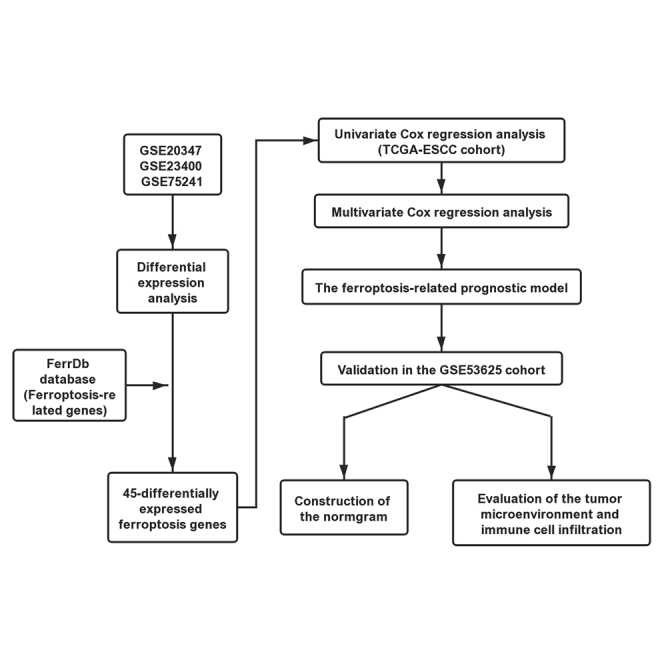
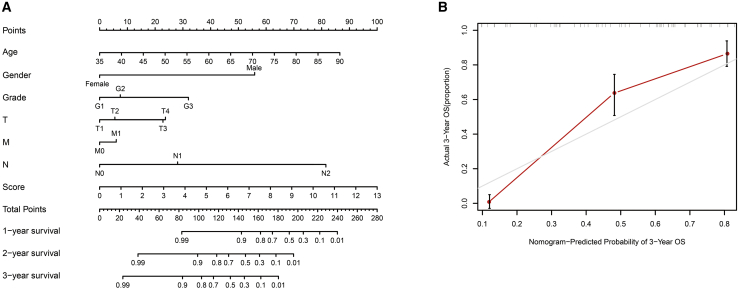
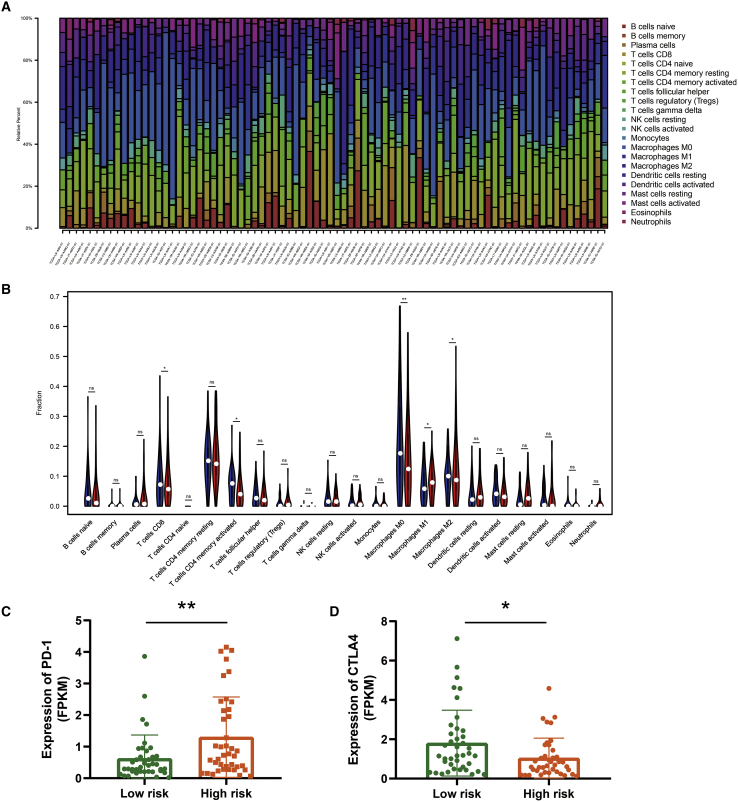
We developed a predictive model associated with ferroptosis to provide a more comprehensive view of esophageal squamous cell carcinoma (ESCC) immunotherapy. Gene expression data and corresponding clinical outcomes were obtained from the GEO and The Cancer Genome Atlas (TCGA) databases, and a ferroptosis-related gene set was obtained from the FerrDb database. We identified 45 ferroptosis-related genes that were differentially expressed, including enrichment in genes involved in the immune system process. We established a ferroptosis-related gene-based prognostic model based on the results of univariate Cox regression and multivariate Cox regression analyses, with an area under the curve (AUC) of 0.76 (3 years). We found that the patients with low-risk scores showed a higher proportion of CD8 T cells, CD4 memory activated T cells, etc. Finally, a predictive ferroptosis-related prognostic nomogram, which included the predictive values of age, gender, grade, TNM stage, and risk score, was established to predict overall survival. In sum, we developed a ferroptosis-related gene-based prognostic model that provides novel insights into the prediction of ESCC prognosis and identifies the relevance of the immune microenvironment for patient outcomes.
我们开发了一种与铁死亡相关的预测模型,以更全面地了解食管鳞状细胞癌(ESCC)免疫治疗。基因表达数据和相应的临床结果来自GEO和癌症基因组图谱(TCGA)数据库,铁死亡相关基因集来自FerrDb数据库。我们鉴定出45个差异表达的铁死亡相关基因,包括参与免疫系统过程的基因富集。基于单变量Cox回归和多变量Cox回归分析结果,我们建立了基于铁死亡相关基因的预后模型,3年曲线下面积(AUC)为0.76。我们发现低风险评分的患者中CD8 T细胞、CD4记忆激活T细胞等比例更高。最后,建立了一个预测性铁死亡相关预后列线图,其中包括年龄、性别、分级、TNM分期和风险评分的预测值,以预测总生存期。总之,我们开发了一种基于铁死亡相关基因的预后模型,该模型为ESCC预后预测提供了新的见解,并确定了免疫微环境与患者预后的相关性。