Ramström Therese, Bunketorp-Käll Lina, Wangdell Johanna
Centre for Advanced Reconstruction of Extremities, Sahlgrenska University Hospital/Mölndal, House U1, Level 6, SE-431 80, Mölndal, Sweden.
Department of Hand Surgery, Institute of Clinical Sciences, Sahlgrenska Academy, University of Gothenburg, Gothenburg, Sweden.
J Patient Rep Outcomes. 2021 May 12;5(1):39. doi: 10.1186/s41687-021-00310-4.
Patient Reported Outcomes Measure (PROM) are commonly used in research and essential to understand the patient experience when receiving treatment. Arm Activity Measure (ArmA) is a valid and reliable self-report questionnaire for assessing passive (section A) and active (section B) real-life arm function in patients with disabling spasticity. The original English version of ArmA has been psychometrically tested and translated into Thai.
Translate and cross-culturally adapt ArmA to Swedish language and context. Further, to evaluate the reliability, validity and sensitivity of the Swedish version of the questionnaire (ArmA-S) in patients with disabling upper limb spasticity caused by injuries to the central nervous system (CNS).
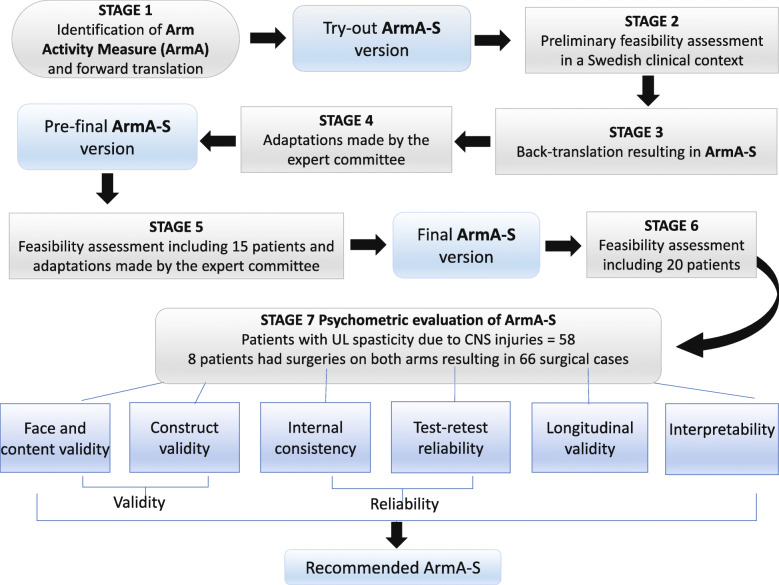
ArmA was translated and cross-culturally adapted according to established guidelines. Validity and reliability were evaluated in 61 patients with disabling spasticity. Face and content validity was evaluated by expert opinions from clinicians and feedback from patients with upper limb spasticity. Internal consistency reliability was assessed with Cronbach's alpha and test-retest reliability was assessed using the quadratic weighted kappa.
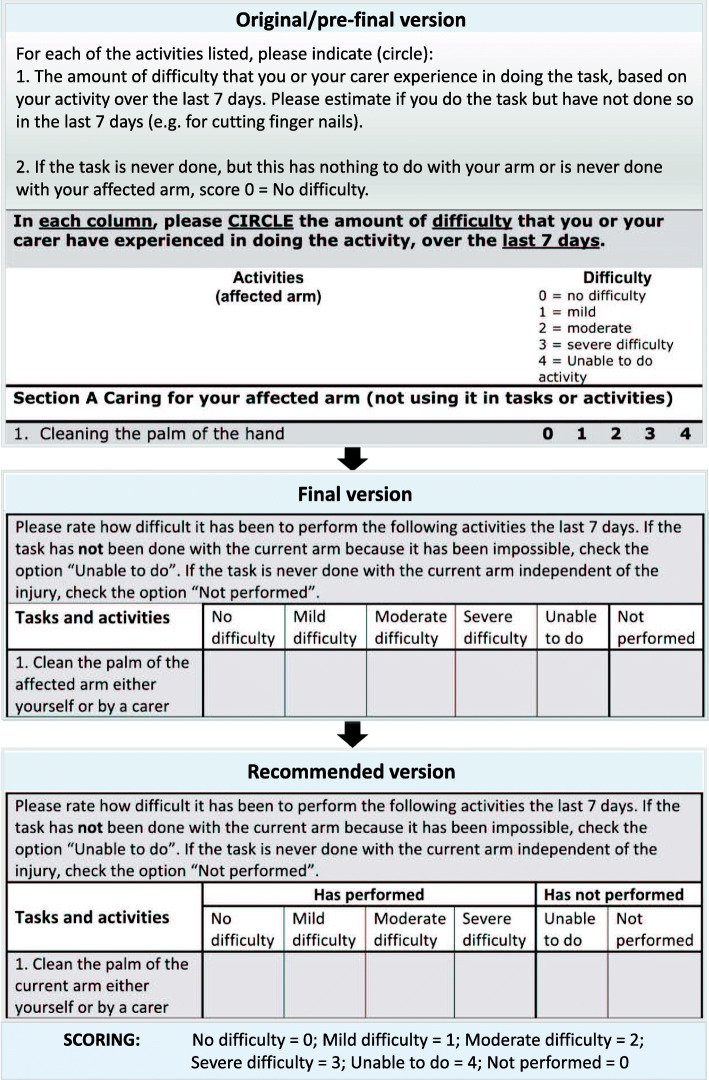
ArmA-S was shown to be clinically feasible, with good face and content validity and no floor or ceiling effects. Internal consistency of ArmA-S was high and equivalent to ArmA; with Chronbach´s alpha coefficients values of 0.94 and 0.93 for section A and B, respectively. Test-retest reliability was good, with kappa values of 0.86 and 0.83 for section A and B, respectively. Some layout modifications of ArmA-S were made to further increase the user-friendliness, test-retest reliability, and responsiveness.
ArmA-S was shown to be a reliable and valid self-report questionnaire for use in clinical practice and research to assess improvements in passive and active upper limb function in patients with disabling spasticity.
患者报告结局测量(PROM)在研究中常用,对于理解患者接受治疗时的体验至关重要。手臂活动测量(ArmA)是一种有效且可靠的自我报告问卷,用于评估患有致残性痉挛的患者的被动(A部分)和主动(B部分)现实生活中的手臂功能。ArmA的原始英文版已进行心理测量测试并翻译成泰语。
将ArmA翻译成瑞典语并进行跨文化适应,以适用于瑞典的语言和背景。此外,评估瑞典语版问卷(ArmA-S)在因中枢神经系统(CNS)损伤导致的致残性上肢痉挛患者中的信度、效度和敏感性。
根据既定指南对ArmA进行翻译和跨文化适应。对61例患有致残性痉挛的患者进行效度和信度评估。通过临床医生的专家意见和上肢痉挛患者的反馈评估表面效度和内容效度。使用Cronbach's alpha评估内部一致性信度,使用二次加权kappa评估重测信度。
ArmA-S在临床上可行,具有良好的表面效度和内容效度,且无地板效应或天花板效应。ArmA-S的内部一致性较高,与ArmA相当;A部分和B部分的Chronbach's alpha系数值分别为0.94和0.93。重测信度良好,A部分和B部分的kappa值分别为0.86和0.83。对ArmA-S的一些布局进行了修改,以进一步提高其用户友好性、重测信度和反应性。
ArmA-S被证明是一种可靠且有效的自我报告问卷,可用于临床实践和研究,以评估患有致残性痉挛的患者被动和主动上肢功能的改善情况。