Institute of Zoology, Zoological Society of London, Regent's Park, London, NW1 4RY, UK.
Science and Solutions for a Changing Planet DTP and the Department of Life Sciences, Imperial College London, Buckhurst Road, Ascot, SL5 7PY, UK.
Ambio. 2022 Jan;51(1):93-102. doi: 10.1007/s13280-021-01560-8. Epub 2021 May 13.
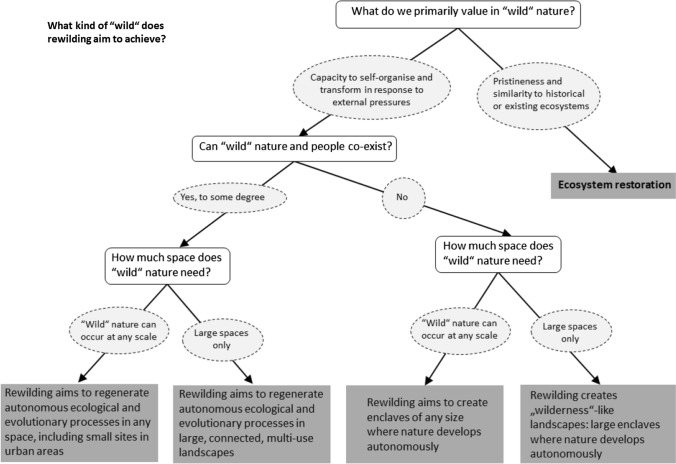
More than 30 years after it was first proposed as a biodiversity conservation strategy, rewilding remains a controversial concept. There is currently little agreement about what the goals of rewilding are, and how these are best achieved, limiting the utility of rewilding in mainstream conservation. Achieving consensus about rewilding requires agreeing about what "wild" means, but many different definitions exist, reflecting the diversity of values in conservation. There are three key debates that must be addressed to find a consensual definition of "wild": (1) to which extent can people and "wild" nature co-exist?; (2) how much space does "wild" nature need? and (3) what kinds of "wild" nature do we value? Depending on the kinds of "wild" nature rewilding aims to create, rewilding policy will be faced with managing different opportunities and risks for biodiversity and people.
在最初被提出作为生物多样性保护策略 30 多年后,重新引入野生动物仍然是一个有争议的概念。目前,对于重新引入野生动物的目标是什么,以及如何最好地实现这些目标,几乎没有达成共识,这限制了重新引入野生动物在主流保护中的应用。要就重新引入野生动物达成共识,就必须就“野生”的含义达成一致,但存在许多不同的定义,反映了保护中存在的多样性价值观。要找到“野生”的共识定义,必须解决三个关键的争论:(1)人类和“野生”自然可以在多大程度上共存?;(2)“野生”自然需要多少空间?和(3)我们看重什么样的“野生”自然?根据重新引入野生动物旨在创造的“野生”自然的种类,重新引入野生动物的政策将面临管理生物多样性和人类的不同机会和风险。