Hilario-Husain Bona Abigail, Tanalgo Krizler Cejuela, Guerrero Sarrah Jane C, Garcia Francisco Gil N, Lerios Tessie E, Garcia May Eva Z, Alvaro-Ele Renee Jane, Manampan-Rubio Meriam, Murray Sedra A, Casim Lothy F, Delos Reyes Jamaica L, Dela Cruz Kier Celestial, Abdullah Sumaira S, Balase Shiela Mae Prince, Respicio Jeaneth Magelen V, Lidasan Asraf K, Buday Zafrullah S, Cabasan Ma Teodora N, Pimentel Jonald L, Tamon Florie Jane M, Agduma Angelo Rellama
Ecology and Conservation Research Laboratory (Eco/Con Lab), Department of Biological Sciences, College of Science and Mathematics, University of Southern Mindanao, Kabacan, 9407, Cotabato, Philippines.
Department of Biological Sciences, College of Science and Mathematics, University of Southern Mindanao, Kabacan, 9407, Cotabato, Philippines.
NPJ Biodivers. 2024 Apr 15;3(1):10. doi: 10.1038/s44185-024-00044-8.
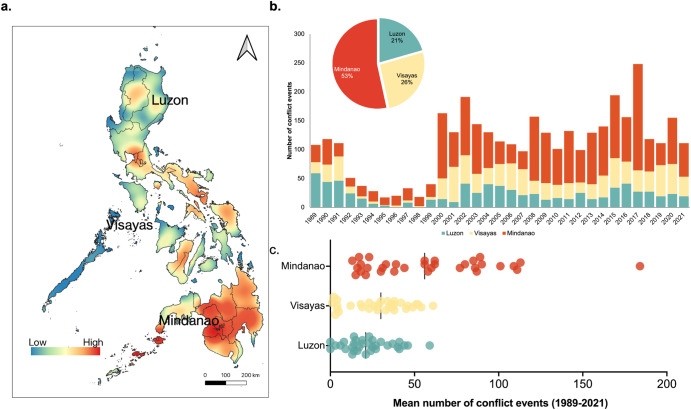
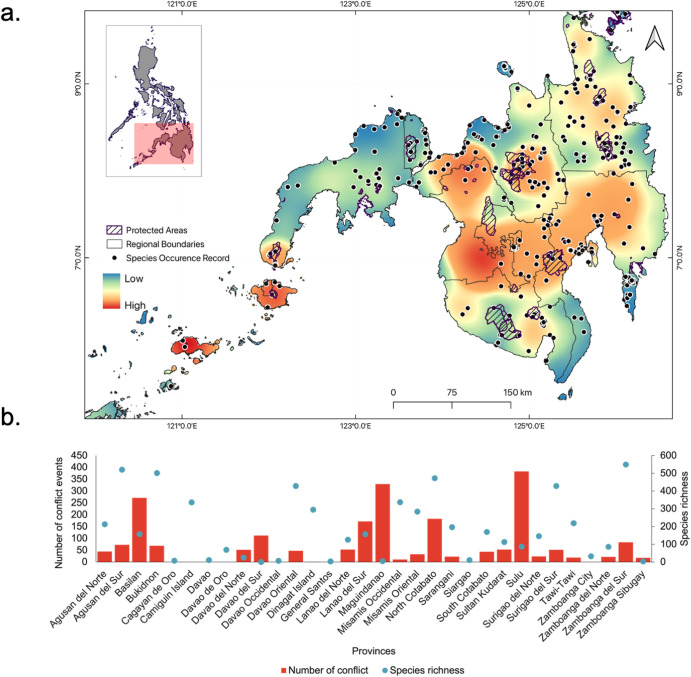
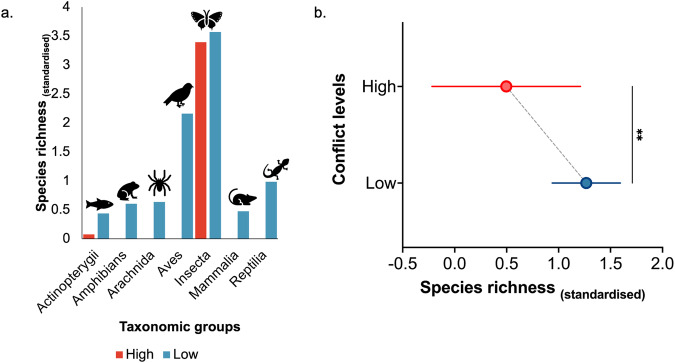
The current state of global biodiversity is confronted with escalating threats arising from human-induced environmental changes and a growing array of unpredictable challenges. However, effective conservation efforts are often hindered by limited knowledge, especially in developing economies such as the Philippines. The limitations imposed by these shortfalls in biodiversity knowledge hamper the capacity to protect biodiversity in light of the continuing extinction crisis. Our study revealed that areas with higher conflict levels exhibited lower species richness, fewer occurrence records, and reduced forest cover. This finding provides initial evidence for the relationship between sociopolitical conflict and biodiversity in the Philippines. We posit that the security risks caused by sociopolitical conflicts could have a negative impact on conservation efforts, particularly in terms of monitoring and implementing measures to protect natural resources. The links that bind armed conflict and biodiversity conservation are multifaceted and complex issues that warrant greater scientific and political attention. Finally, we identified 10 meaningful approaches to address shortfalls in biodiversity knowledge in conflicted areas, particularly incorporating conflict-sensitive approaches, considering the geopolitical context and conflict dynamics to adapt and align their strategies with local realities for more effective conservation efforts.
全球生物多样性的现状正面临着由人类引起的环境变化所带来的不断升级的威胁以及一系列日益增多的不可预测的挑战。然而,有效的保护工作常常受到知识有限的阻碍,尤其是在菲律宾等发展中经济体。生物多样性知识的这些不足所带来的限制,鉴于持续的物种灭绝危机,阻碍了保护生物多样性的能力。我们的研究表明,冲突程度较高的地区物种丰富度较低、出现记录较少且森林覆盖率降低。这一发现为菲律宾社会政治冲突与生物多样性之间的关系提供了初步证据。我们认为,社会政治冲突造成的安全风险可能会对保护工作产生负面影响,特别是在监测和实施保护自然资源的措施方面。将武装冲突与生物多样性保护联系起来的纽带是多方面且复杂的问题,值得科学界和政界给予更多关注。最后,我们确定了10种有意义的方法来解决冲突地区生物多样性知识的不足,特别是纳入对冲突敏感的方法,考虑地缘政治背景和冲突动态,以使策略适应并与当地实际情况保持一致,从而开展更有效的保护工作。