Cellular and Molecular Endocrine Research Center, Research Institute for Endocrine Sciences, Shahid Beheshti University of Medical Sciences, PO Box 19195-4763, Tehran, Iran.
Endocrine Research Center, Research Institute for Endocrine Sciences, Shahid Beheshti University of Medical Sciences, Tehran, Iran.
Sci Rep. 2021 May 13;11(1):10305. doi: 10.1038/s41598-021-89509-5.
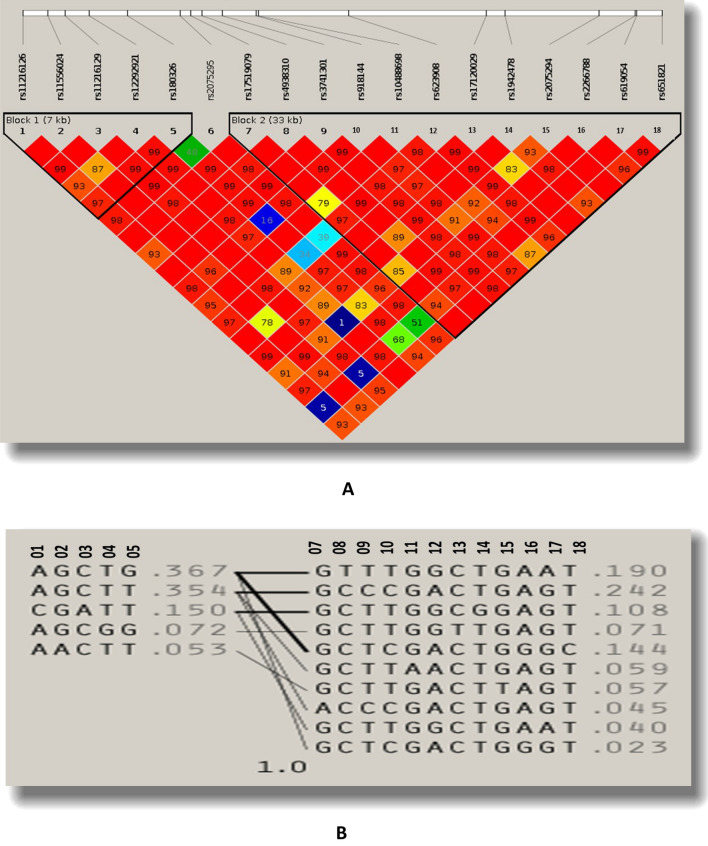
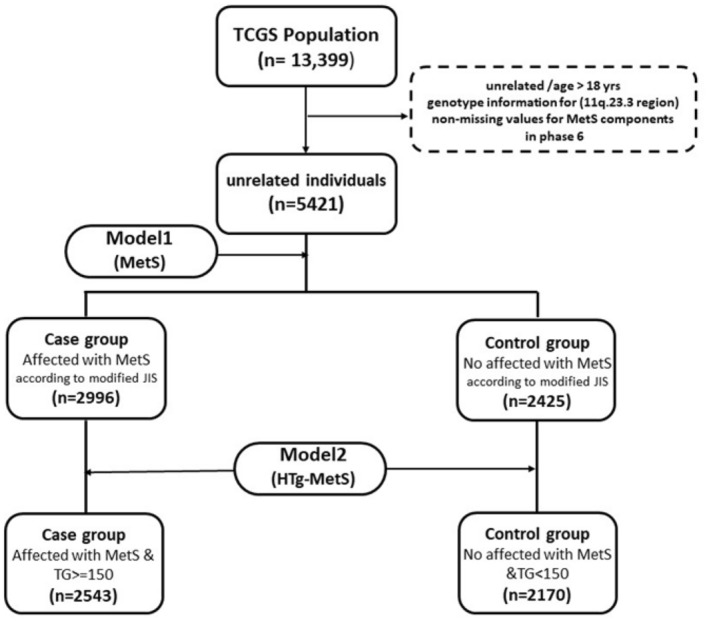
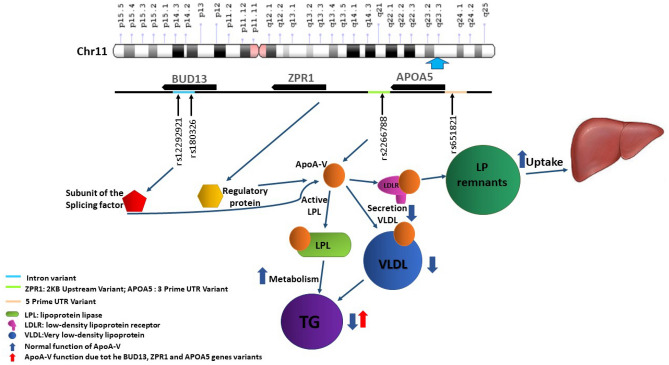
Metabolic syndrome (MetS) is one of the most important risk factors for cardiovascular disease. The 11p23.3 chromosomal region plays a potential role in the pathogenesis of MetS. The present study aimed to assess the association between 18 single nucleotide polymorphisms (SNPs) located at the BUD13, ZPR1, and APOA5 genes with MetS in the Tehran Cardio-metabolic Genetics Study (TCGS). In 5421 MetS affected and non-affected participants, we analyzed the data using two models. The first model (MetS model) examined SNPs' association with MetS. The second model (HTg-MetS Model) examined the association of SNPs with MetS affection participants who had a high plasma triglyceride (TG). The four-gamete rules were used to make SNP sets from correlated nearby SNPs. The kernel machine regression models and single SNP regression evaluated the association between SNP sets and MetS. The kernel machine results showed two sets over three sets of correlated SNPs have a significant joint effect on both models (p < 0.0001). Also, single SNP regression results showed that the odds ratios (ORs) for both models are almost similar; however, the p-values had slightly higher significance levels in the HTg-MetS model. The strongest ORs in the HTg-MetS model belonged to the G allele in rs2266788 (MetS: OR = 1.3, p = 3.6 × 10; HTg-MetS: OR = 1.4, p = 2.3 × 10) and the T allele in rs651821 (MetS: OR = 1.3, p = 2.8 × 10; HTg-MetS: OR = 1.4, p = 3.6 × 10). In the present study, the kernel machine regression models could help assess the association between the BUD13, ZPR1, and APOA5 gene variants (11p23.3 region) with lipid-related traits in MetS and MetS affected with high TG.
代谢综合征 (MetS) 是心血管疾病最重要的危险因素之一。11p23.3 染色体区域在 MetS 的发病机制中发挥潜在作用。本研究旨在评估位于 BUD13、ZPR1 和 APOA5 基因的 18 个单核苷酸多态性 (SNP) 与 Tehran Cardio-metabolic Genetics Study (TCGS) 中 MetS 的相关性。在 5421 名患有和未患有 MetS 的参与者中,我们使用两种模型分析了数据。第一种模型 (MetS 模型) 检查了 SNP 与 MetS 的关联。第二种模型 (HTg-MetS 模型) 检查了具有高血浆甘油三酯 (TG) 的 MetS 受影响参与者中 SNP 与 MetS 发病的关联。四配子规则用于从相关的附近 SNP 中构建 SNP 集。核机器回归模型和单 SNP 回归评估了 SNP 集与 MetS 之间的关联。核机器结果显示,在两种模型中,三组相关 SNP 的两组 SNP 集具有显著的联合效应 (p<0.0001)。此外,单 SNP 回归结果表明,两种模型的优势比 (OR) 几乎相似;然而,在 HTg-MetS 模型中,p 值具有更高的显著水平。在 HTg-MetS 模型中,最强的 OR 属于 rs2266788 中的 G 等位基因(MetS:OR=1.3,p=3.6×10;HTg-MetS:OR=1.4,p=2.3×10)和 rs651821 中的 T 等位基因(MetS:OR=1.3,p=2.8×10;HTg-MetS:OR=1.4,p=3.6×10)。在本研究中,核机器回归模型可帮助评估 BUD13、ZPR1 和 APOA5 基因变异(11p23.3 区域)与 MetS 中脂质相关特征以及具有高 TG 的 MetS 受影响者之间的关联。