Department of Oral Medicine and Oral Diagnosis, School of Dentistry and Dental Research Institute, Seoul National University, #101, Daehak-ro, Jongro-gu, Seoul, 03080, Korea.
Department of Advanced General Dentistry, Yonsei University College of Dentistry, Seoul, 03722, Korea.
Sci Rep. 2021 May 13;11(1):10246. doi: 10.1038/s41598-021-89742-y.
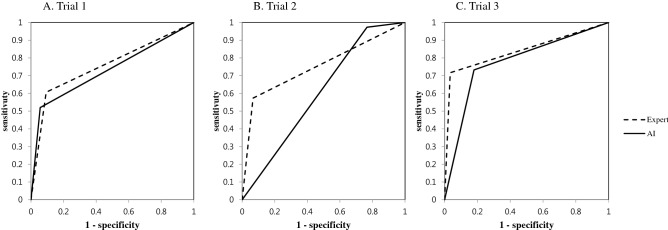
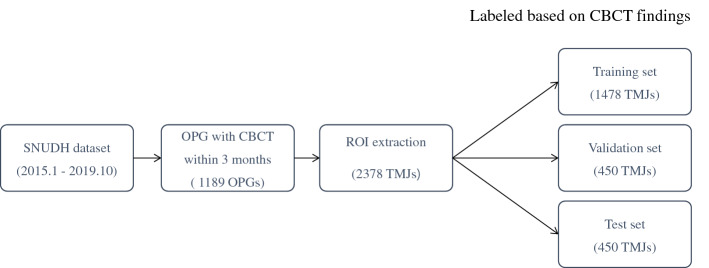
Orthopantomogram (OPG) is important for primary diagnosis of temporomandibular joint osteoarthritis (TMJOA), because of cost and the radiation associated with computed tomograms (CT). The aims of this study were to develop an artificial intelligence (AI) model and compare its TMJOA diagnostic performance from OPGs with that of an oromaxillofacial radiology (OMFR) expert. An AI model was developed using Karas' ResNet model and trained to classify images into three categories: normal, indeterminate OA, and OA. This study included 1189 OPG images confirmed by cone-beam CT and evaluated the results by model (accuracy, precision, recall, and F1 score) and diagnostic performance (accuracy, sensitivity, and specificity). The model performance was unsatisfying when AI was developed with 3 categories. After the indeterminate OA images were reclassified as normal, OA, or omission, the AI diagnosed TMJOA in a similar manner to an expert and was in most accord with CBCT when the indeterminate OA category was omitted (accuracy: 0.78, sensitivity: 0.73, and specificity: 0.82). Our deep learning model showed a sensitivity equivalent to that of an expert, with a better balance between sensitivity and specificity, which implies that AI can play an important role in primary diagnosis of TMJOA from OPGs in most general practice clinics where OMFR experts or CT are not available.
口腔颌面全景片(OPG)对于颞下颌关节骨关节炎(TMJOA)的初步诊断很重要,因为其具有成本效益,且相对于计算机断层扫描(CT)的辐射较小。本研究的目的是开发一种人工智能(AI)模型,并比较其从 OPG 诊断 TMJOA 的性能与口腔颌面放射学专家(OMFR)的诊断性能。我们使用 Karas 的 ResNet 模型开发了一个 AI 模型,并对其进行训练,以将图像分为三类:正常、不确定型 OA 和 OA。本研究纳入了 1189 张经锥形束 CT 证实的 OPG 图像,并通过模型(准确性、精确度、召回率和 F1 评分)和诊断性能(准确性、敏感性和特异性)评估结果。当 AI 分为 3 类时,模型性能并不令人满意。在将不确定型 OA 图像重新分类为正常、OA 或遗漏后,AI 以类似于专家的方式诊断 TMJOA,当遗漏不确定型 OA 类别时与 CBCT 最为一致(准确性:0.78、敏感性:0.73 和特异性:0.82)。我们的深度学习模型表现出与专家相当的敏感性,并且在敏感性和特异性之间具有更好的平衡,这意味着在大多数没有 OMFR 专家或 CT 的普通诊所中,AI 可以在从 OPG 进行 TMJOA 的初步诊断中发挥重要作用。