Huang Haiming, Du Jialin, Jin Bo, Pang Lu, Duan Nan, Huang Chenwei, Hou Jiayin, Yu Wei, Hao Han, Li Haixia
Department of Clinical Laboratory, Peking University First Hospital, Beijing, China.
Department of Urology, Peking University First Hospital and Institute of Urology, Beijing, China.
Front Oncol. 2021 Apr 27;11:667212. doi: 10.3389/fonc.2021.667212. eCollection 2021.
The recent discovery of miRNAs and lncRNAs in urine exosomes has emerged as promising diagnostic biomarkers for bladder cancer (BCa). However, mRNAs as the direct products of transcription has not been well evaluated in exosomes as biomarkers for BCa diagnosis. The purpose of this study was to identify tumor progression-related mRNAs and lncRNAs in urine exosomes that could be used for detection of BCa.
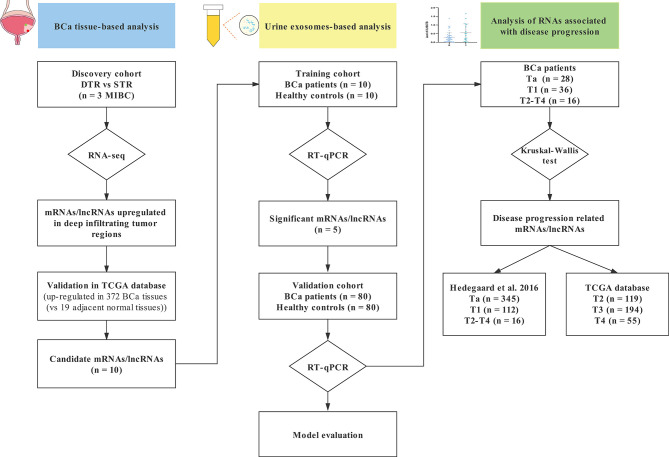
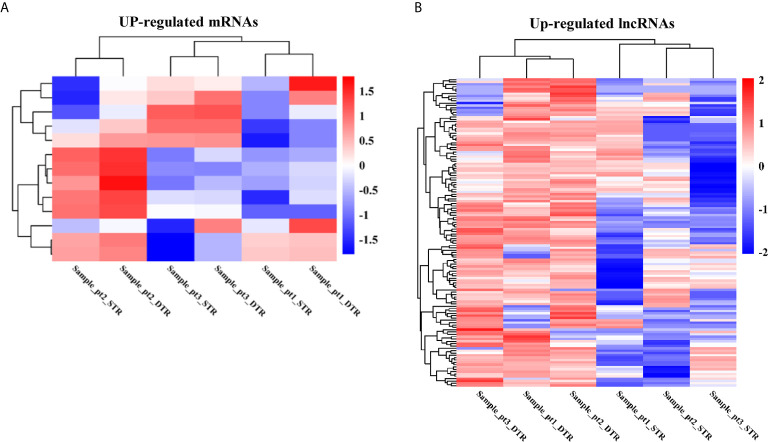
RNA-sequencing was performed to identify tumor progression-related biomarkers in three matched superficial tumor and deep infiltrating tumor regions of muscle-invasive bladder cancer (MIBC) specimens, differently expressed mRNAs and lncRNAs were validated in TCGA dataset (n = 391) in the discovery stage. Then candidate RNAs were chosen for evaluation in urine exosomes of a training cohort (10 BCa and 10 healthy controls) and a validation cohort (80 BCa and 80 healthy controls) using RT-qPCR. The diagnostic potential of the candidates were evaluated by receiver operating characteristic (ROC) curves.
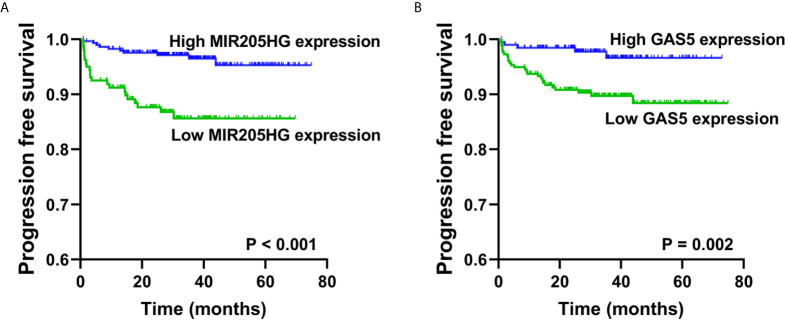
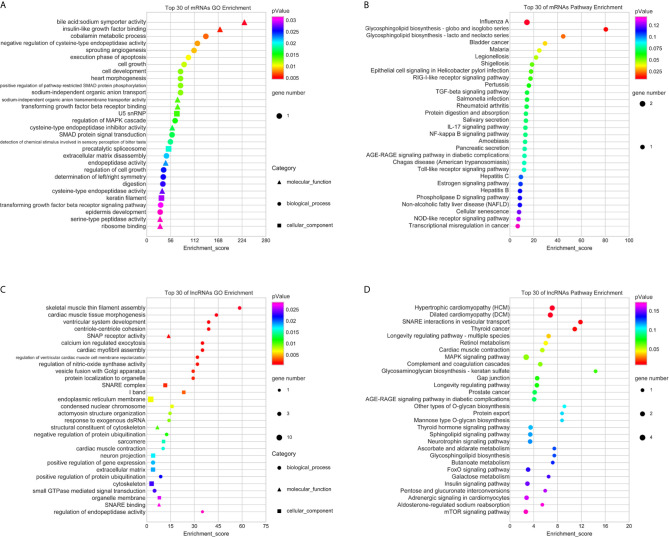
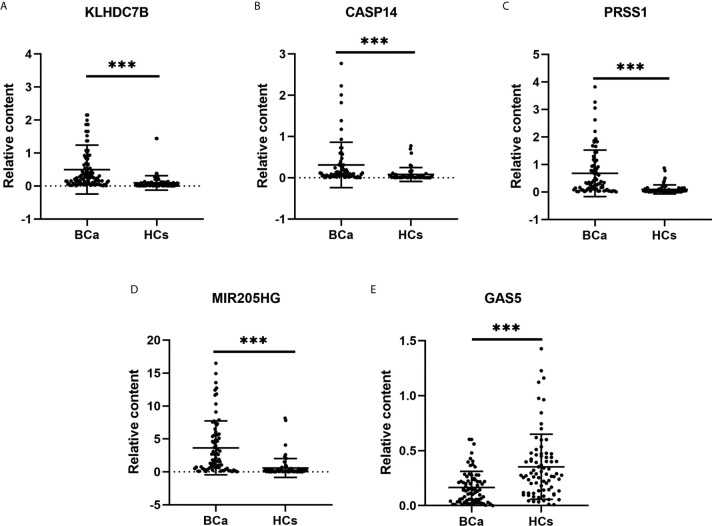
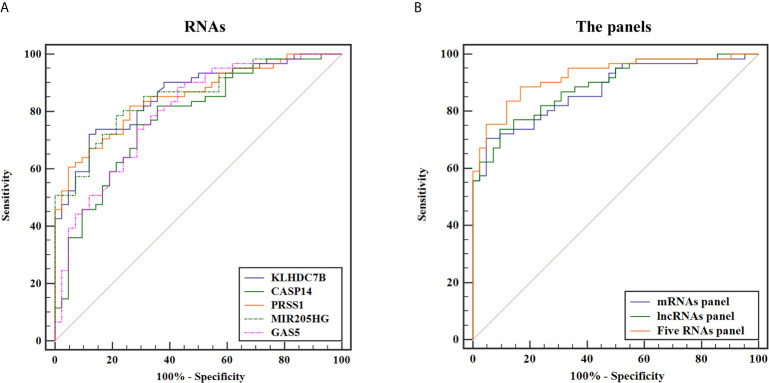
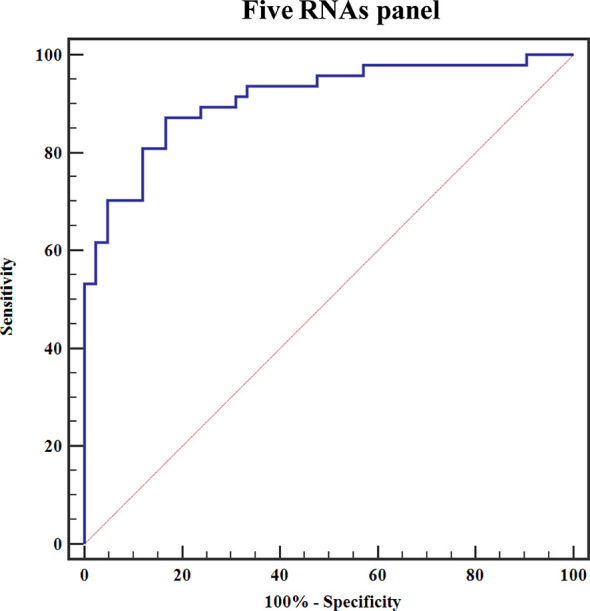
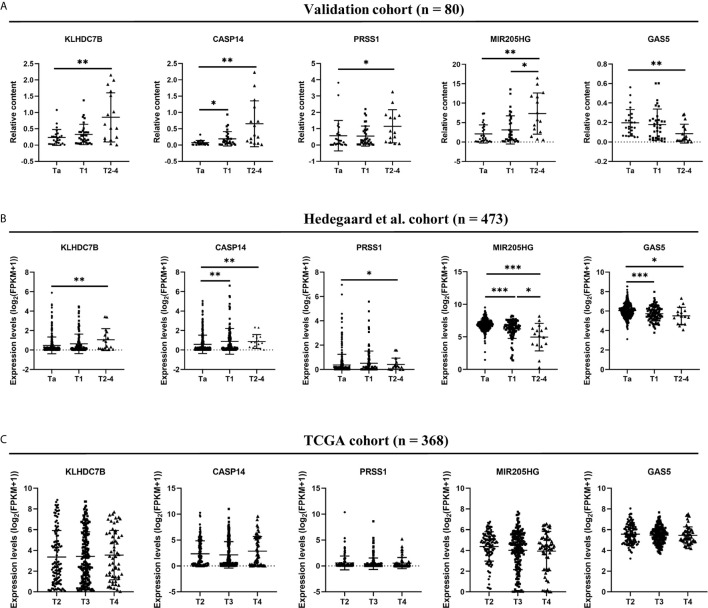
RNA sequencing revealed 8 mRNAs and 32 lncRNAs that were significantly upregulated in deep infiltrating tumor region. After validation in TCGA database, 10 markedly dysregulated RNAs were selected for further investigation in urine exosomes, of which five (mRNAs: KLHDC7B, CASP14, and PRSS1; lncRNAs: MIR205HG and GAS5) were verified to be significantly dysregulated. The combination of the five RNAs had the highest AUC to disguising the BCa (0.924, 95% CI, 0.875-0.974) or early stage BCa patients (0.910, 95% CI, 0.850 to 0.971) from HCs. The expression levels of these five RNAs were correlated with tumor stage, grade, and hematuria degrees.
These findings highlight the potential of urine exosomal mRNAs and lncRNAs profiling in the early diagnosis and provide new insights into the molecular mechanisms involved in BCa.
尿液外泌体中微小RNA(miRNA)和长链非编码RNA(lncRNA)的最新发现已成为膀胱癌(BCa)有前景的诊断生物标志物。然而,作为转录直接产物的信使RNA(mRNA)在外泌体中作为BCa诊断生物标志物尚未得到充分评估。本研究的目的是鉴定尿液外泌体中与肿瘤进展相关的mRNA和lncRNA,可用于BCa的检测。
进行RNA测序以鉴定肌肉浸润性膀胱癌(MIBC)标本的三个匹配的浅表肿瘤和深层浸润肿瘤区域中与肿瘤进展相关的生物标志物,在发现阶段在TCGA数据集(n = 391)中验证差异表达的mRNA和lncRNA。然后选择候选RNA在训练队列(10例BCa和10例健康对照)和验证队列(80例BCa和80例健康对照)的尿液外泌体中使用逆转录定量聚合酶链反应(RT-qPCR)进行评估。通过受试者工作特征(ROC)曲线评估候选物的诊断潜力。
RNA测序显示在深层浸润肿瘤区域中8种mRNA和32种lncRNA显著上调。在TCGA数据库中验证后,选择10种明显失调的RNA在尿液外泌体中进行进一步研究,其中5种(mRNA:KLHDC7B、CASP14和PRSS1;lncRNA:MIR205HG和GAS5)被证实显著失调。这5种RNA的组合在区分BCa患者(0.924,95%可信区间,0.875 - 0.974)或早期BCa患者(0.910,95%可信区间,0.850至0.971)与健康对照方面具有最高的曲线下面积(AUC)。这5种RNA的表达水平与肿瘤分期、分级和血尿程度相关。
这些发现突出了尿液外泌体mRNA和lncRNA谱在早期诊断中的潜力,并为BCa相关的分子机制提供了新的见解。