Liu Guoqiang, Kang Shuo, Wang Xinchen, Shang Fangjian
Department of Pharmacy, The Third Hospital of Hebei Medical University, Shijiazhuang, China.
Laboratory of Pathology, Hebei Cancer Institute, The Fourth Hospital of Hebei Medical University, Shijiazhuang, China.
Front Oncol. 2021 Apr 27;11:669195. doi: 10.3389/fonc.2021.669195. eCollection 2021.
Atezolizumab could significantly improve clinical outcomes and was associated with less toxicity compared with chemotherapy as the first-line treatment of PD-L1-selected patients with EGFR and ALK wild-type metastatic non-small-cell lung cancer (NSCLC). However, the economic outcomes remain unclear yet in China. This study aimed to investigate the cost-effectiveness of atezolizumab versus chemotherapy as first-line therapy for metastatic NSCLC with different PD-L1 expression status from the Chinese health sector perspective.
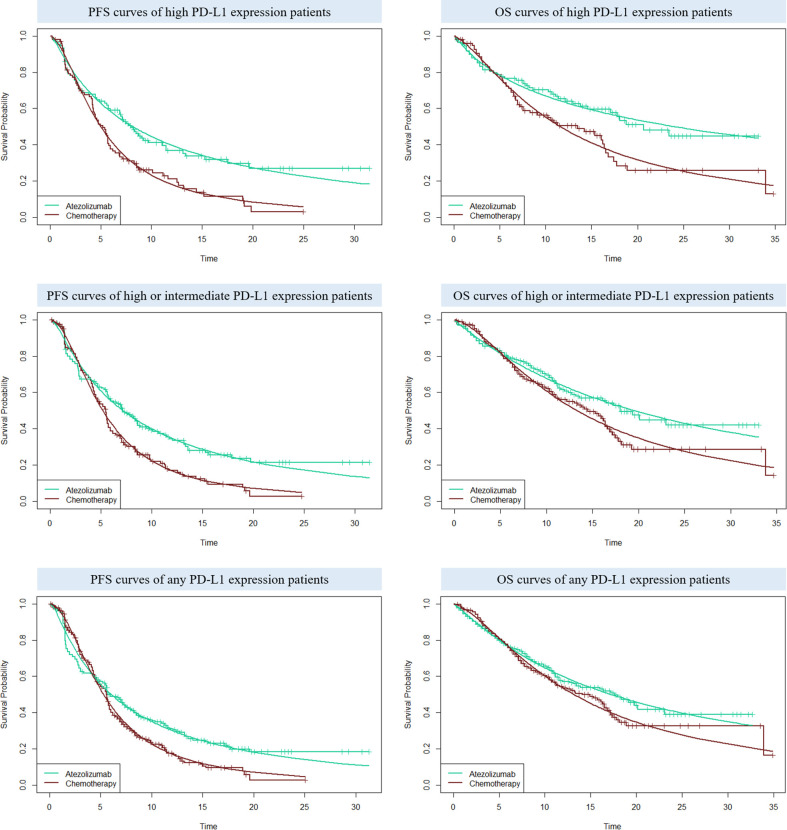
A decision-analytic model was conducted to evaluate the economic outcomes for the first-line treatment of EGFR and ALK wild-type metastatic NSCLC with atezolizumab and chemotherapy in high PD-L1 expression, high or intermediate PD-L1 expression and any PD-L1 expression populations, respectively. The efficacy and safety data were obtained from the IMpower110 trial. Cost and utility values were gathered from the local charges and published literatures. Incremental cost-effectiveness ratio (ICER) was estimated. A scenario analysis for a patient assistance program (PAP) was conducted. One-way and probabilistic sensitivity analyses were performed to explore the robustness of the model results.
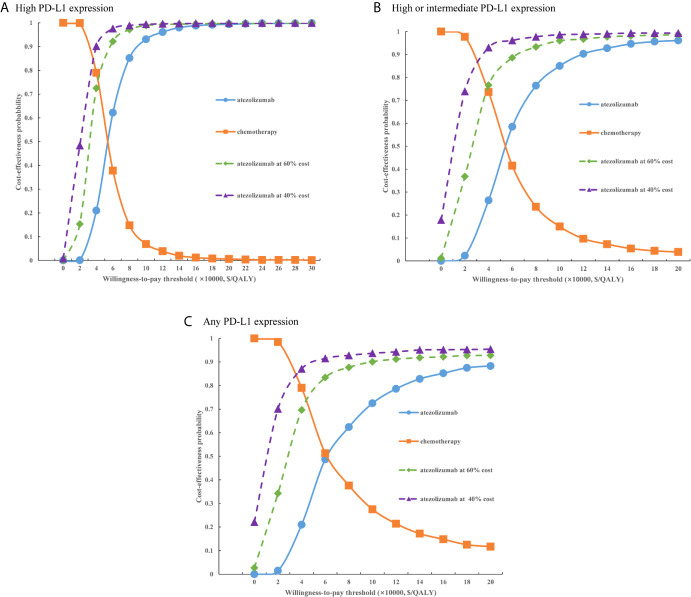
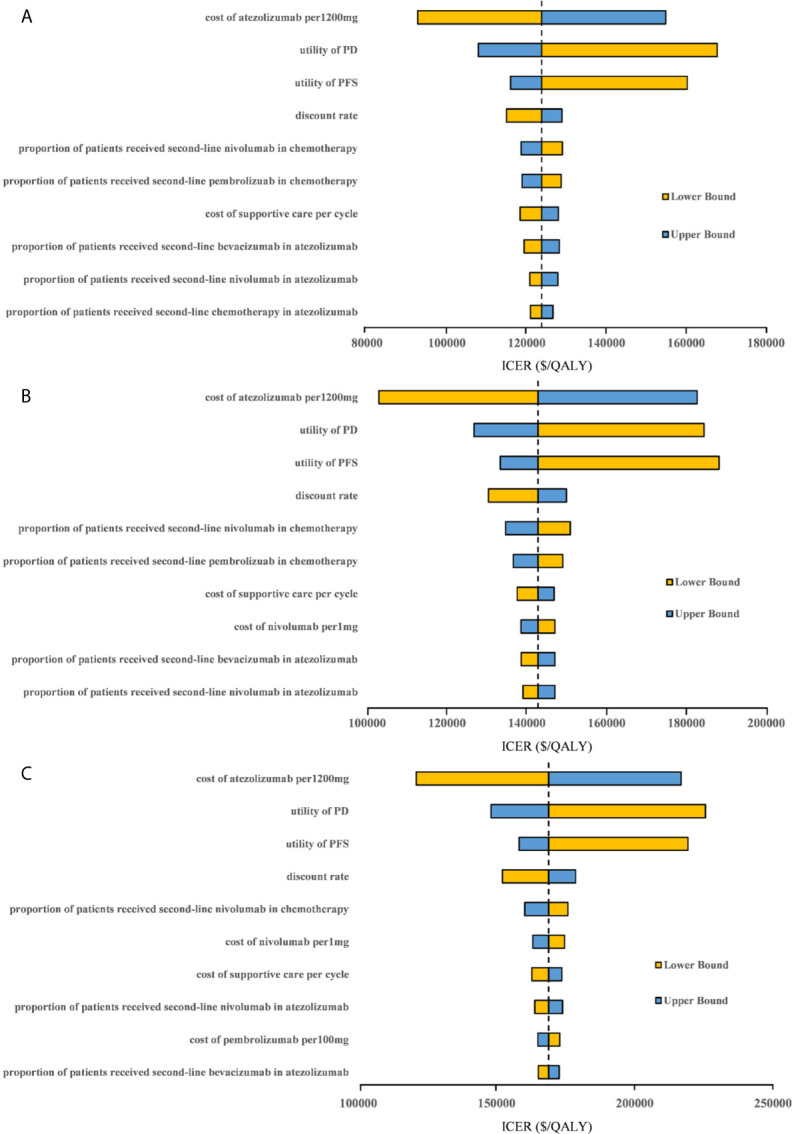
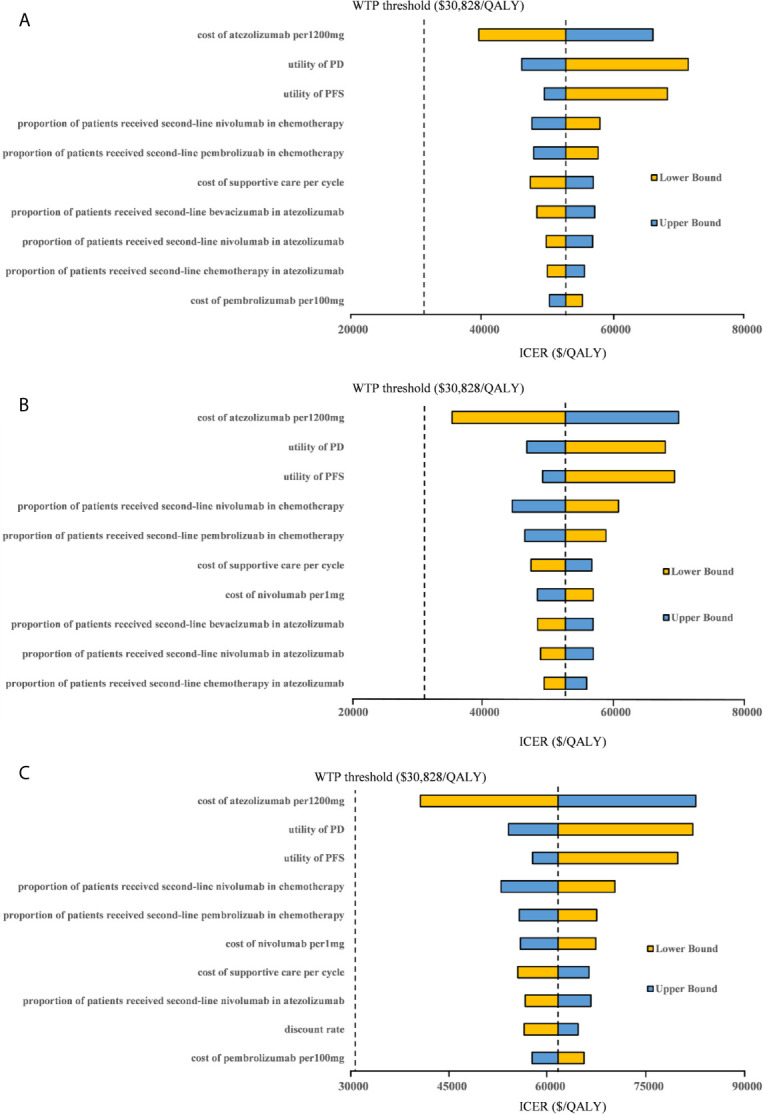
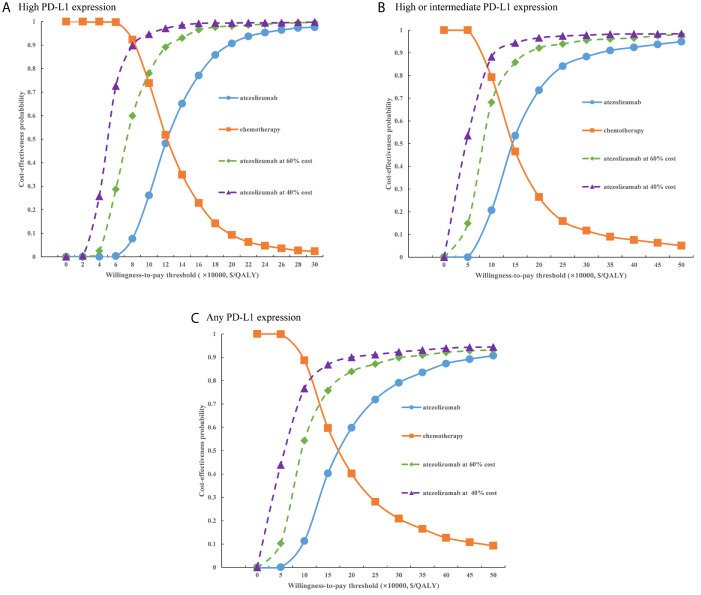
Atezolizumab yielded additional 0.91 QALYs, 0.57 QALYs, 0.42 QALYs in comparison with chemotherapy, and the ICERs were $123,778.60/QALY, $142,827.19/QALY, $168,902.66/QALY in the high PD-L1 expression, high or intermediate PD-L1 expression, and any PD-L1 expression populations, respectively. When PAP was available, the ICERs were $52,414.63/QALY, $52,329.73/QALY, $61,189.66/QALY in the three categories of PD-L1 expression status populations, respectively. The ICERs were exceed the willingness-to-pay (WTP) threshold of $30,828/QALY (three times of per capita gross domestic product of China in 2019) in China. One-way sensitivity analyses suggested that the cost of atezolizumab played a vital role in the model outcomes, and the probabilistic sensitivity analyses showed atezolizumab was unlikely to be cost-effective at the WTP threshold regardless of PD-L1 expression status and whether the PAP was available or not.
Atezolizumab as first-line treatment for PD-L1-selected metastatic NSCLC patients without EGFR mutations or ALK translocations is unlikely to be cost-effective compared with chemotherapy regardless of PD-L1 expression status in the Chinese context.
作为一线治疗方案,阿替利珠单抗可显著改善EGFR和ALK野生型转移性非小细胞肺癌(NSCLC)且PD-L1呈阳性的患者的临床结局,与化疗相比毒性更小。然而,在中国其经济效果仍不明确。本研究旨在从中国卫生部门的角度,探讨阿替利珠单抗与化疗作为不同PD-L1表达状态的转移性NSCLC一线治疗方案的成本效益。
采用决策分析模型,分别评估阿替利珠单抗和化疗作为一线治疗方案用于EGFR和ALK野生型转移性NSCLC的高PD-L1表达、高或中PD-L1表达以及任何PD-L1表达人群时的经济效果。疗效和安全性数据来自IMpower110试验。成本和效用值从当地收费标准和已发表的文献中收集。估算增量成本效益比(ICER)。对患者援助计划(PAP)进行情景分析。进行单因素和概率敏感性分析以探讨模型结果的稳健性。
与化疗相比,阿替利珠单抗在高PD-L1表达、高或中PD-L1表达以及任何PD-L1表达人群中分别产生了额外的0.91个质量调整生命年(QALY)、0.57个QALY、0.42个QALY,ICER分别为123,778.60美元/QALY、142,827.19美元/QALY、168,902.66美元/QALY。当有PAP时,在三类PD-L1表达状态人群中ICER分别为52,414.63美元/QALY、52,329.73美元/QALY、61,189.66美元/QALY。在中国,这些ICER超过了意愿支付(WTP)阈值30,828美元/QALY(2019年中国国内生产总值人均的三倍)。单因素敏感性分析表明阿替利珠单抗的成本在模型结果中起关键作用,概率敏感性分析表明无论PD-L1表达状态以及是否有PAP,在WTP阈值下阿替利珠单抗不太可能具有成本效益。
在中国背景下,无论PD-L1表达状态如何,对于无EGFR突变或ALK易位且经PD-L1筛选的转移性NSCLC患者,阿替利珠单抗作为一线治疗方案与化疗相比不太可能具有成本效益。