Chandra Goutam, Mázala Davi A G, Jaiswal Jyoti K
Center of Genetic Medicine Research, Children's National Research Institute, 111 Michigan Av NW, Washington, DC 20010, Washington, DC.
Inter University Centre for Biomedical Research & Super Specialty Hospital, Mahatma Gandhi University Campus at Thalappady, Kottayam, Kerala, India.
Cell Stress. 2021 Apr 16;5(5):73-75. doi: 10.15698/cst2021.05.249.
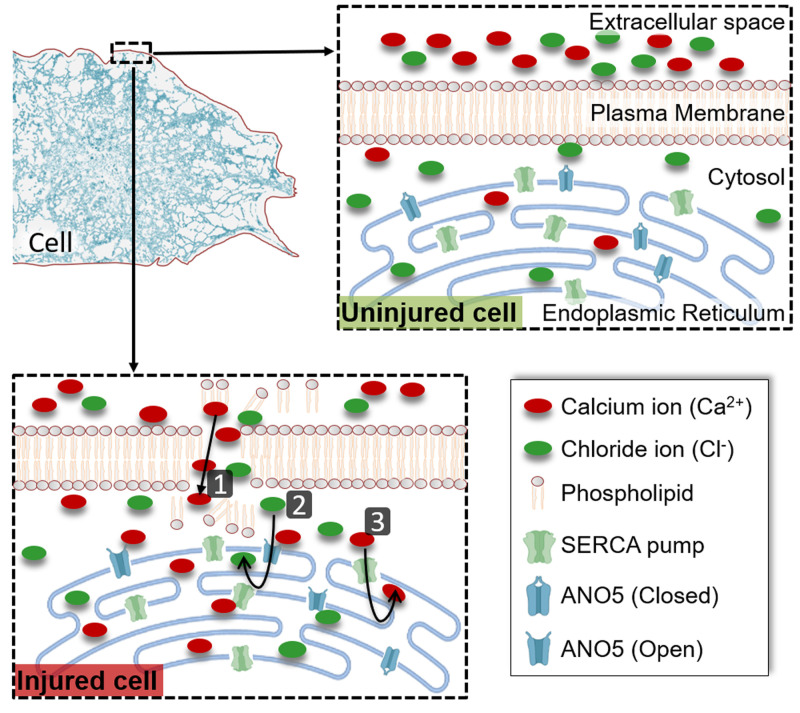
Cells maintain their cytosolic calcium (Ca) in nanomolar range and use controlled increase in Ca for intracellular signaling. With the extracellular Ca in the millimolar range, there is a steep Ca gradient across the plasma membrane (PM). Thus, injury that damages PM, leads to a cytosolic Ca overload, which helps activate PM repair (PMR) response. However, in order to survive, the cells must cope with the Ca overload. In a recent study (Chandra J Cell Biol, doi: 10.1083/jcb.202006035) we have examined how cells cope with injury-induced cytosolic Ca overload. By monitoring Ca dynamics in the cytosol and endoplasmic reticulum (ER), we found that PM injury-triggered increase in cytosolic Ca is taken up by the ER. Pharmacological inhibition of ER Ca uptake interferes with this process and compromises the repair ability of the injured cells. Muscle cells from patients and mouse model for the muscular dystrophy showed that lack of Anoctamin 5 (ANO5)/Transmembrane protein 16E (TMEM16E), an ER-resident putative Ca-activated chloride channel (CaCC), are poor at coping with cytosolic Ca overload. Pharmacological inhibition of CaCC and lack of ANO5, both prevent Ca uptake into ER. These studies identify a requirement of Cl uptake by the ER in sequestering injury-triggered cytosolic Ca increase in the ER. Further, these studies show that ER helps injured cells cope with Ca overload during PMR, lack of which contributes to muscular dystrophy due to mutations in the ANO5 protein.
细胞将其胞质钙(Ca)维持在纳摩尔范围内,并利用Ca的可控增加进行细胞内信号传导。细胞外Ca处于毫摩尔范围内,因此跨质膜(PM)存在陡峭的Ca梯度。因此,损伤质膜会导致胞质Ca过载,这有助于激活质膜修复(PMR)反应。然而,为了存活,细胞必须应对Ca过载。在最近的一项研究(钱德拉,《细胞生物学杂志》,doi:10.1083/jcb.202006035)中,我们研究了细胞如何应对损伤诱导的胞质Ca过载。通过监测细胞质和内质网(ER)中的Ca动态,我们发现质膜损伤引发的胞质Ca增加被内质网吸收。内质网Ca摄取的药理学抑制会干扰这一过程,并损害受损细胞的修复能力。来自肌肉营养不良患者和小鼠模型的肌肉细胞表明,缺乏Anoctamin 5(ANO5)/跨膜蛋白16E(TMEM16E),一种内质网驻留的假定Ca激活氯通道(CaCC),在应对胞质Ca过载方面较差。CaCC的药理学抑制和ANO5的缺乏都阻止了Ca进入内质网。这些研究确定了内质网摄取Cl对于隔离损伤引发的内质网胞质Ca增加的必要性。此外,这些研究表明,内质网在质膜修复过程中帮助受损细胞应对Ca过载,内质网功能缺失会由于ANO5蛋白突变导致肌肉营养不良。