Department of Economics, University of Manitoba, Winnipeg, Manitoba, Canada.
Department of Economics and Olin School of Business, Washington University in St. Louis, St. Louis, Missouri, United States of America.
PLoS One. 2021 May 14;16(5):e0250564. doi: 10.1371/journal.pone.0250564. eCollection 2021.
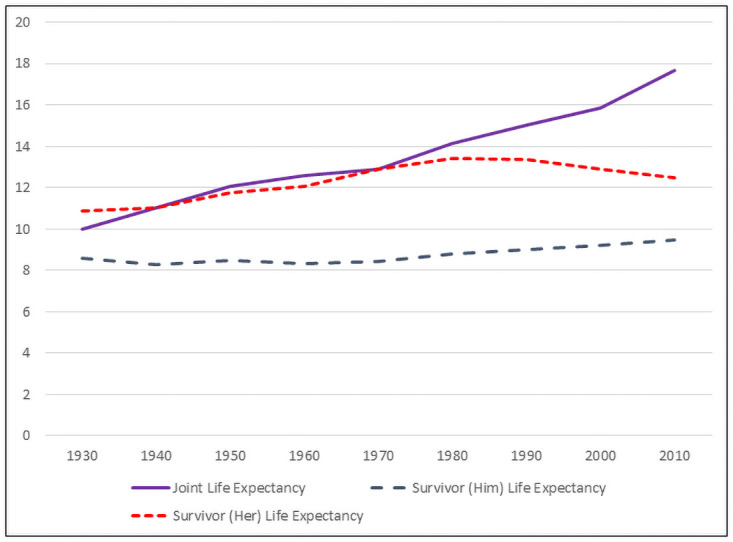
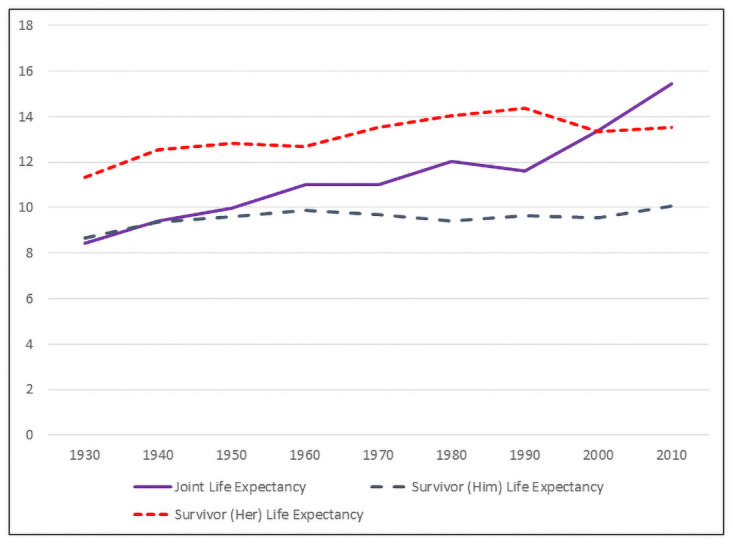
Individual life expectancies provide information for individuals making retirement decisions and for policy makers. For couples, analogous measures are the expected years both spouses will be alive (joint life expectancy) and the expected years the surviving spouse will be a widow or widower (survivor life expectancy). Using individual life expectancies to calculate summary measures for couples is intuitively appealing but yield misleading results, overstating joint life expectancy and dramatically understating survivor life expectancies. This implies that standard "individual life cycle models" are misleading for couples and that "couple life cycle models" must be substantially more complex. Using the CDC life tables for 2010, we construct joint and survivor life expectancy measures for randomly formed couples. The couples we form are defined by age, race and ethnicity, and education. Due to assortative marriage, inequalities in individual life expectancies are compounded into inequalities in joint and survivor life expectancies. We also calculate life expectancy measures for randomly formed couples for the 1930-2010 decennial years. Trends over time show how the relative rate of decrease in the mortality rates of men and women affect joint and survivor life expectancies. Because our couple life expectancy measures are based on randomly formed couples, they do not capture the effects of differences in spouses' premarital characteristics (apart from sex, age, race and ethnicity, and, in some cases, education) or of correlations in spouses' experiences or behaviors during marriage. However, they provide benchmarks which have been sorely lacking in the public discourse.
个人预期寿命为个人做出退休决策和政策制定者提供了信息。对于夫妇来说,类似的指标是夫妻双方预期的生存年限(联合预期寿命)和幸存配偶成为寡妇或鳏夫的预期年限(生存预期寿命)。使用个人预期寿命来计算夫妇的综合指标具有直观的吸引力,但会产生误导性的结果,夸大联合预期寿命,大大低估生存预期寿命。这意味着标准的“个人生命周期模型”对夫妇来说是具有误导性的,而“夫妇生命周期模型”必须更加复杂。我们使用 CDC 2010 年生命表,为随机形成的夫妇构建联合和生存预期寿命指标。我们形成的夫妇是根据年龄、种族和民族以及教育程度来定义的。由于婚姻的选择性,个人预期寿命的不平等会加剧联合和生存预期寿命的不平等。我们还为随机形成的夫妇计算了 1930 年至 2010 年十年间的预期寿命指标。随着时间的推移,趋势显示男女死亡率相对下降率如何影响联合和生存预期寿命。由于我们的夫妇预期寿命指标是基于随机形成的夫妇,因此它们不能捕捉到配偶婚前特征(除了性别、年龄、种族和民族以及在某些情况下的教育)差异或配偶在婚姻期间经历或行为的相关性的影响。然而,它们提供了在公共话语中严重缺乏的基准。