Department of Neonatology, University Children's Hospital, Heidelberg, Germany.
Institute for Applied Research, SRH University Heidelberg, Heidelberg, Germany.
PLoS One. 2021 May 14;16(5):e0250071. doi: 10.1371/journal.pone.0250071. eCollection 2021.
In Neonatal Intensive Care Units (NICUs) premature infants are exposed to various acoustic, environmental and emotional stressors which have a negative impact on their development and the mental health of their parents. Family-centred music therapy bears the potential to positively influence these stressors. The few existing studies indicate that interactive live-improvised music therapy interventions both reduce parental stress factors and support preterm infants' development.
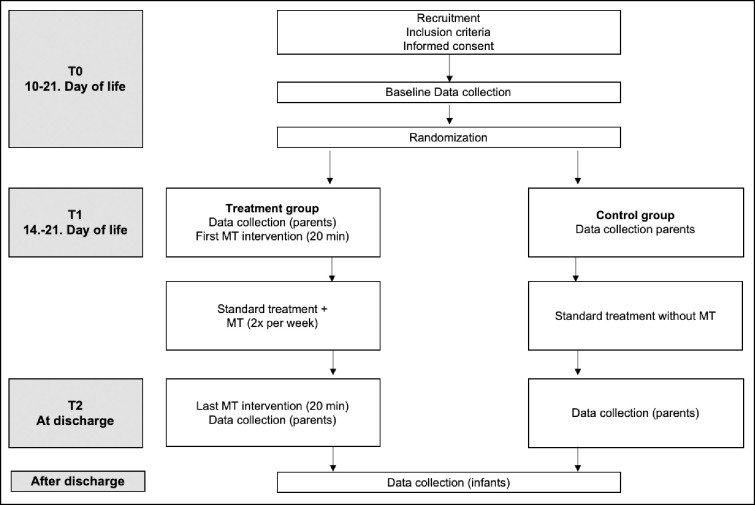
The present randomized controlled longitudinal study (RCT) with very low and extremely low birth weight infants (born <30+0 weeks of gestation) and their parents analyzed the influence of music therapy on both the physiological development of premature infants and parental stress factors. In addition, possible interrelations between infant development and parental stress were explored. 65 parent-infant-pairs were enrolled in the study. The treatment group received music therapy twice a week from the 21st day of life till discharge from hospital. The control group received treatment as usual.
Compared to the control group, infants in the treatment group showed a 11.1 days shortening of caffeine therapy, 12.1 days shortening of nasogastric/ orogastric tube feed and 15.5 days shortening of hospitalization, on average. While these differences were not statistically significant, a factor-analytical compound measure of all three therapy durations was. From pre-to-post-intervention, parents showed a significant reduction in stress factors. However, there were no differences between control and treatment group. A regression analysis showed links between parental stress factors and physiological development of the infants.
This pilot study suggests that a live-improvised interactive music therapy intervention for extremely and very preterm infants and their parents may have a beneficial effect on the therapy duration needed for premature infants before discharge from hospital is possible. The study identified components of the original physiological variables of the infants as appropriate endpoints and suggested a slight change in study design to capture possible effects of music therapy on infants' development as well. Further studies should assess both short-term and long-term effects on premature infants as well as on maternal and paternal health outcomes, to determine whether a family-centered music therapy, actually experienced as an added value to developmental care, should be part of routine care at the NICU.
在新生儿重症监护病房(NICU)中,早产儿会接触到各种声学、环境和情感压力源,这些压力源会对他们的发育和父母的心理健康产生负面影响。以家庭为中心的音乐治疗有可能对这些压力源产生积极影响。现有的少数研究表明,互动式现场即兴音乐治疗干预措施既可以降低父母的压力因素,又可以支持早产儿的发育。
本研究为一项随机对照纵向研究(RCT),纳入极低和极早产儿(出生胎龄<30+0 周)及其父母,分析音乐治疗对早产儿生理发育和父母压力因素的影响。此外,还探讨了婴儿发育和父母压力之间的可能相互关系。共有 65 对母婴参与了研究。治疗组从出生后第 21 天开始每周接受两次音乐治疗,直至出院。对照组接受常规治疗。
与对照组相比,治疗组婴儿的咖啡因治疗时间平均缩短了 11.1 天,鼻饲/口饲管喂养时间缩短了 12.1 天,住院时间缩短了 15.5 天。尽管这些差异没有统计学意义,但所有三种治疗持续时间的综合分析显示出差异。从干预前到干预后,父母的压力因素显著降低。然而,对照组和治疗组之间没有差异。回归分析显示,父母的压力因素与婴儿的生理发育之间存在联系。
这项初步研究表明,为极早产儿和其父母提供现场即兴互动音乐治疗干预可能会对早产儿出院前所需的治疗时间产生有益影响。该研究确定了婴儿原始生理变量的组成部分作为适当的终点,并提出了轻微改变研究设计,以捕捉音乐治疗对婴儿发育的可能影响。进一步的研究应评估对早产儿以及母婴健康结果的短期和长期影响,以确定以家庭为中心的音乐治疗是否应作为 NICU 常规护理的一部分,实际上被视为发育护理的附加值。