Natural Capital Project, Stanford University, Stanford, CA 94305;
Institute of Environmental Sciences, Leiden University, 2333 CC Leiden, The Netherlands.
Proc Natl Acad Sci U S A. 2021 Jun 1;118(22). doi: 10.1073/pnas.2018472118.
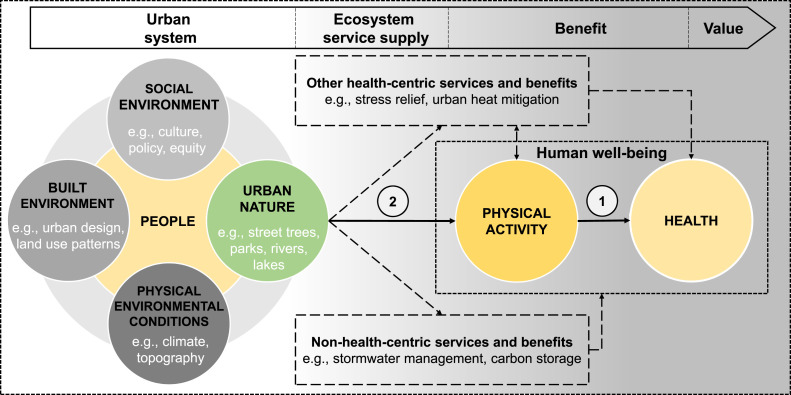
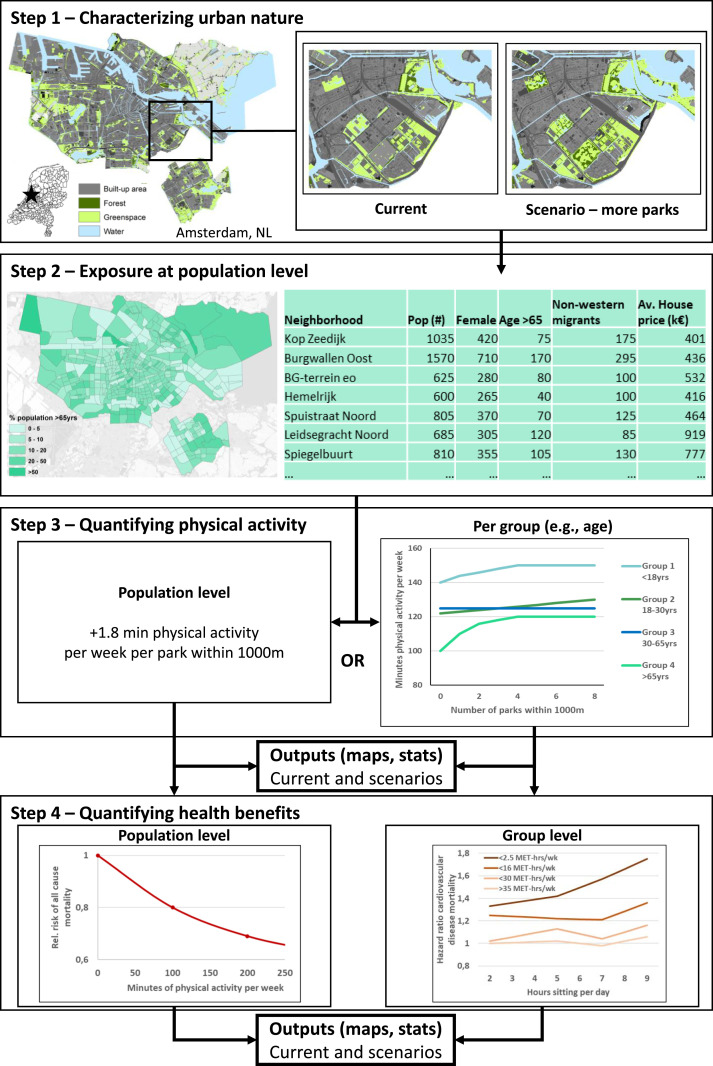
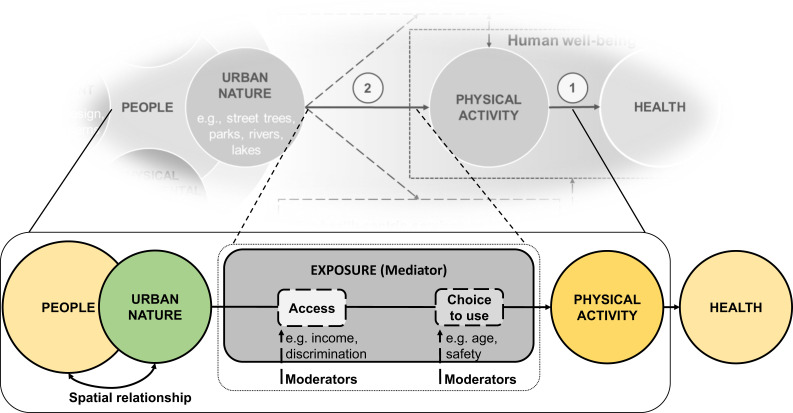
Nature underpins human well-being in critical ways, especially in health. Nature provides pollination of nutritious crops, purification of drinking water, protection from floods, and climate security, among other well-studied health benefits. A crucial, yet challenging, research frontier is clarifying how nature promotes physical activity for its many mental and physical health benefits, particularly in densely populated cities with scarce and dwindling access to nature. Here we frame this frontier by conceptually developing a spatial decision-support tool that shows where, how, and for whom urban nature promotes physical activity, to inform urban greening efforts and broader health assessments. We synthesize what is known, present a model framework, and detail the model steps and data needs that can yield generalizable spatial models and an effective tool for assessing the urban nature-physical activity relationship. Current knowledge supports an initial model that can distinguish broad trends and enrich urban planning, spatial policy, and public health decisions. New, iterative research and application will reveal the importance of different types of urban nature, the different subpopulations who will benefit from it, and nature's potential contribution to creating more equitable, green, livable cities with active inhabitants.
自然以关键的方式支撑着人类的福祉,尤其是在健康方面。自然提供了营养作物的授粉、饮用水的净化、洪水的防护以及气候安全等诸多经充分研究证实的健康益处。一个关键但具有挑战性的研究前沿是阐明自然如何促进身体活动,从而带来许多身心健康益处,尤其是在人口密集、自然匮乏且日益减少的城市。在这里,我们通过概念性地开发一个空间决策支持工具来构建这个前沿,该工具展示了城市自然环境在何处、如何以及为谁促进身体活动,以指导城市绿化工作和更广泛的健康评估。我们综合了已知的知识,提出了一个模型框架,并详细说明了可以产生可推广的空间模型和评估城市自然与身体活动关系的有效工具的模型步骤和数据需求。目前的知识支持一个初始模型,可以区分广泛的趋势并丰富城市规划、空间政策和公共卫生决策。新的迭代研究和应用将揭示不同类型的城市自然、将从中受益的不同人群以及自然在创造更公平、绿色、宜居且充满活力的城市方面的潜在贡献。