Selcuk University Faculty of Medicine, Department of Anesthesiology and Intensive Care, Konya, Turkey.
Selcuk University Faculty of Medicine, Department of Anesthesiology and Intensive Care, Konya, Turkey; Cleveland Clinic Main Hospital, Anesthesiology Institute, Department of Outcomes Research, Cleveland, Ohio, USA.
Braz J Anesthesiol. 2022 Jan-Feb;72(1):55-62. doi: 10.1016/j.bjane.2021.04.027. Epub 2021 May 12.
Several devices and algorithms have already been examined and compared for difficult airway management. However, there is no existing study comparing the success of the Intubating Catheter (IC) and the Videolaryngoscope (VL) in patients who are difficult to intubate. We aimed to compare Frova IC and McGrath VL in terms of intubation success rates in patients with difficult intubation.
This prospective, randomized study was performed in an university hospital. Patients who underwent an operation under general anesthesia and whom airway management process was deemed difficult were included in this study. Patients were randomly divided into two groups by envelopes containing a number: the intubating catheter group (Group IC), intubated using the Frova IC, and the videolaryngoscope group (Group VL), intubated using the McGrath VL. Study data were collected by a technician who was blind to the study groups and the type of device used in the intubation procedure.
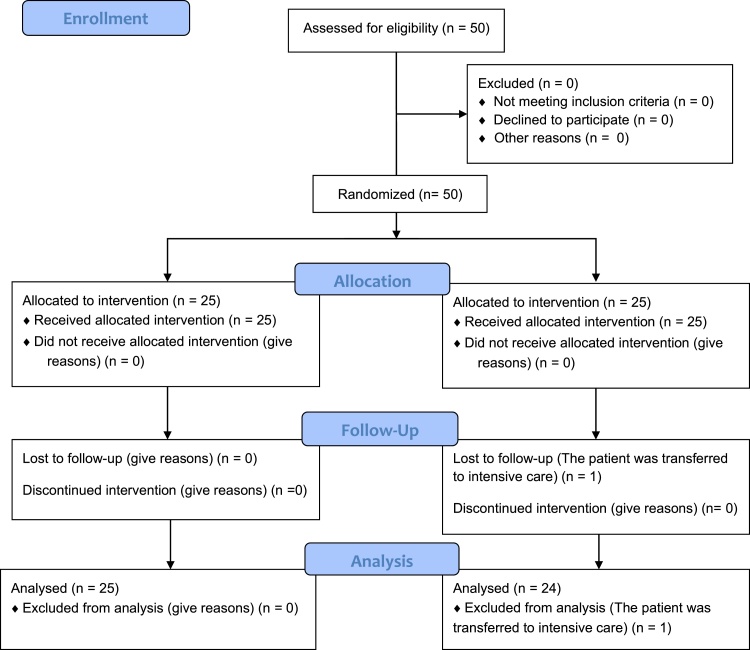
A total of 49 patients with difficult airway were included in the study, including 25 patients in the Frova IC Group and 24 patients in the McGrath VL Group. The rate of successful intubation was determined to be 88% in Group IC and 66% in Group VL (p = 0.074). The mean duration of intubation attempt in Group VL was 44.62 seconds, whereas in Group IC, it was 51.12 seconds (p = 0.593). Group VL was found to have a significantly lower Cormack-Lehane grade compared to Group IC (p < 0.001).
Frova IC is a candidate to be an indispensable instrument in terms of cost-effectiveness in clinics such as anesthesia and emergency medicine, where difficult intubation cases are frequently encountered. However, the combination of Frova IC and McGrath VL seems to be more successful in difficult intubation situations, so future studies should focus on using these two devices together.
已经有几种设备和算法用于困难气道管理,并进行了检查和比较。然而,目前尚无研究比较在困难插管患者中插管导管(IC)和视频喉镜(VL)的成功率。我们旨在比较Frova IC 和 McGrath VL 在困难插管患者中的插管成功率。
这是一项在大学医院进行的前瞻性、随机研究。纳入在全身麻醉下接受手术且气道管理过程被认为困难的患者。通过包含数字的信封将患者随机分为两组:插管导管组(IC 组),使用 Frova IC 插管;视频喉镜组(VL 组),使用 McGrath VL 插管。研究数据由一名对研究组和插管过程中使用的设备类型均不知情的技术员收集。
共有 49 例困难气道患者纳入研究,其中 Frova IC 组 25 例,McGrath VL 组 24 例。IC 组的插管成功率为 88%,VL 组为 66%(p=0.074)。VL 组的插管尝试平均持续时间为 44.62 秒,而 IC 组为 51.12 秒(p=0.593)。VL 组的 Cormack-Lehane 分级明显低于 IC 组(p<0.001)。
Frova IC 作为一种成本效益高的工具,在麻醉和急诊等经常遇到困难插管病例的科室中具有应用价值。然而,Frova IC 和 McGrath VL 的联合应用似乎在困难插管情况下更为成功,因此未来的研究应侧重于这两种设备的联合使用。