Department of Science and Environmental Studies, The Education University of Hong Kong, Tai Po, N.T., Hong Kong, China; SCNU Environmental Research Institute, Guangdong Provincial Key Laboratory of Chemical Pollution and Environmental Safety & MOE Key Laboratory of Theoretical Chemistry of Environment, South China Normal University, Guangzhou 510006, China; School of Environment, South China Normal University, University Town, Guangzhou 510006, China.
Department of Science and Environmental Studies, The Education University of Hong Kong, Tai Po, N.T., Hong Kong, China; SCNU Environmental Research Institute, Guangdong Provincial Key Laboratory of Chemical Pollution and Environmental Safety & MOE Key Laboratory of Theoretical Chemistry of Environment, South China Normal University, Guangzhou 510006, China; School of Environment, South China Normal University, University Town, Guangzhou 510006, China.
Ecotoxicol Environ Saf. 2021 Aug;219:112297. doi: 10.1016/j.ecoenv.2021.112297. Epub 2021 Apr 30.
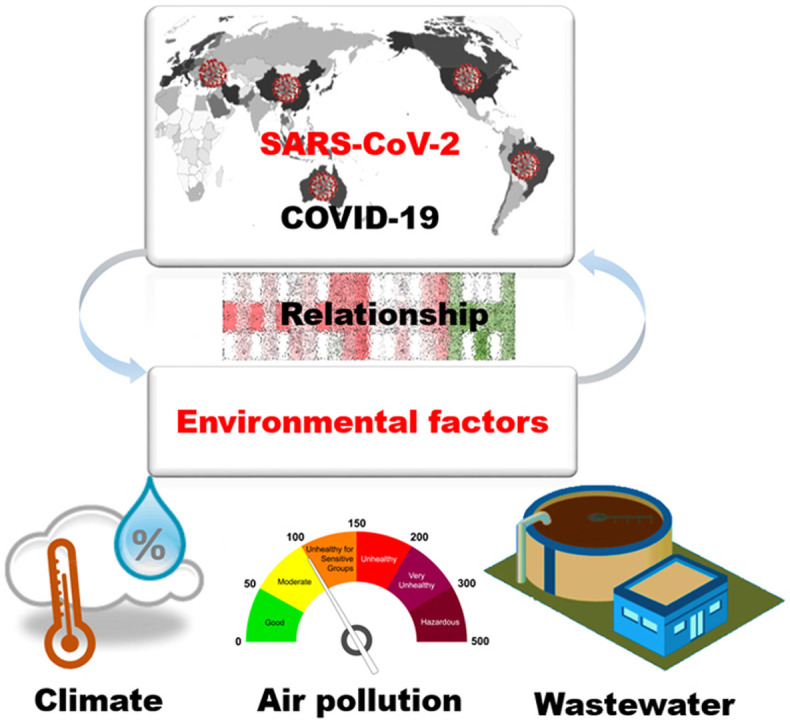
The pandemic of coronavirus disease 2019 (COVID-19), caused by severe acute respiratory syndrome coronavirus 2 (SARS-CoV-2), is a major challenge to health systems worldwide. Recently, numbers of epidemiological studies have illustrated that climate conditions and air pollutants are associated with the COVID-19 confirmed cases worldwide. Researches also suggested that the SARS-CoV-2 could be detected in fecal and wastewater samples. These findings provided the possibility of preventing and controlling the COVID-19 pandemic from an environmental perspective. With this review, the main purpose is to summarize the relationship between the atmospheric and wastewater environment and COVID-19. In terms of the atmospheric environment, the evidence of the relationship between atmospheric environment (climate factors and air pollution) and COVID-19 is growing, but currently available data and results are various. It is necessary to comprehensively analyze their associations to provide constructive suggestions in responding to the pandemic. Recently, large numbers of studies have shown the widespread presence of this virus in wastewater and the feasibility of wastewater surveillance when the pandemic is ongoing. Therefore, there is an urgent need to clarify the occurrence and implication of viruses in wastewater and to understand the potential of wastewater-based epidemiology of pandemic. Overall, environmental perspective-based COVID-19 studies can provide new insight into pandemic prevention and control, and minimizes the economic cost for COVID-19 in areas with a large outbreak or a low economic level.
2019 年冠状病毒病(COVID-19)大流行是由严重急性呼吸系统综合征冠状病毒 2(SARS-CoV-2)引起的,是对全球卫生系统的重大挑战。最近,许多流行病学研究表明,气候条件和空气污染物与全球 COVID-19 确诊病例有关。研究还表明,SARS-CoV-2 可在粪便和废水样本中检测到。这些发现从环境角度提供了预防和控制 COVID-19 大流行的可能性。通过本次综述,主要目的是总结大气和废水环境与 COVID-19 之间的关系。就大气环境而言,大气环境(气候因素和空气污染)与 COVID-19 之间关系的证据越来越多,但目前的数据和结果各不相同。有必要对其进行综合分析,以在应对大流行时提供建设性的建议。最近,大量研究表明,这种病毒在废水中广泛存在,并且在大流行期间进行废水监测是可行的。因此,迫切需要澄清废水中病毒的发生和影响,并了解基于废水的流行性病学的潜力。总的来说,基于环境角度的 COVID-19 研究可以为大流行的预防和控制提供新的见解,并在爆发地区或经济水平较低的地区降低 COVID-19 的经济成本。