Pani-Harreman Katinka E, van Duren Joop M A, Kempen Gertrudis I J M, Bours Gerrie J J W
Department of Health Services Research, Maastricht University, Care and Public Health Research Institute, Maastricht, the Netherlands.
Research Centre for Facility Management, Zuyd University of Applied Sciences, Nieuw Eyckholt 300, 6419 DJ Heerlen, the Netherlands.
Eur J Ageing. 2021 May 10;19(1):49-62. doi: 10.1007/s10433-021-00622-w. eCollection 2022 Mar.
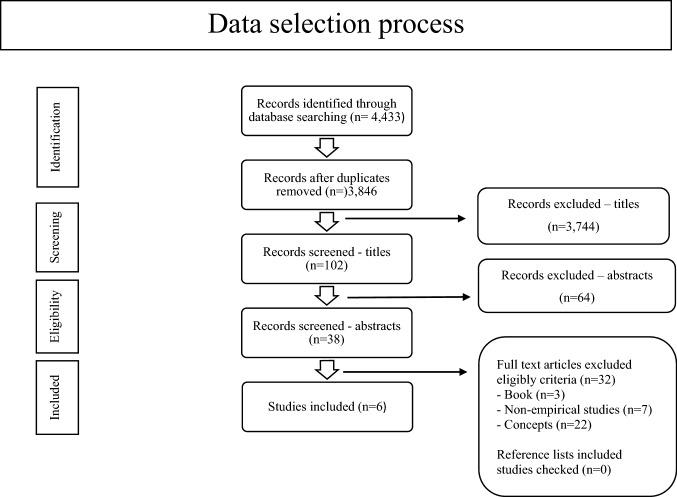
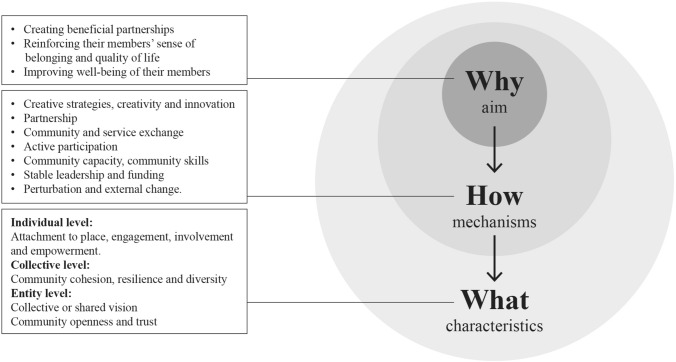
Older people today are more likely to age in their own private living environment. However, many face declining health and/or other issues that affect their ability to live independently and necessitate additional support. Such support can be provided by formal networks, but a considerable part can also be offered by informal networks of older people themselves. Going beyond these networks, older people can additionally and perhaps even more substantially benefit from . Nevertheless, even though this term is increasingly common in the literature, its meaning remains indistinct. A more thorough understanding of this concept might provide valuable knowledge that health care professionals, researchers and community workers can use to offer meaningful and effective support. The purpose of this paper is to draw on existing empirical research on vital communities to build knowledge of the different descriptions and dimensions of the concept. Arksey and O'Malley's scoping review methodology was adopted. Our search, conducted on 23 March 2020 and updated on 06 January 2021, yielded 4433 articles, of which six articles were included in the scoping review. We deduced that the conceptualisation of a vital community is based on three dimensions: the aim of a vital community, the processes behind a vital community and the typical characteristics of a vital community. None of the selected studies have mapped all three dimensions. Nevertheless, we assume that understanding all three matters when vital communities aim to contribute to the quality of life of people ageing in place.
如今,老年人更有可能在自己的私人生活环境中变老。然而,许多人面临健康状况下降和/或其他问题,这些问题影响了他们独立生活的能力,需要额外的支持。这种支持可以由正式网络提供,但很大一部分也可以由老年人自身的非正式网络提供。除了这些网络,老年人还可以从……中额外受益,甚至可能受益更多。然而,尽管这个术语在文献中越来越常见,但其含义仍然不明确。对这一概念更深入的理解可能会提供有价值的知识,医疗保健专业人员、研究人员和社区工作者可以利用这些知识提供有意义和有效的支持。本文的目的是借鉴关于活力社区的现有实证研究,以构建对该概念不同描述和维度的认识。采用了阿克西和奥马利的范围审查方法。我们于2020年3月23日进行搜索,并于2021年1月6日更新,共获得4433篇文章,其中6篇文章被纳入范围审查。我们推断,活力社区概念的形成基于三个维度:活力社区的目标、活力社区背后的过程以及活力社区的典型特征。所选研究均未涵盖所有这三个维度。然而,我们认为,当活力社区旨在为就地养老的人们的生活质量做出贡献时,理解所有这三个维度都很重要。