Wiley Cameron R, Pourmand Vida, Thayer Julian F, Williams DeWayne P
Department of Psychological Science, University of California, Irvine, Irvine, CA, United States.
Department of Psychology, Western Washington University, Bellingham, WA, United States.
Front Neurosci. 2021 Apr 30;15:625276. doi: 10.3389/fnins.2021.625276. eCollection 2021.
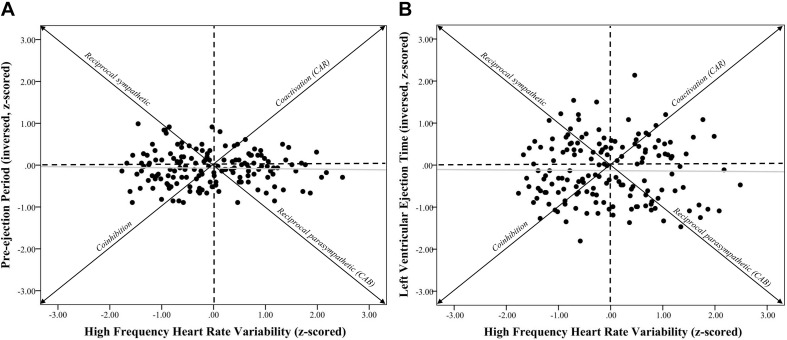
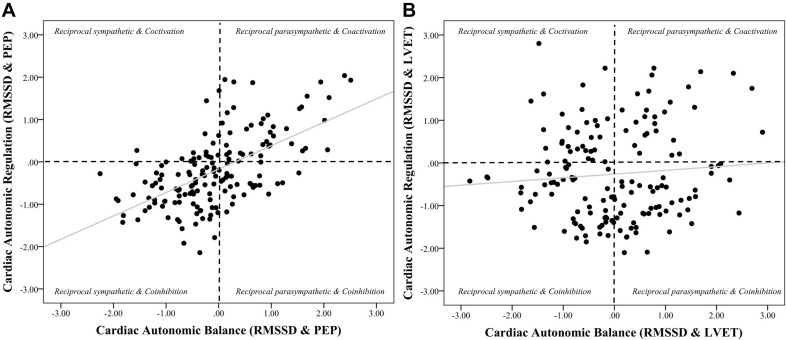
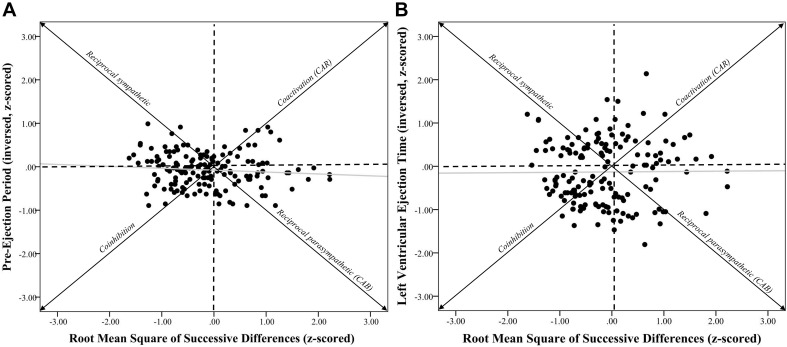
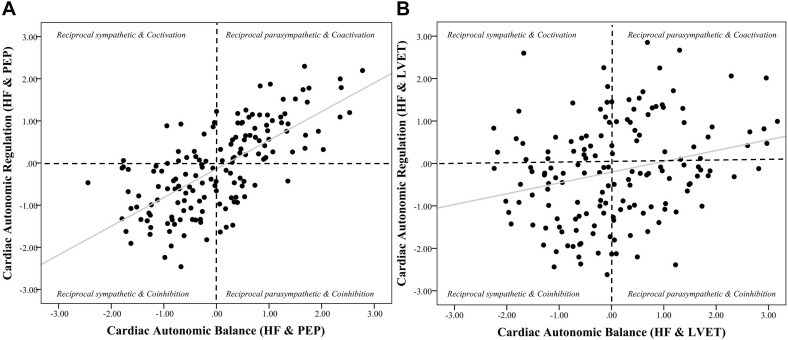
Traditionally, impedance derived measures of cardiac autonomic balance (CAB) and regulation (CAR) are calculated using indices of heart rate variability (HRV) that primarily reflect parasympathetic nervous system activity (e.g., high-frequency HRV | HF-HRV) and pre-ejection period (PEP; a systolic time interval and measure of sympathetic activity). However, HF-HRV and PEP are considered measures of chronotropic and inotropic cardiac influence, respectively. Left ventricular ejection time (LVET) is a systolic time interval that reflects sympathetic chronotropic influence, and therefore may be a more appropriate measure for calculating CAB and CAR compared to PEP. Thus, the current study evaluates both PEP and LVET in the calculation of CAB and CAR. Data from 158 healthy participants (mean age = 19.09 years old, SD = 1.84 years) were available for analyses. CAB and CAR values were calculated using both HF-HRV and the root mean square of successive differences, in addition to both PEP and LVET, in accordance with previously established guidelines. Analyses showed that correlations were significantly weaker between CAB and CAR calculated using LVET for both HF ( = 5.12, < 0.001) and RMSSD ( = 5.26, < 0.001) than with PEP. These data suggest that LVET, compared to PEP, provides better "autonomic space" as evidenced by a lack of correlation between CAB and CAR computed using LVET. We stress that future research consider calculating CAB and CAR using chronotropic measures for both parasympathetic and sympathetic activity, as doing so may yield more accurate and independent measures of cardiac autonomic activity compared to a mixture of inotropic (i.e., PEP) and chronotropic (i.e., HF-HRV) measures.
传统上,心脏自主神经平衡(CAB)和调节(CAR)的阻抗衍生测量值是使用心率变异性(HRV)指标来计算的,这些指标主要反映副交感神经系统活动(例如,高频HRV | HF-HRV)和射血前期(PEP;一个收缩期时间间隔,也是交感神经活动的指标)。然而,HF-HRV和PEP分别被认为是变时性和变力性心脏影响的测量指标。左心室射血时间(LVET)是一个反映交感神经变时性影响的收缩期时间间隔,因此与PEP相比,它可能是计算CAB和CAR更合适的指标。因此,本研究评估了在计算CAB和CAR时PEP和LVET两者的情况。有158名健康参与者(平均年龄 = 19.09岁,标准差 = 1.84岁)的数据可供分析。根据先前确立的指南,除了PEP和LVET之外,还使用HF-HRV和逐次差值的均方根来计算CAB和CAR值。分析表明,对于HF(r = 5.12,p < 0.001)和RMSSD(r = 5.26,p < 0.001),使用LVET计算的CAB和CAR之间的相关性明显弱于使用PEP计算的相关性。这些数据表明,与PEP相比,LVET提供了更好的“自主神经空间”,这一点通过使用LVET计算的CAB和CAR之间缺乏相关性得到证明。我们强调,未来的研究应考虑使用副交感神经和交感神经活动的变时性测量指标来计算CAB和CAR,因为与变力性(即PEP)和变时性(即HF-HRV)测量指标的混合使用相比,这样做可能会产生更准确和独立的心脏自主神经活动测量值。