Pei Guanxiong, Jin Jia, Li Taihao, Fang Cheng
Research Center for Advanced AI Theory, Zhejiang Lab, Hangzhou, China.
Laboratory of Applied Brain and Cognitive Sciences, School of Business and Management, Shanghai International Studies University, Shanghai, China.
Front Psychol. 2021 Apr 28;12:571952. doi: 10.3389/fpsyg.2021.571952. eCollection 2021.
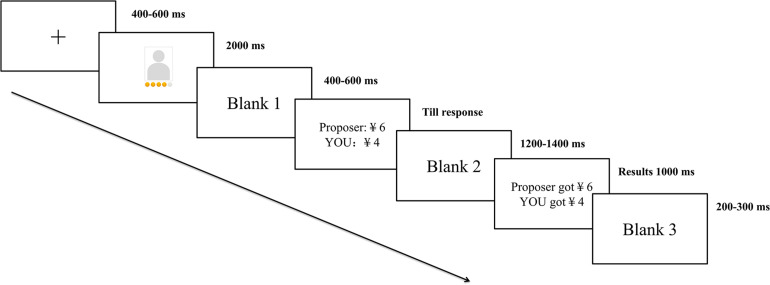
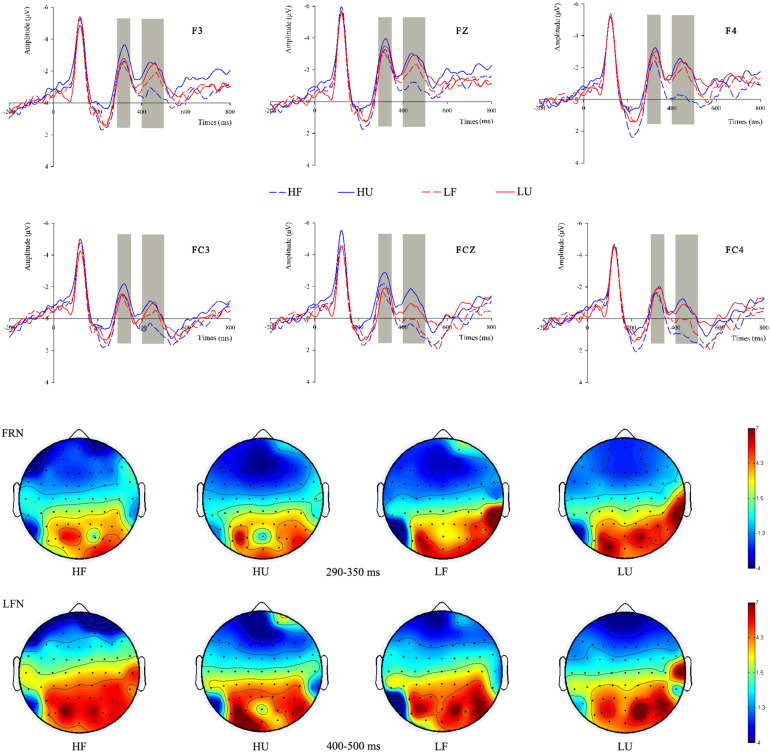
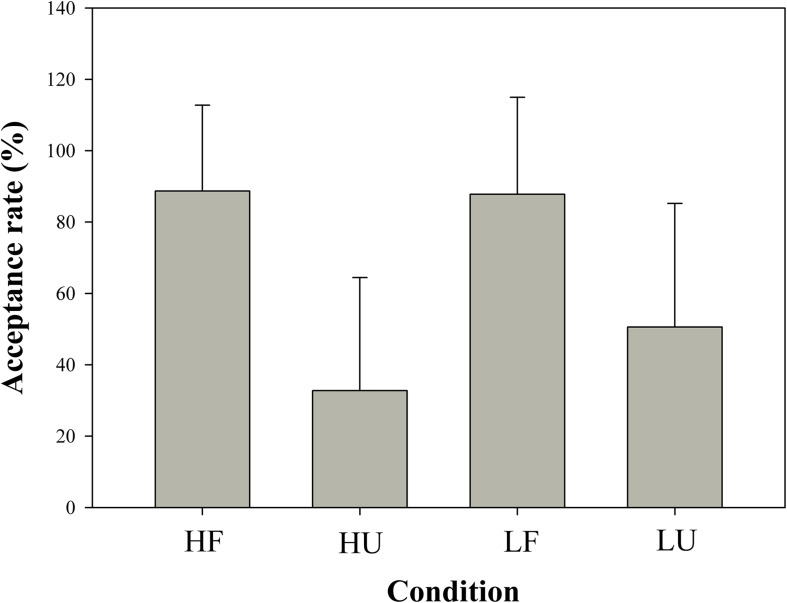
Objective wealth plays an important role in social interaction and economic decision making. Previous studies indicate that objective wealth of others may influence the way we participate in resources allocation. However, the effect of objective wealth on responses to fairness-related resource distribution is far from clear, as are the underlying neural processes. To address this issue, we dynamically manipulated proposers' objective wealth and analyzed participants' behavior as responders in a modified Ultimatum Game, during which event-related potentials were recorded. Behavioral results showed that participants were prone to reject unfair proposals although that rejection would reduce their own benefit. Importantly, participants were more likely to accept unfair offers from proposers with low objective wealth than from proposers with high objective wealth, with a drastic increase in acceptance rates of unfair offers from 32.79 to 50.59%. Further electrophysiological results showed that there was significantly enhanced feedback-related negativity amplitude toward proposers with high (relative to low) objective wealth for unfair offers. Furthermore, the late frontal negativity amplitude was larger for all the conditions which are not high-fair, which might be the only option that did not elicit any ambiguity. These findings suggest a strong role of proposers' objective wealth in modulating responders' behavioral and neural responses to fairness.
客观财富在社会互动和经济决策中起着重要作用。先前的研究表明,他人的客观财富可能会影响我们参与资源分配的方式。然而,客观财富对与公平相关的资源分配反应的影响尚不清楚,其潜在的神经过程也是如此。为了解决这个问题,我们动态操纵了提议者的客观财富,并在一个修改后的最后通牒博弈中分析了参与者作为回应者的行为,在此期间记录了事件相关电位。行为结果表明,参与者倾向于拒绝不公平的提议,尽管这种拒绝会减少他们自己的利益。重要的是,参与者更有可能接受来自客观财富低的提议者的不公平提议,而不是来自客观财富高的提议者的不公平提议,不公平提议的接受率从32.79%急剧上升到50.59%。进一步的电生理结果表明,对于不公平提议,相对于客观财富低的提议者,对客观财富高的提议者的反馈相关负波幅显著增强。此外,对于所有不高度公平的条件,晚期额叶负波幅更大,这可能是唯一没有引起任何歧义的选择。这些发现表明,提议者的客观财富在调节回应者对公平的行为和神经反应方面起着重要作用。