Gallo Laura M H, Giampietro Vincent, Zunszain Patricia A, Tan Kai Syng
Department of Psychological Medicine, Institute of Psychiatry, Psychology and Neuroscience, King's College London, London, United Kingdom.
Department of Neuroimaging, Institute of Psychiatry, Psychology and Neuroscience, King's College London, London, United Kingdom.
Front Psychol. 2021 Apr 30;12:650314. doi: 10.3389/fpsyg.2021.650314. eCollection 2021.
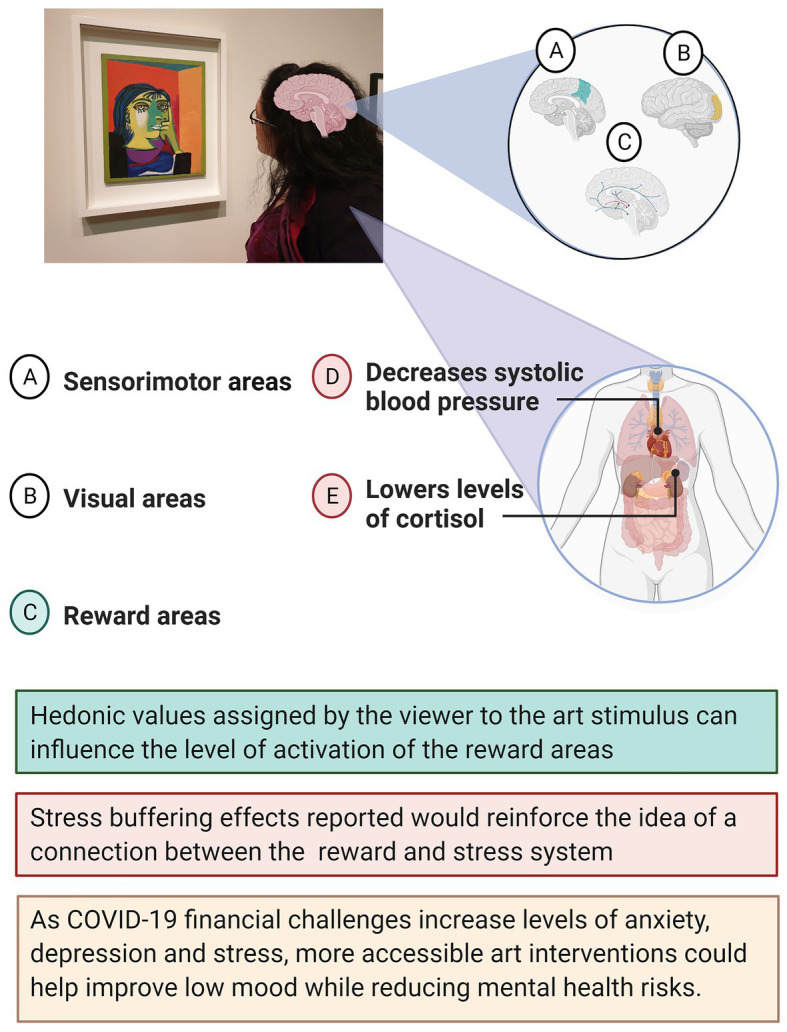
A worldwidemental health crisis is expected, as millions worldwide fear death and disease while being forced into repeated isolation. Thus, there is a need for new proactive approaches to improve mental resilience and prevent mental health conditions. Since the 1990s, art has emerged as an alternative mental health therapy in the United States and Europe, becoming part of the social care agenda. This article focuses on how visual esthetic experiences can create similar patterns of neuronal activity as those observed when the reward system is activated. The activation of the reward structures could have a stress buffering effect, given the interdependence observed between the reward and stress systems. Therefore, could visual esthetic experiences stimulate mental resilience? And if this were the case, could art-based interventions be offered for mental health in the context of COVID-19 and beyond?
预计将出现一场全球心理健康危机,因为全球数百万人在被迫反复隔离的同时,既恐惧死亡又害怕疾病。因此,需要新的积极方法来提高心理韧性并预防心理健康问题。自20世纪90年代以来,艺术在美国和欧洲已成为一种替代性心理健康疗法,成为社会护理议程的一部分。本文重点探讨视觉审美体验如何能产生与奖励系统激活时所观察到的类似神经元活动模式。鉴于奖励系统与压力系统之间存在相互依存关系,奖励结构的激活可能具有压力缓冲作用。那么,视觉审美体验能否刺激心理韧性呢?如果是这样,在新冠疫情及之后的背景下,能否提供基于艺术的心理健康干预措施呢?