Schnell Tatjana, Krampe Henning
Existential Psychology Lab, Institute of Psychology, University of Innsbruck, Innsbruck, Austria.
Psychology of Religion, MF Norwegian School of Theology, Religion and Society, Oslo, Norway.
Front Psychiatry. 2020 Sep 23;11:582352. doi: 10.3389/fpsyt.2020.582352. eCollection 2020.
As evidenced by several studies, mental distress increased substantially during the COVID-19 pandemic. In this period, citizens were asked to exercise a high degree of self-control with regard to personal and social health behavior. At the same time, we witnessed an increase of prosocial acts and shared creative expressions, which are known to serve as sources of meaning. Meaning in life and self-control are acknowledged psychological resources. Especially in times of crisis, meaning in life has been shown to be a crucial factor for resilience and coping. However, threatening and stressful situations can also jeopardize existential security and trigger crises of meaning. The present study aimed to document levels of acute COVID-19 stress and general mental distress in Germany and Austria during the lockdown and in the weeks thereafter. In order to identify potential risk factors related to demographics and living conditions, their associations with COVID-19 stress were analyzed exploratively. The primary objective of the study, however, was to investigate the buffering effect of two psychological resources-meaningfulness and self-control-with regard to the relation between acute COVID-19 stress and general mental distress. Finally, a potential aggravation of mental distress due to the occurrence of crises of meaning was examined.
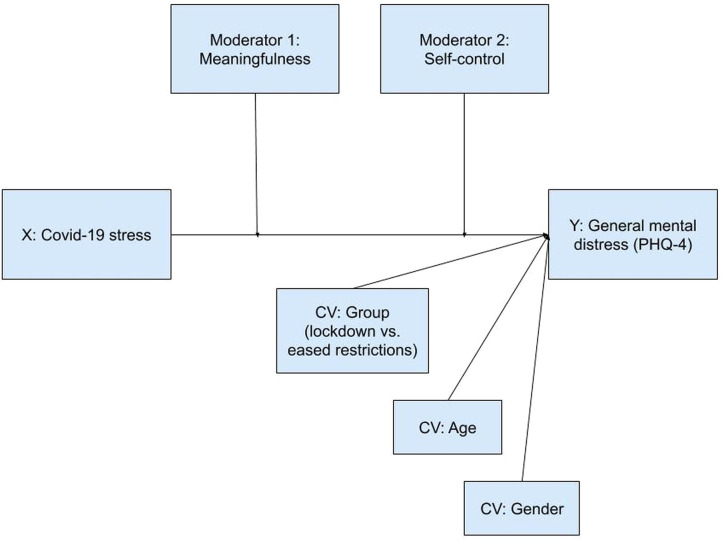
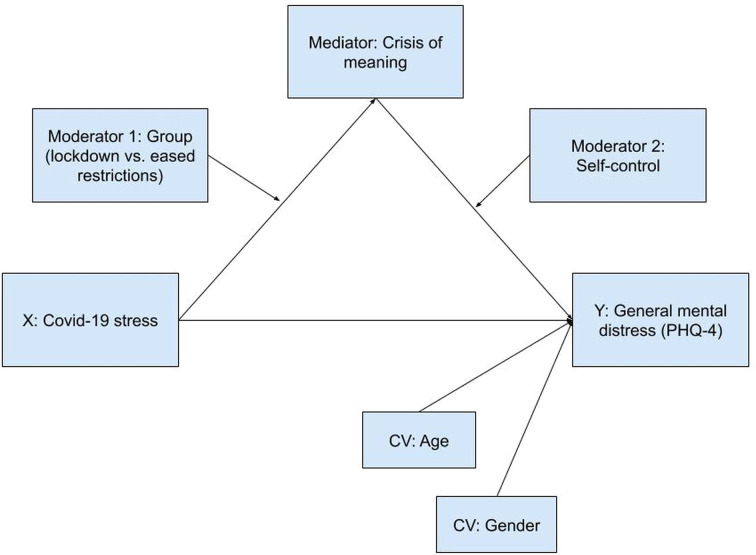
A cross-sectional survey was conducted online during lockdown (survey group 1) and the subsequent weeks characterized by eased restrictions (survey group 2). A total of N = 1,538 German-speaking participants completed a questionnaire battery including a novel measure of acute COVID-19 stress, meaningfulness and crisis of meaning (SoMe), self-control (SCS-KD), and a screening of general mental distress, measured by core symptoms of depression and anxiety (PHQ-4). In a first step, associations between living conditions, demographics, and COVID-19 stress were explored. Second, a moderation and a mediation model were tested. Meaningfulness, a measure of presence of meaning in life, as well as self-control were proposed to serve as buffers in a time of crisis, thus moderating the relation between acute COVID-19 stress and general mental distress (double moderation). Crisis of meaning, operationalizing an experienced lack of meaning in life, was proposed to mediate the relationship between acute COVID-19 stress and general mental distress, with an assumed moderation of the association between COVID-19 stress and crisis of meaning by survey group (lockdown versus eased restrictions after lockdown), and a hypothesized moderation of the link between crisis of meaning and general mental distress by self-control (dual moderated mediation).
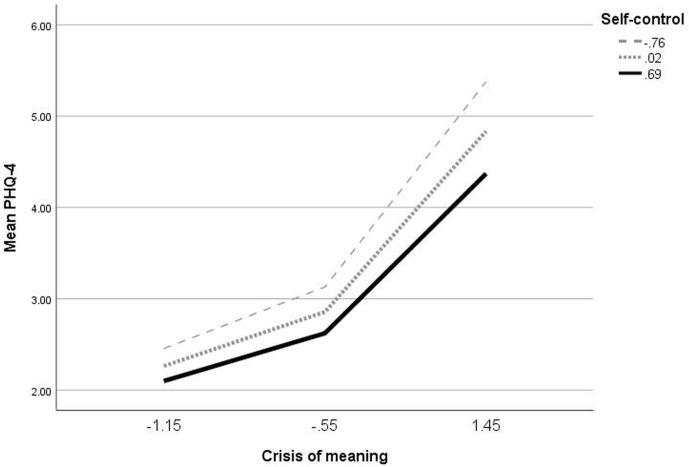
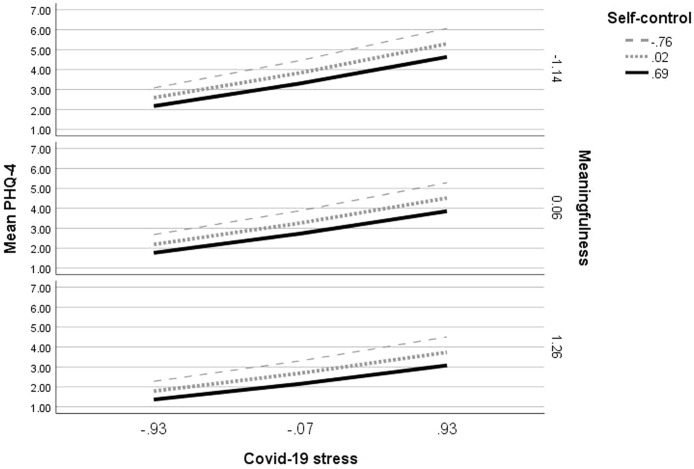
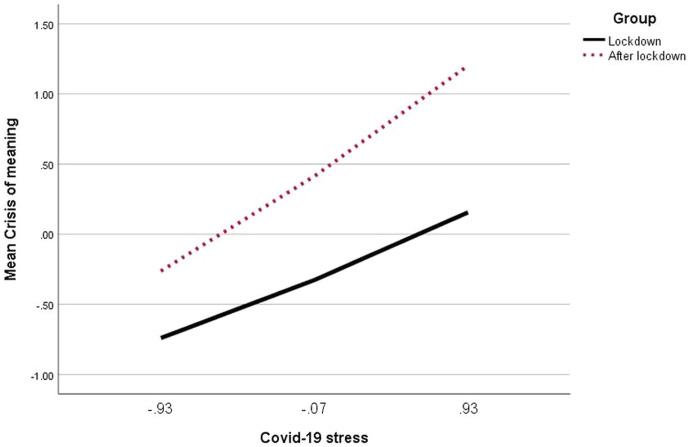
COVID-19 stress was slightly right-skewed. Scores were higher during lockdown than in the weeks thereafter. The rate of clinically significant general mental distress was high, exceeding prevalence rates from both the general population and clinical samples of the time before the pandemic. In the weeks following the lockdown (group 2), general mental distress and crisis of meaning were significantly higher than during lockdown (group 1), whereas meaningfulness and self-control were significantly lower. Demographically, age had the strongest association with COVID-19 stress, with older participants perceiving less acute stress (r = -.21). People who were partnered or married suffered less from COVID-19 stress (η2 = .01). Living alone (η2 = .006), living in a room versus a flat or house (η2 = .008), and being unemployed due to the pandemic (η2 = .008) were related to higher experience of COVID-19 stress. COVID-19 stress and general mental distress were strongly related (r = .53). Both meaningfulness and self-control were negatively associated with general mental distress (r = -.40 and -.36, respectively). They also moderated the relationship between COVID-19 stress and general mental distress: When meaningfulness was high, high COVID-19 stress was related to substantially lower PHQ-4 scores than when meaningfulness was low. The same held for self-control: High scores of self-control were associated with lower PHQ-4 scores especially when COVID-19 stress was high. Crisis of meaning mediated the relationship between COVID-19 stress and PHQ-4. There was a higher likelihood of crises of meaning occurring when COVID-19 stress was high; crisis of meaning, in turn, was associated with general mental distress. Survey group moderated the first path of this mediation, i.e., the relationship between COVID-19 stress and crisis of meaning: High scores of COVID-19 stress were associated more strongly with crisis of meaning in the second survey group (after the lockdown). Self-control moderated the second path, i.e., the relationship between crisis of meaning and PHQ-4: When a crisis of meaning was present, self-control could buffer its effect on general mental distress.
Also in the present study among German-speaking participants, general mental distress was high. Scores were higher after than during the lockdown, indicating an ongoing destabilization for a significant part of the population. People who saw a meaning in their lives and who were capable of self-control reported substantially less mental distress. Meaningfulness and self-control also served as buffers between COVID-19 stress and general mental distress: When COVID-19 stress was high, the presence of meaningfulness and self-control accounted for lower general mental distress. Moreover, people who suffered strongly from COVID-19 stress were more likely to develop a crisis of meaning which, in turn, was associated with higher general mental distress. This suggests that ongoing anxiety and depression might (also) be based on existential struggles. Again here, self-control buffered the impact of crisis of meaning on general mental health. We conclude from these findings that public health policies can support citizens in coping with large-scale crises by enabling experiences of meaningfulness, e.g., through transparent and reliable modes of communicating goals and necessary intermediate steps. Moreover, health professionals are well advised to invite individuals to confront existential questions and struggles, and to encourage them to exercise self-control. The latter can be boosted by keeping higher-order goals salient-which again is inherently linked to an understanding of their meaning.
多项研究表明,在新冠疫情期间,心理困扰显著增加。在此期间,民众被要求在个人和社会健康行为方面高度自律。与此同时,我们也目睹了亲社会行为和共享创意表达的增加,而这些行为被认为是意义的来源。生活意义和自我控制是公认的心理资源。特别是在危机时期,生活意义已被证明是恢复力和应对能力的关键因素。然而,威胁性和压力性的情况也可能危及生存安全感并引发意义危机。本研究旨在记录德国和奥地利在封锁期间及之后几周的急性新冠压力水平和总体心理困扰程度。为了确定与人口统计学和生活条件相关的潜在风险因素,我们对它们与新冠压力的关联进行了探索性分析。然而,该研究的主要目的是调查两种心理资源——意义感和自我控制——在急性新冠压力与总体心理困扰之间的关系中所起的缓冲作用。最后,我们考察了因意义危机的发生而导致的心理困扰加剧的可能性。
在封锁期间(调查组1)以及随后限制放宽的几周内(调查组2)进行了一项在线横断面调查。共有N = 1538名讲德语的参与者完成了一套问卷,其中包括一种新的急性新冠压力测量方法、意义感和意义危机(SoMe)、自我控制(SCS - KD),以及通过抑郁和焦虑的核心症状(PHQ - 4)对总体心理困扰进行的筛查。第一步,探索生活条件、人口统计学因素与新冠压力之间的关联。第二步,测试了一个调节模型和一个中介模型。意义感(一种衡量生活中意义存在的指标)以及自我控制被认为在危机时期起到缓冲作用,从而调节急性新冠压力与总体心理困扰之间的关系(双重调节)。意义危机(将生活中体验到的意义缺失进行操作化)被认为在急性新冠压力与总体心理困扰之间起中介作用,假定调查组(封锁期间与封锁后限制放宽)对新冠压力与意义危机之间的关联有调节作用,并且自我控制对意义危机与总体心理困扰之间的联系有调节作用(双重调节中介)。
新冠压力呈轻微右偏态分布。封锁期间的得分高于之后几周。具有临床显著意义的总体心理困扰发生率很高,超过了疫情前普通人群和临床样本的患病率水平。在封锁后的几周(第2组),总体心理困扰和意义危机显著高于封锁期间(第1组),而意义感和自我控制则显著较低。在人口统计学方面,年龄与新冠压力的关联最强,年龄较大的参与者感受到的急性压力较小(r = -0.21)。有伴侣或已婚的人受新冠压力的影响较小(η² = .01)。独自生活(η² = .006)、居住在单间而非公寓或房屋中(η² = .008)以及因疫情失业(η² = .008)与更高的新冠压力体验相关。新冠压力与总体心理困扰密切相关(r = .53)。意义感和自我控制均与总体心理困扰呈负相关(分别为r = -0.40和 -0.36)。它们还调节了新冠压力与总体心理困扰之间的关系:当意义感较高时,与意义感较低时相比,高新冠压力与显著更低的PHQ - 4得分相关。自我控制也是如此:高自我控制得分与更低的PHQ - 4得分相关,尤其是在新冠压力较高时。意义危机在新冠压力与PHQ - 4之间起中介作用。当新冠压力较高时,出现意义危机的可能性更大;意义危机反过来又与总体心理困扰相关。调查组调节了这一中介的第一条路径,即新冠压力与意义危机之间的关系:在第二个调查组(封锁后)中,高新冠压力得分与意义危机的关联更强。自我控制调节了第二条路径,即意义危机与PHQ - 4之间的关系:当存在意义危机时,自我控制可以缓冲其对总体心理困扰的影响。
在本项针对讲德语参与者的研究中,总体心理困扰程度也很高。封锁后的得分高于封锁期间,这表明相当一部分人群的心理状态持续不稳定。那些在生活中看到意义并且有自我控制能力的人报告的心理困扰要少得多。意义感和自我控制在新冠压力与总体心理困扰之间也起到了缓冲作用:当新冠压力较高时,意义感和自我控制的存在使得总体心理困扰程度较低。此外,受新冠压力严重影响的人更有可能出现意义危机,而这反过来又与更高程度的总体心理困扰相关。这表明持续的焦虑和抑郁可能(也)基于生存挣扎。同样在此处,自我控制缓冲了意义危机对总体心理健康的影响。我们从这些发现中得出结论,公共卫生政策可以通过促成有意义的体验来支持民众应对大规模危机,例如通过透明且可靠的方式传达目标和必要的中间步骤。此外,健康专业人员最好引导个体面对生存问题和挣扎,并鼓励他们进行自我控制。通过突出更高层次的目标可以增强自我控制,而这又与对其意义的理解内在相关。