Ouyang Xiwu, Feng Lemeng, Yao Lei, Xiao Yao, Hu Xianyu, Zhang Gewen, Liu Guodong, Wang Zhiming
Department of General Surgery, Xiangya Hospital, Central South University, Changsha 410008, China.
Xiangya School of Medicine, Central South University, Changsha 410013, China.
Mol Ther Nucleic Acids. 2021 Apr 2;24:755-767. doi: 10.1016/j.omtn.2021.03.021. eCollection 2021 Jun 4.
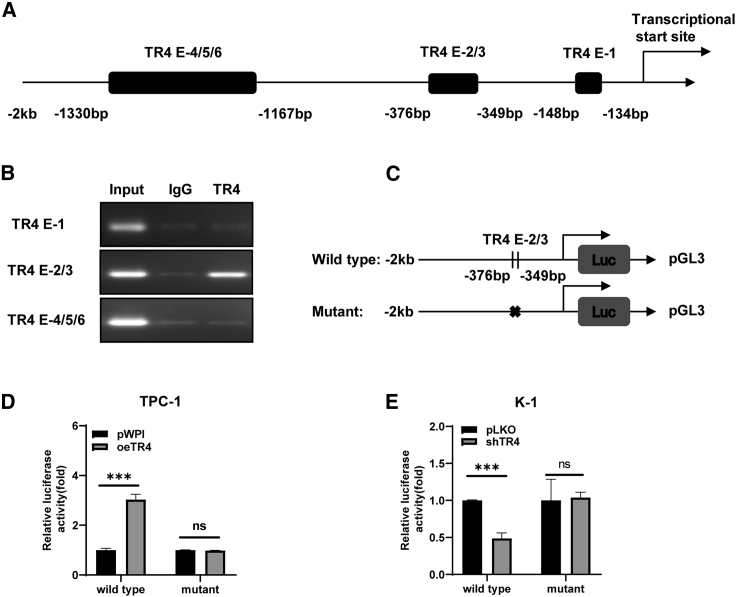
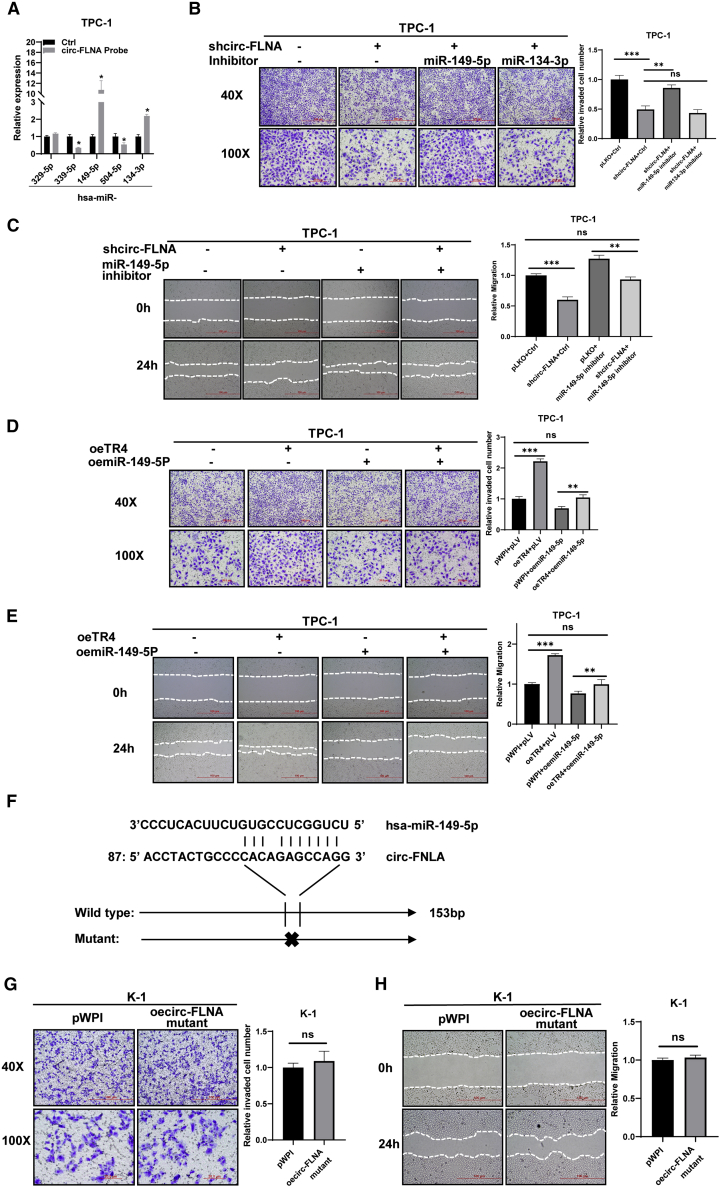
The incidence and mortality of papillary thyroid cancer (PTC) have steadily increased. Although conventional therapies are very effective toward differentiated PTC patients, very limited therapeutic options are applicable to those patients with distant metastases. Therefore, better understanding of the molecular biology of metastatic PTC helps identify novel targets and facilitates the development of new therapies. In this study, we first found that testicular orphan receptor 4 (TR4) was significantly increased in PTC tumors spreading to lymph nodes compared to the paired primary tumors. Experimental evidence suggested that TR4 drove PTC progression via promoting its cell invasion and cell migration. Mechanistically, TR4 transcriptionally regulated the expression level of circ-filamin A (FLNA), which competed with matrix metalloproteinase 9 (MMP9) for microRNA (miR)-149-5p binding and led to an increased protein level of MMP9. Interruption assays with various gene manipulations verified that the TR4/circ-FLNA/miR-149-5p/MMP9 signaling axis played a central role in cell invasion and cell migration of PTC cells. Moreover, a xenografted mouse model also confirmed that the TR4/circ-FLNA signal promoted PTC tumor growth. Overall, our study pinpoints the oncogenic role of TR4 in PTC development, and the targeting of TR4/circ-FLNA/miR-149-5p/MMP9 signaling may be an alternative option for metastatic PTC patients.
甲状腺乳头状癌(PTC)的发病率和死亡率一直在稳步上升。尽管传统疗法对分化型PTC患者非常有效,但对于那些有远处转移的患者,适用的治疗选择非常有限。因此,更好地了解转移性PTC的分子生物学有助于识别新的靶点,并促进新疗法的开发。在本研究中,我们首先发现,与配对的原发性肿瘤相比,在扩散至淋巴结的PTC肿瘤中,睾丸孤儿受体4(TR4)显著增加。实验证据表明,TR4通过促进细胞侵袭和迁移来推动PTC进展。机制上,TR4转录调控circ-丝状肌动蛋白A(FLNA)的表达水平,其与基质金属蛋白酶9(MMP9)竞争微小RNA(miR)-149-5p的结合,导致MMP9蛋白水平升高。各种基因操作的干扰试验证实,TR4/circ-FLNA/miR-149-5p/MMP9信号轴在PTC细胞的侵袭和迁移中起核心作用。此外,异种移植小鼠模型也证实,TR4/circ-FLNA信号促进PTC肿瘤生长。总体而言,我们的研究明确了TR4在PTC发展中的致癌作用,靶向TR4/circ-FLNA/miR-149-5p/MMP9信号可能是转移性PTC患者的另一种选择。