He Jinhua, Wu Feifeng, Han Zeping, Hu Min, Lin Weida, Li Yuguang, Cao Mingrong
Department of Laboratory Medicine, Central Hospital of Panyu District, Guangzhou, China.
Department of Hepatobiliary Surgery, The First Affiliated Hospital of Jinan University, Guangzhou, China.
Front Oncol. 2021 Apr 29;11:632834. doi: 10.3389/fonc.2021.632834. eCollection 2021.
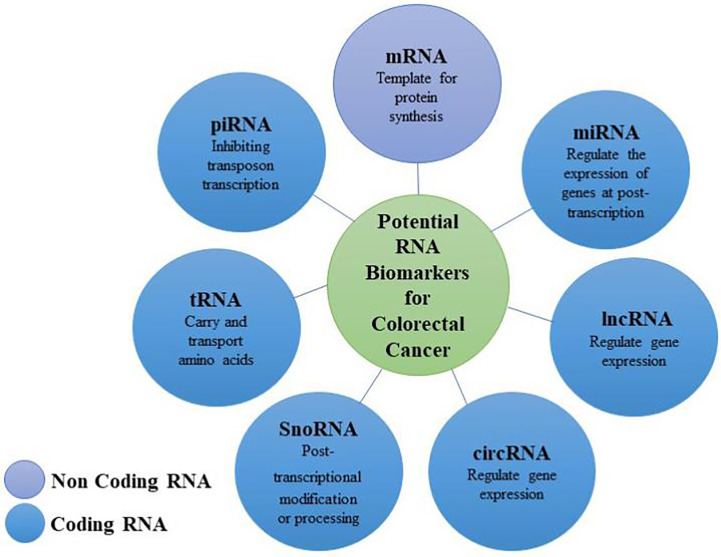
In recent years, the diagnosis and treatment of colorectal cancer (CRC) have been continuously improved, but the mortality rate continues to be high, especially in advanced patients. CRC patients usually have no obvious symptoms in the early stage and are already in the advanced stage when they are diagnosed. The 5-year survival rate is only 10%. The blood markers currently used to screen for CRC, such as carcinoembryonic antigen and carbohydrate antigen 19-9, have low sensitivity and specificity, whereas other methods are invasive or too expensive. As a result, recent research has shifted to the development of minimally invasive or noninvasive biomarkers in the form of body fluid biopsies. Non-coding RNA molecules are composed of microRNAs, long non-coding RNAs, small nucleolar RNAs, and circular RNAs, which have important roles in the occurrence and development of diseases and can be utilized for the early diagnosis and prognosis of tumors. In this review, we focus on the latest findings of mRNA-ncRNA as biomarkers for the diagnosis and prognosis of CRC, from fluid to tissue level.
近年来,结直肠癌(CRC)的诊断和治疗水平不断提高,但死亡率仍然居高不下,尤其是在晚期患者中。CRC患者早期通常没有明显症状,确诊时往往已处于晚期。其5年生存率仅为10%。目前用于CRC筛查的血液标志物,如癌胚抗原和糖类抗原19-9,敏感性和特异性较低,而其他方法具有侵入性或成本过高。因此,近期的研究已转向以体液活检形式开发微创或无创生物标志物。非编码RNA分子由微小RNA、长链非编码RNA、小核仁RNA和环状RNA组成,它们在疾病的发生发展中起重要作用,可用于肿瘤的早期诊断和预后评估。在这篇综述中,我们重点关注从体液到组织水平,mRNA-ncRNA作为CRC诊断和预后生物标志物的最新研究结果。