Shalekoff Sharon, Loubser Shayne, Dias Bianca Da Costa, Strehlau Renate, Shiau Stephanie, Wang Shuang, He Yun, Abrams Elaine J, Kuhn Louise, Tiemessen Caroline T
Centre for HIV & STIs, National Institute for Communicable Diseases and School of Pathology, Faculty of Health Sciences, University of the Witwatersrand, Johannesburg, South Africa.
Empilweni Services and Research Unit, Rahima Moosa Mother and Child Hospital, Department of Paediatrics and Child Health, School of Clinical Medicine, Faculty of Health Sciences, University of the Witwatersrand, Johannesburg, South Africa.
Front Pediatr. 2021 Apr 29;9:618191. doi: 10.3389/fped.2021.618191. eCollection 2021.
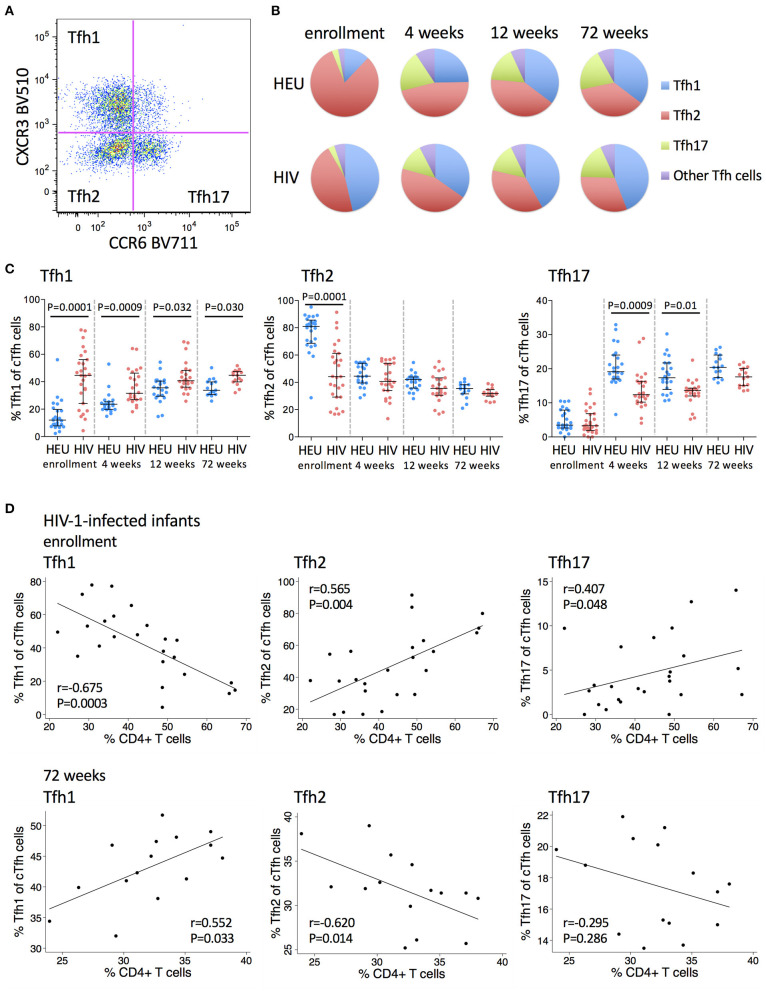
Infant HIV-1-infection is associated with high morbidity and mortality if antiretroviral treatment (ART) is not initiated promptly. We characterized development of circulating T follicular helper cells (cTfh) and their relationship to naïve/memory B cell subsets in a cohort of neonates initiating ART within the first week of life. Infants were diagnosed within 48 hours of birth and started ART as soon as possible. The frequency and phenotype of cTfh and B cells were analyzed at enrollment (birth -19 days) and at 4, 12, and 72 weeks of age in blood of 27 HIV-1-intrauterine-infected and 25 HIV-1 exposed uninfected (HEU) infants as part of a study in Johannesburg, South Africa. cTfh cells were divided into Tfh1, Tfh2, and Tfh17 subsets. B cell phenotypes were defined as naïve, resting memory, activated memory and tissue-like memory cells. HIV-1-infected infants had higher frequencies of cTfh cells than HEU infants up to 12 weeks of age and these cTfh cells were polarized toward the Tfh1 subset. Higher frequencies of Tfh1 and lower frequencies of Tfh2 and Tfh17 correlated with lower CD4+ T cell percentages. Lower frequencies of resting memory, with corresponding higher frequencies of activated memory B cells, were observed with HIV-1 infection. Importantly, dysregulations in B cell, but not cTfh cell, subsets were normalized by 72 weeks. Very early ART initiation in HIV-1-infected infants normalizes B cell subsets but does not fully normalize perturbations in cTfh cell subsets which remain Tfh1 polarized at 72 weeks. It remains to be determined if very early ART improves vaccine antibody responses despite the cTfh and B cell perturbations observed over the time course of this study.
如果不及时启动抗逆转录病毒治疗(ART),婴儿HIV-1感染会导致高发病率和死亡率。我们对一组在出生后第一周内开始接受ART的新生儿中循环滤泡辅助性T细胞(cTfh)的发育及其与初始/记忆B细胞亚群的关系进行了特征描述。婴儿在出生后48小时内被诊断出来,并尽快开始接受ART治疗。作为南非约翰内斯堡一项研究的一部分,对27名宫内感染HIV-1的婴儿和25名暴露于HIV-1但未感染(HEU)的婴儿在入组时(出生-19天)以及4、12和72周龄时血液中的cTfh和B细胞的频率及表型进行了分析。cTfh细胞被分为Tfh1、Tfh2和Tfh17亚群。B细胞表型被定义为初始、静息记忆、活化记忆和组织样记忆细胞。在12周龄之前,HIV-1感染婴儿的cTfh细胞频率高于HEU婴儿,且这些cTfh细胞向Tfh1亚群极化。Tfh1频率较高以及Tfh2和Tfh17频率较低与较低的CD4+T细胞百分比相关。HIV-1感染时观察到静息记忆B细胞频率较低,相应地活化记忆B细胞频率较高。重要的是,B细胞亚群的失调在72周时恢复正常,但cTfh细胞亚群未恢复正常。HIV-1感染婴儿极早期开始ART可使B细胞亚群恢复正常,但不能完全纠正cTfh细胞亚群的紊乱,这些细胞在72周时仍为Tfh1极化。尽管在本研究的时间过程中观察到cTfh和B细胞紊乱,但极早期ART是否能改善疫苗抗体反应仍有待确定。