Vertullo Christopher J, Cadman Joseph, Dabirrahmani Danè, Appleyard Richard
Knee Research Australia and the Centre for Musculoskeletal Research, Menzies Health Institute, Griffith University, Gold Coast, Australia.
Orthopaedic Biomechanics Research Group, Department of Biomedical Sciences, Faculty of Medicine and Health Sciences, Macquarie University, Sydney, Australia.
Orthop J Sports Med. 2021 Apr 22;9(4):23259671211000464. doi: 10.1177/23259671211000464. eCollection 2021 Apr.
Meniscus root repairs are important for restoring knee function after a complete meniscus root tear. Various suturing patterns have been proposed for the root repair. The 2-simple-stitches (TSS) method is currently the preferred technique, as it is simplest to perform and allows the least displacement of the meniscus root.
To compare the biomechanical properties of a posterior medial meniscus transtibial root repair consisting of an all-inside meniscal repair device (AMRD) construct with the TSS pullout suture pattern.
Controlled laboratory study.
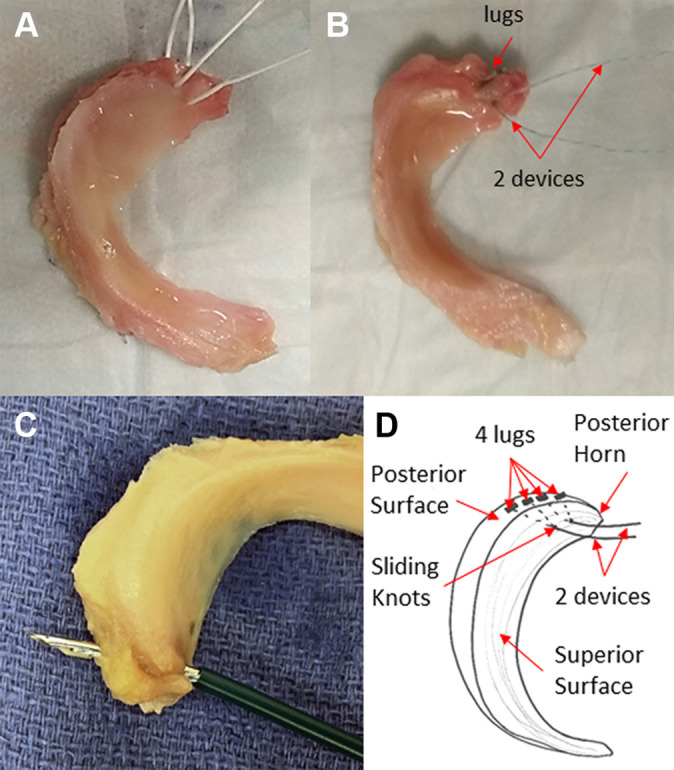
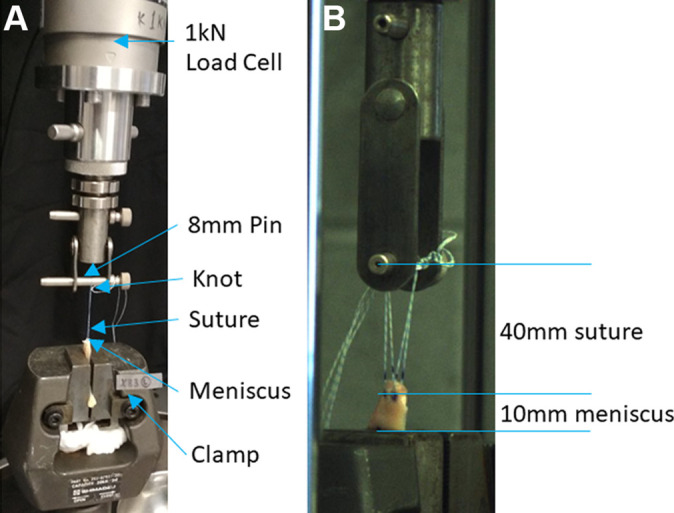
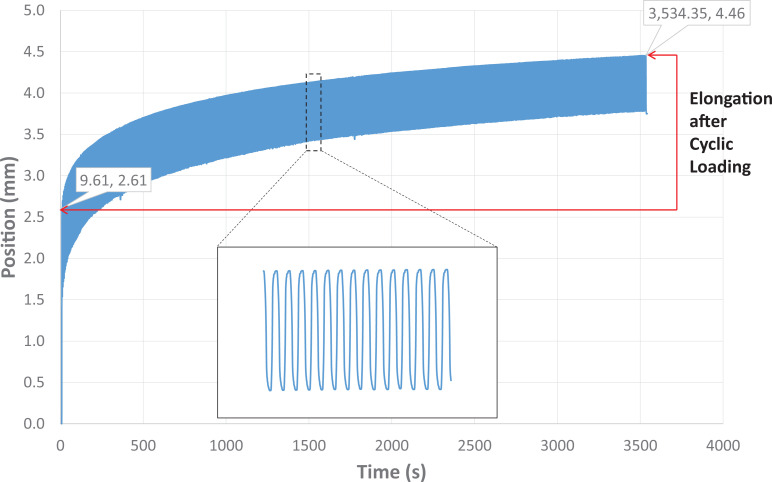
Ten pairs of cadaveric medial menisci were prepared with 1 of the 2 constructs. The constructs were randomized between pairs. All constructs were subjected to preloading with 2 N for 10 seconds and then cyclic loading from 5 N to 20 N for 1000 cycles at a frequency of 0.5 Hz. Subsequently, the menisci were loaded to failure at a rate of 0.5 mm/s. All loads were applied in-line with the circumferential meniscal fibers near the posterior medial meniscal horn.
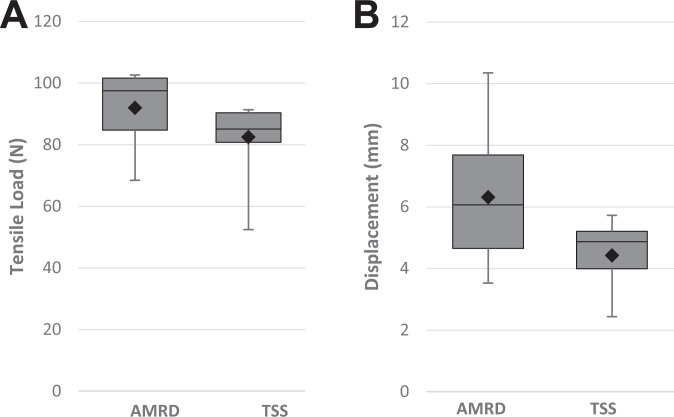
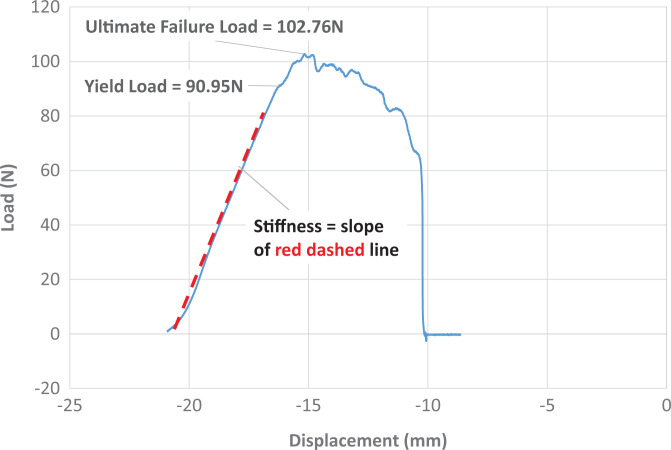
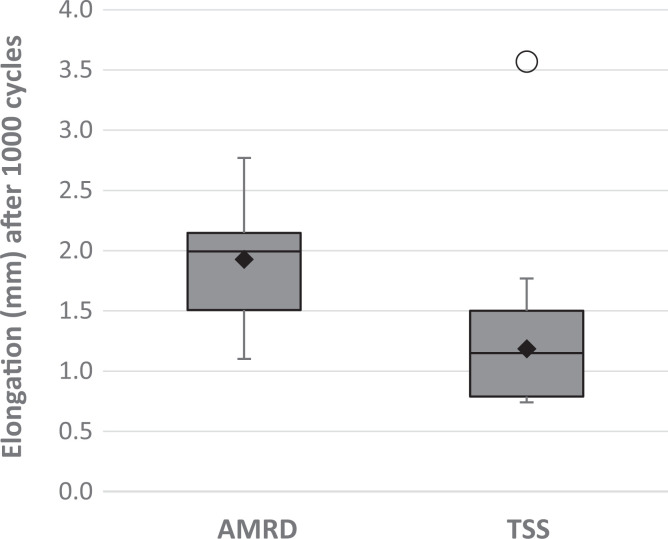
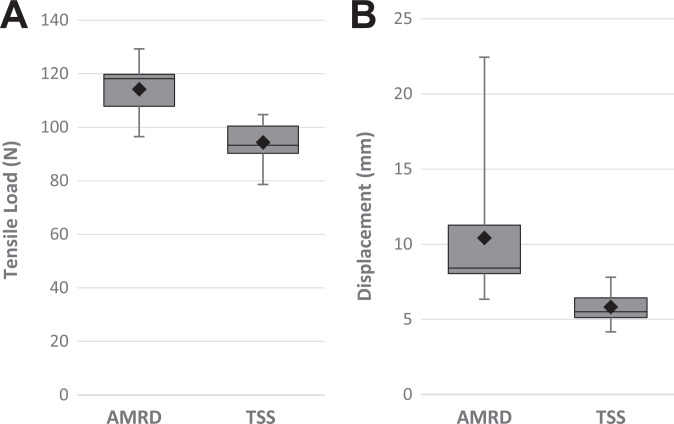
The mean yield load and stiffness were similar for both constructs. The elongation after cyclic loading was greater for the AMRD. The displacement at both yield load and ultimate failure were also higher for the AMRD. The ultimate failure load of the AMRD was also significantly higher. During load to failure, the mode of failure in the AMRD was heterogeneous. All the TSS constructs failed by suture cutout.
Posterior medial meniscus root repairs using both the AMRD and TSS constructs have elongation under the biomechanically acceptable threshold of 3 mm. The stiffness and yield loads indicate similar mechanical properties of the constructs. However, the significantly higher elongation for the AMRD leaves the TSS method as the preferred option for transtibial repairs. Despite this, the AMRD construct may still represent a viable alternative to the TSS suture pattern, comparable to alternative suture patterns with similar limitations.
The AMRD construct may represent a viable alternative to the TSS suture pattern.
半月板根部修复对于完全性半月板根部撕裂后恢复膝关节功能至关重要。已提出多种用于根部修复的缝合方式。双简单缝合(TSS)法目前是首选技术,因为其操作最简单且半月板根部移位最小。
比较由全内半月板修复装置(AMRD)构建的后内侧半月板经胫骨根部修复与TSS拔出缝线方式的生物力学性能。
对照实验室研究。
制备10对尸体内侧半月板,每对半月板采用两种构建方式中的一种。构建方式在各对之间随机分配。所有构建物先以2 N预加载10秒,然后以0.5 Hz的频率从5 N至20 N循环加载1000次。随后,以0.5 mm/s的速率加载半月板直至破坏。所有载荷均沿后内侧半月板角附近的半月板圆周纤维方向施加。
两种构建方式的平均屈服载荷和刚度相似。AMRD在循环加载后的伸长更大。AMRD在屈服载荷和最终破坏时的位移也更高。AMRD的最终破坏载荷也显著更高。在加载至破坏过程中,AMRD的破坏模式不均匀。所有TSS构建物均因缝线穿出而失败。
使用AMRD和TSS构建方式进行后内侧半月板根部修复时,在生物力学可接受的3 mm阈值以下均有伸长。刚度和屈服载荷表明构建物的力学性能相似。然而,AMRD明显更高的伸长使得TSS法成为经胫骨修复的首选。尽管如此,AMRD构建方式仍可能是TSS缝线方式的可行替代方案,与具有类似局限性的其他缝线方式相当。
AMRD构建方式可能是TSS缝线方式的可行替代方案。