Zhang Yintao, Attarilar Shokouh, Wang Liqiang, Lu Weijie, Yang Junlin, Fu Yuanfei
State Key Laboratory of Metal Matrix Composites, School of Materials Science and Engineering, Shanghai Jiao Tong University, Shanghai 200240, China.
Department of Pediatric Orthopaedics, Xinhua Hospital Affiliated to Shanghai Jiao Tong University, School of Medicine, Shanghai 200092, China.
Int J Bioprint. 2021 Apr 15;7(2):340. doi: 10.18063/ijb.v7i2.340. eCollection 2021.
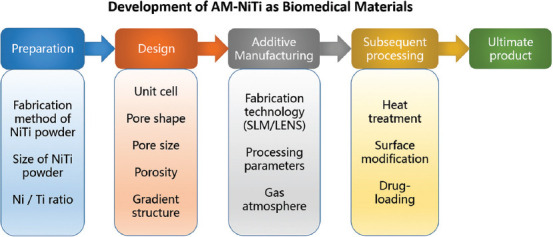
NiTi alloy has a wide range of applications as a biomaterial due to its high ductility, low corrosion rate, and favorable biocompatibility. Although Young's modulus of NiTi is relatively low, it still needs to be reduced; one of the promising ways is by introducing porous structure. Traditional manufacturing processes, such as casting, can hardly produce complex porous structures. Additive manufacturing (AM) is one of the most advanced manufacturing technologies that can solve impurity issues, and selective laser melting (SLM) is one of the well-known methods. This paper reviews the developments of AM-NiTi with a particular focus on SLM-NiTi utilization in biomedical applications. Correspondingly, this paper aims to describe the three key factors, including powder preparation, processing parameters, and gas atmosphere during the overall process of porous NiTi. The porous structure design is of vital importance, so the unit cell and pore parameters are discussed. The mechanical properties of SLM-NiTi, such as hardness, compressive strength, tensile strength, fatigue behavior, and damping properties and their relationship with design parameters are summarized. In the end, it points out the current challenges. Considering the increasing application of NiTi implants, this review paper may open new frontiers for advanced and modern designs.
由于具有高延展性、低腐蚀速率和良好的生物相容性,镍钛合金作为生物材料有着广泛的应用。尽管镍钛合金的杨氏模量相对较低,但仍需要进一步降低;一种很有前景的方法是引入多孔结构。传统制造工艺,如铸造,很难制造出复杂的多孔结构。增材制造(AM)是能够解决杂质问题的最先进制造技术之一,选择性激光熔化(SLM)是其中一种广为人知的方法。本文综述了增材制造镍钛合金的发展情况,特别关注选择性激光熔化镍钛合金在生物医学应用中的利用。相应地,本文旨在描述多孔镍钛合金整个过程中的三个关键因素,包括粉末制备、工艺参数和气体气氛。多孔结构设计至关重要,因此对晶胞和孔隙参数进行了讨论。总结了选择性激光熔化镍钛合金的力学性能,如硬度、抗压强度、抗拉强度、疲劳行为和阻尼性能及其与设计参数的关系。最后,指出了当前面临的挑战。考虑到镍钛合金植入物的应用日益增加,这篇综述论文可能为先进和现代设计开辟新的领域。