Department of Biochemistry and Molecular Biology, Center for Membrane Biology, University of Texas Health Science Center - McGovern Medical School, Houston, United States.
Swiss Light Source, Paul Scherrer Institute, Villigen, Switzerland.
Elife. 2021 May 17;10:e65903. doi: 10.7554/eLife.65903.
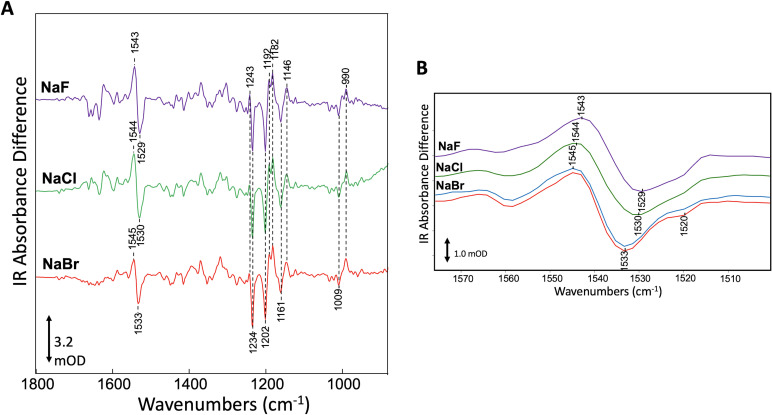
The crystal structure of the light-gated anion channel ACR1 reported in our previous Research Article (Li et al., 2019) revealed a continuous tunnel traversing the protein from extracellular to intracellular pores. We proposed the tunnel as the conductance channel closed by three constrictions: C1 in the extracellular half, mid-membrane C2 containing the photoactive site, and C3 on the cytoplasmic side. Reported here, the crystal structure of bromide-bound ACR1 reveals structural changes that relax the C1 and C3 constrictions, including a novel salt-bridge switch mechanism involving C1 and the photoactive site. These findings indicate that substrate binding induces a transition from an inactivated state to a pre-activated state in the dark that facilitates channel opening by reducing free energy in the tunnel constrictions. The results provide direct evidence that the tunnel is the closed form of the channel of ACR1 and shed light on the light-gated channel activation mechanism.
我们之前的研究文章(Li 等人,2019)中报道了光敏阴离子通道 ACR1 的晶体结构,该结构揭示了一条从细胞外到细胞内孔连续贯穿蛋白质的隧道。我们提出这条隧道是由三个限制因素关闭的电导通道:细胞外半部分的 C1、含有光活性位点的中膜 C2 和细胞质侧的 C3。本文报道了溴化物结合的 ACR1 的晶体结构,揭示了结构变化,这些变化放松了 C1 和 C3 的限制,包括涉及 C1 和光活性位点的新型盐桥开关机制。这些发现表明,底物结合诱导从无活性状态到预激活状态的转变,在黑暗中促进通道打开,减少隧道限制中的自由能。结果提供了直接证据表明隧道是 ACR1 通道的关闭形式,并阐明了光门控通道激活机制。