Division of Anaesthesiology, Department of Anaesthesiology Intensive Care and Pain Medicine, University of Helsinki and Helsinki University Hospital, Helsinki, Finland.
Department of Cardiac Surgery, Heart and Lung Center, University of Helsinki and Helsinki University Hospital, Helsinki, Finland.
PLoS One. 2021 May 17;16(5):e0251747. doi: 10.1371/journal.pone.0251747. eCollection 2021.
Experimental cardiac ischemia-reperfusion injury causes degradation of the glycocalyx and coronary washout of its components syndecan-1 and heparan sulfate. Systemic elevation of syndecan-1 and heparan sulfate is well described in cardiac surgery. Still, the events during immediate reperfusion after aortic declamping are unknown both in the systemic and in the coronary circulation.
In thirty patients undergoing aortic valve replacement, arterial concentrations of syndecan-1 and heparan sulfate were measured immediately before and at one, five and ten minutes after aortic declamping (reperfusion). Parallel blood samples were drawn from the coronary sinus to calculate trans-coronary gradients (coronary sinus-artery).
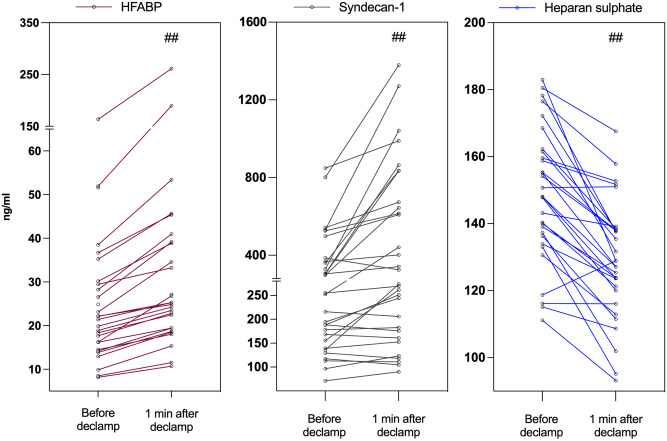
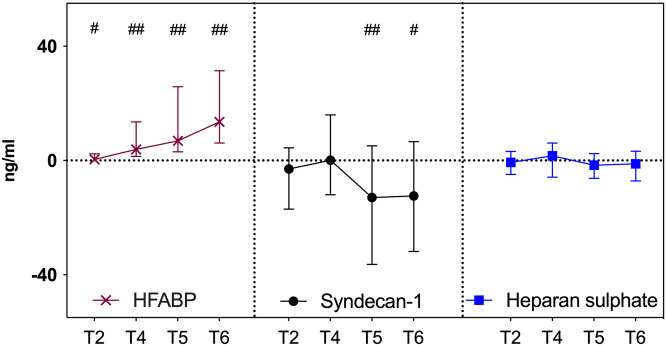
Compared with immediately before aortic declamping, arterial syndecan-1 increased by 18% [253.8 (151.6-372.0) ng/ml vs. 299.1 (172.0-713.7) ng/ml, p < 0.001] but arterial heparan sulfate decreased by 14% [148.1 (135.7-161.7) ng/ml vs. 128.0 (119.0-138.2) ng/ml, p < 0.001] at one minute after aortic declamping. There was no coronary washout of syndecan-1 or heparan sulfate during reperfusion. On the contrary, trans-coronary sequestration of syndecan-1 occurred at five [-12.96 ng/ml (-36.38-5.15), p = 0.007] and at ten minutes [-12.37 ng/ml (-31.80-6.62), p = 0.049] after reperfusion.
Aortic declamping resulted in extracardiac syndecan-1 release and extracardiac heparan sulfate sequestration. Syndecan-1 was sequestered in the coronary circulation during early reperfusion. Glycocalyx has been shown to degrade during cardiac surgery. Besides degradation, glycocalyx has propensity for regeneration. The present results of syndecan-1 and heparan sulfate sequestration may reflect endogenous restoration of the damaged glycocalyx in open heart surgery.
实验性心脏缺血再灌注损伤导致糖萼降解和糖萼成分硫酸乙酰肝素和连接蛋白-1 的冠状洗脱。心脏手术中系统升高硫酸乙酰肝素和连接蛋白-1 已有很好的描述。然而,在主动脉钳夹解除后的即刻再灌注期间,无论是在全身还是在冠状循环中,事件尚不清楚。
在 30 例接受主动脉瓣置换术的患者中,在主动脉钳夹解除前和解除后 1、5 和 10 分钟测量动脉中连接蛋白-1 和硫酸乙酰肝素的浓度(再灌注)。从冠状窦平行抽取血液样本以计算冠状窦-动脉的跨冠状梯度。
与主动脉钳夹解除前相比,动脉连接蛋白-1 增加 18%[253.8(151.6-372.0)ng/ml 比 299.1(172.0-713.7)ng/ml,p<0.001],但动脉硫酸乙酰肝素降低 14%[148.1(135.7-161.7)ng/ml 比 128.0(119.0-138.2)ng/ml,p<0.001]在主动脉钳夹解除后 1 分钟。再灌注期间没有连接蛋白-1 或硫酸乙酰肝素的冠状洗脱。相反,在再灌注后 5 分钟[-12.96 ng/ml(-36.38-5.15),p=0.007]和 10 分钟[-12.37 ng/ml(-31.80-6.62),p=0.049]时发生了跨冠状的连接蛋白-1 隔离。
主动脉钳夹导致心脏外连接蛋白-1 释放和心脏外硫酸乙酰肝素隔离。在早期再灌注期间,连接蛋白-1 被隔离在冠状循环中。糖萼在心脏手术中已被证明会降解。除了降解之外,糖萼还有再生的倾向。连接蛋白-1 和硫酸乙酰肝素隔离的结果可能反映了心脏手术中受损糖萼的内源性恢复。