Yale PET Center, Department of Radiology and Biomedical Imaging, Yale University, 801 Howard Avenue, New Haven, CT 06520, USA.
Yale PET Center, Department of Radiology and Biomedical Imaging, Yale University, 801 Howard Avenue, New Haven, CT 06520, USA.
Neuroimage. 2021 Aug 15;237:118167. doi: 10.1016/j.neuroimage.2021.118167. Epub 2021 May 15.
The human brain is inherently organized into distinct networks, as reported widely by resting-state functional magnetic resonance imaging (rs-fMRI), which are based on blood-oxygen-level-dependent (BOLD) signal fluctuations. C-UCB-J PET maps synaptic density via synaptic vesicle protein 2A, which is a more direct structural measure underlying brain networks than BOLD rs-fMRI.
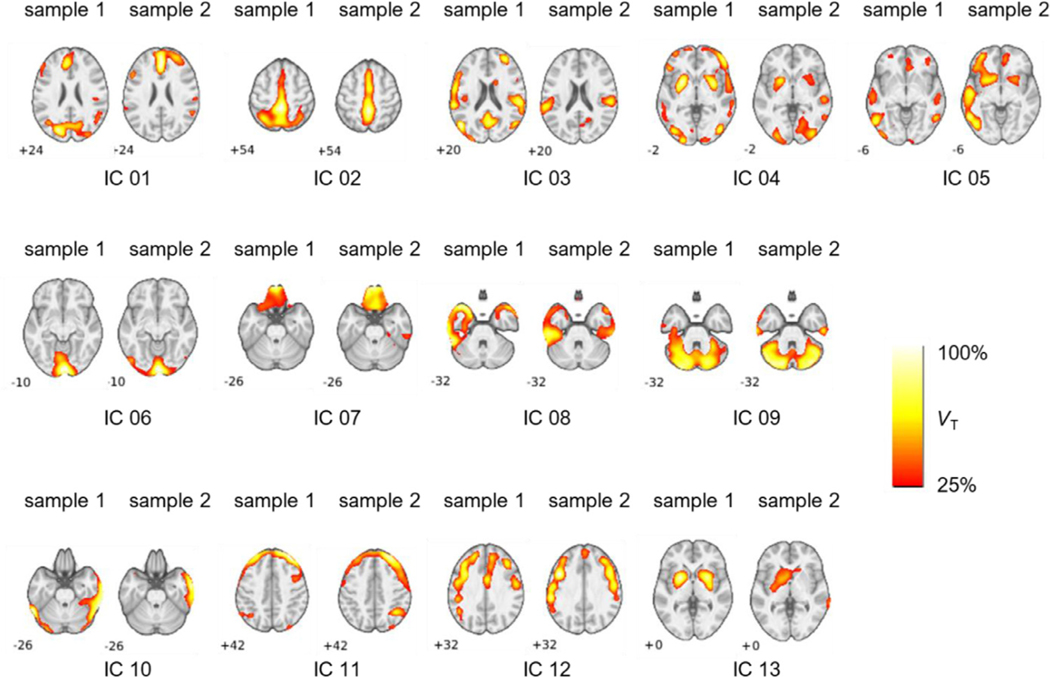
The aim of this study was to identify maximally independent brain source networks, i.e., "spatial patterns with common covariance across subjects", in C-UCB-J data using independent component analysis (ICA), a data-driven analysis method. Using a population of 80 healthy controls, we applied ICA to two 40-sample subsets and compared source network replication across samples. We examined the identified source networks at multiple model orders, as the ideal number of maximally independent components (IC) is unknown. In addition, we investigated the relationship between the strength of the loading weights for each source network and age and sex.
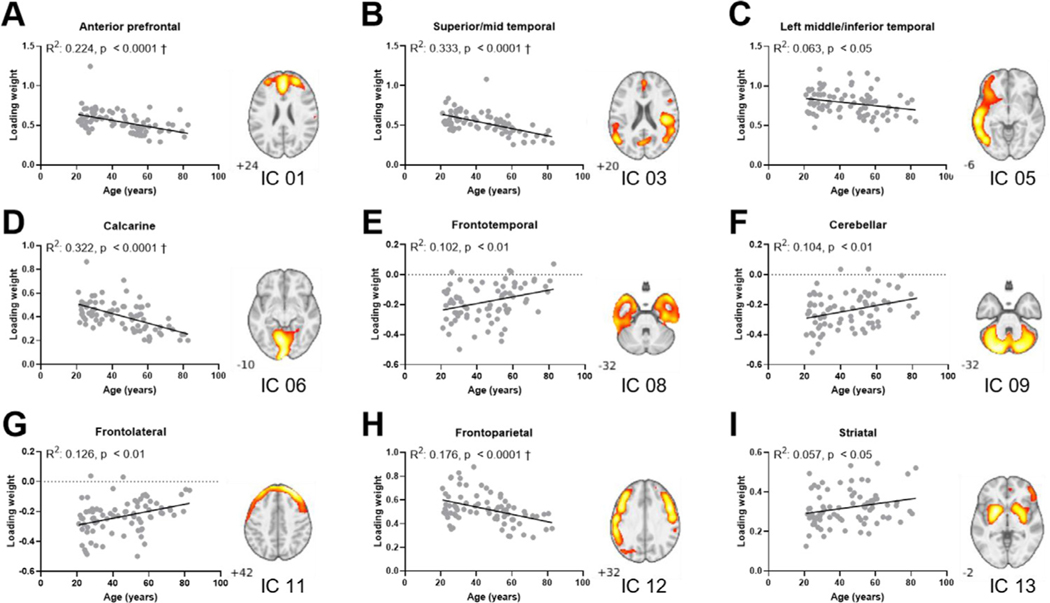
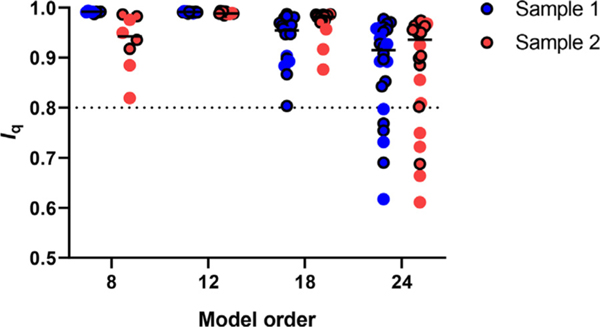
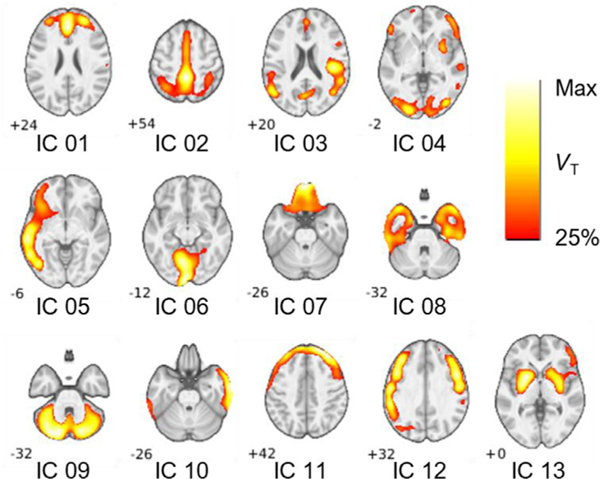
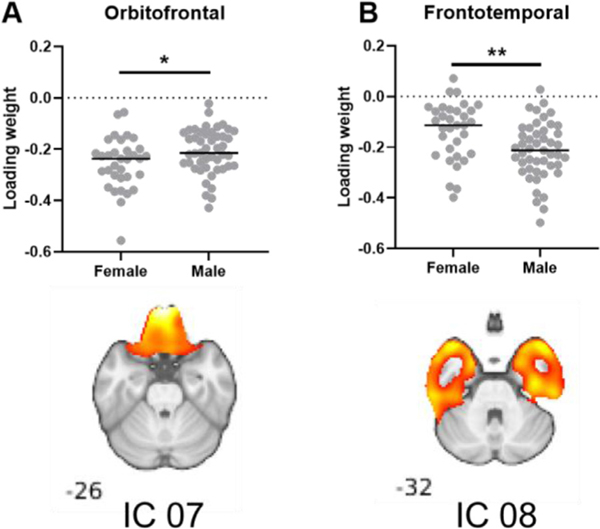
Thirteen source networks replicated across both samples. We determined that a model order of 18 components provided stable, replicable components, whereas estimations above 18 were not stable. Effects of sex were found in two ICs. Nine ICs showed age-related change, with 4 remaining significant after correction for multiple comparison.
This study provides the first evidence that human brain synaptic density can be characterized into organized covariance patterns. Furthermore, we demonstrated that multiple synaptic density source networks are associated with age, which supports the potential utility of ICA to identify biologically relevant synaptic density source networks.
静息态功能磁共振成像(rs-fMRI)广泛报道,人类大脑固有地组织成不同的网络,这些网络基于血氧水平依赖(BOLD)信号波动。C-UCB-J PET 通过突触小泡蛋白 2A 来绘制突触密度图,这是一种比 BOLD rs-fMRI 更直接的大脑网络结构测量方法。
本研究的目的是使用独立成分分析(ICA),一种数据驱动的分析方法,从 C-UCB-J 数据中识别最大独立的大脑源网络,即“具有共同协方差的空间模式”。使用 80 名健康对照者的群体,我们将 ICA 应用于两个 40 个样本子集,并比较样本间源网络的复制情况。我们在多个模型顺序下检查了识别出的源网络,因为理想的最大独立分量(IC)数量是未知的。此外,我们研究了每个源网络的加载权重与年龄和性别的关系。
13 个源网络在两个样本中都有复制。我们确定,18 个分量的模型顺序提供了稳定、可复制的分量,而高于 18 的估计则不稳定。在两个 IC 中发现了性别的影响。9 个 IC 显示与年龄相关的变化,其中 4 个在进行多次比较校正后仍然显著。
本研究首次提供了人类大脑突触密度可以被描述为有组织的协方差模式的证据。此外,我们证明了多个突触密度源网络与年龄相关,这支持了 ICA 识别与生物学相关的突触密度源网络的潜在效用。