Sehn Ana Paula, Brand Caroline, Welser Letícia, Gaya Anelise Reis, Agostinis-Sobrinho Cesar, Cristi-Montero Carlos, de Mello Elza Daniel, Reuter Cézane Priscila
Graduate Program in Health Promotion, University of Santa Cruz do Sul (UNISC), Independência Av, 2293 - Universitário, Santa Cruz do Sul, RS, 96815-900, Brazil.
Graduate Program in Human Movement Sciences, Federal University of Rio Grande do Sul (UFRGS), Porto Alegre, RS, Brazil.
BMC Pediatr. 2021 May 17;21(1):234. doi: 10.1186/s12887-021-02696-y.
The increased incidence of cardiometabolic risk factors has become a public health issue, especially in childhood and adolescence. Thus, early identification is essential to avoid or reduce future complications in adulthood. In this sense, the present study aimed to verify the influence of cardiorespiratory fitness (CRF) as a moderator in the association between neck circumference (NC) and cardiometabolic risk in children and adolescents.
Cross-sectional study that included 2418 randomly selected children and adolescents (52.5% girls), aged 6 to 17 years old. Anthropometric measurements, such as NC and body mass index (BMI), and CRF was measured by the six-minute running/walking test, as well as cardiometabolic risk (systolic blood pressure, glucose, HDL-C, and triglycerides), were assessed.
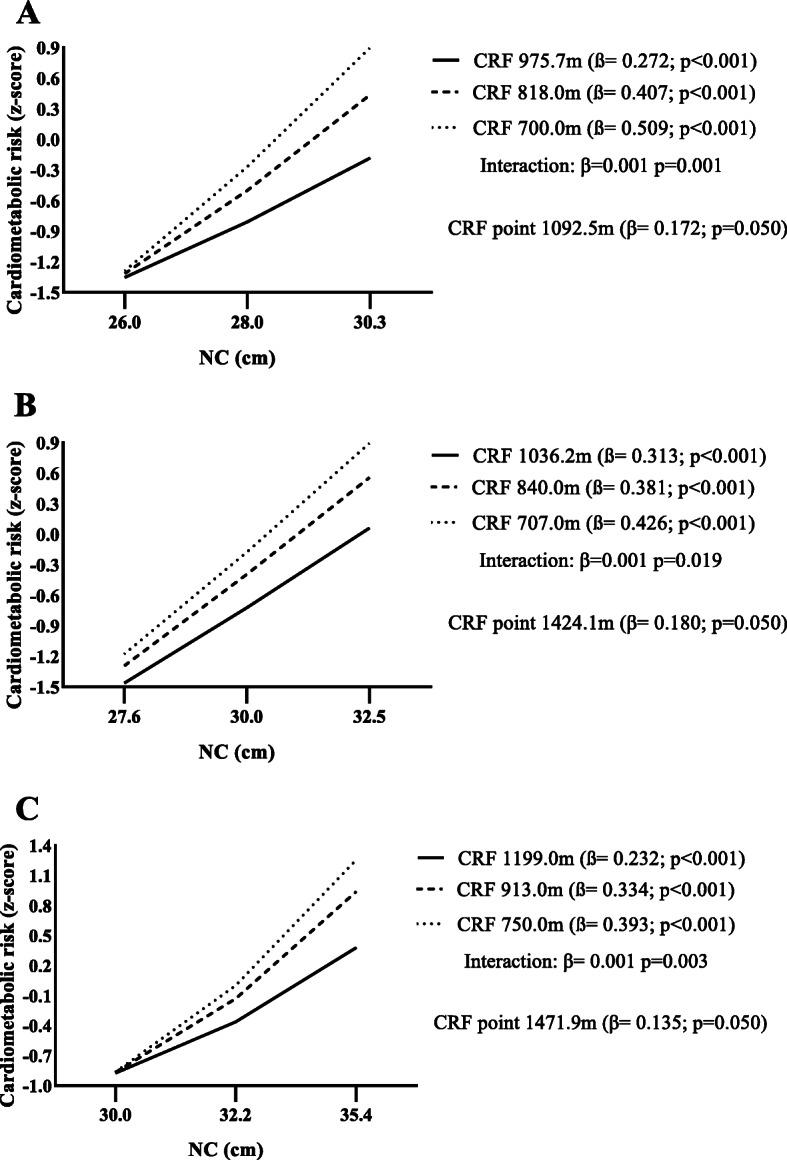
For all age groups, NC showed a negative relationship with CRF. A significant interaction term was found for CRF x NC with cardiometabolic risk for children (6 to 9 years old), early adolescents (10 to 12 years old), and middle adolescents (13 to 17 years old). It was found that children who accomplished more than 1092.49 m in CRF test were protected against cardiometabolic risk when considering NC. In adolescents, protection against cardiometabolic risk was found when the CRF test was completed above 1424.14 m and 1471.87 m (early and middle stage, respectively).
CRF is inversely associated with NC and acts as a moderator in the relationship between NC and cardiometabolic risk in children and adolescents. Therefore, this detrimental health impact linked to fatness might be attenuated by improving CRF levels.
心脏代谢危险因素的发病率上升已成为一个公共卫生问题,尤其是在儿童和青少年中。因此,早期识别对于避免或减少成年期未来的并发症至关重要。从这个意义上说,本研究旨在验证心肺适能(CRF)作为调节因素在儿童和青少年颈部周长(NC)与心脏代谢风险之间关联中的作用。
横断面研究纳入了2418名随机选取的6至17岁儿童和青少年(52.5%为女孩)。评估了人体测量指标,如NC和体重指数(BMI),通过六分钟跑步/步行测试测量CRF,以及心脏代谢风险(收缩压、血糖、高密度脂蛋白胆固醇和甘油三酯)。
在所有年龄组中,NC与CRF呈负相关。发现CRF×NC与儿童(6至9岁)、青少年早期(10至12岁)和青少年中期(13至17岁)的心脏代谢风险存在显著交互作用项。研究发现,在考虑NC时,CRF测试成绩超过1092.49米的儿童可预防心脏代谢风险。在青少年中,当CRF测试分别在1424.14米和1471.87米以上完成(分别为早期和中期)时,可预防心脏代谢风险。
CRF与NC呈负相关,并在儿童和青少年的NC与心脏代谢风险之间的关系中起调节作用。因此,通过提高CRF水平可能会减轻与肥胖相关的这种有害健康影响。