Department of Neurology, Medical University of Vienna, Waehringer Guertel 18-20, 1090, Vienna, Austria.
Department of Neurology, Rostock University Medical Center, Rostock, Germany.
J Neurol. 2021 Dec;268(12):4809-4815. doi: 10.1007/s00415-021-10596-5. Epub 2021 May 18.
Fatigue is one of the most frequent symptoms in patients with multiple sclerosis (MS), causing a major impact on quality-of-life. Non-pharmacological intervention strategies involve physical activity, which has been shown to reduce fatigue. Training under normobaric hypoxic conditions is thought to improve the response to endurance training and may, therefore, have an additional benefit over normoxic training conditions in MS patients.
To compare the effects of endurance training under hypoxic and normoxic conditions on fatigue, mobility and spasticity in patients with MS during inpatient rehabilitation.
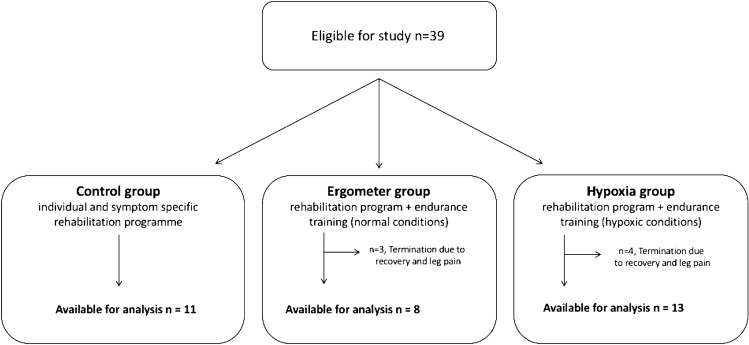
Thirty-nine patients with MS were assigned within a randomized prospective longitudinal pilot study to (1) a routine clinical rehabilitation program, (2) a routine clinical rehabilitation program + normoxic endurance training and (3) a routine clinical rehabilitation program + hypoxic endurance training for 14 days. Fatigue (WEIMuS and MFIS), spasticity (MSSS-88) and walking endurance (6MinWT) were assessed at days 0, 7 and 14.
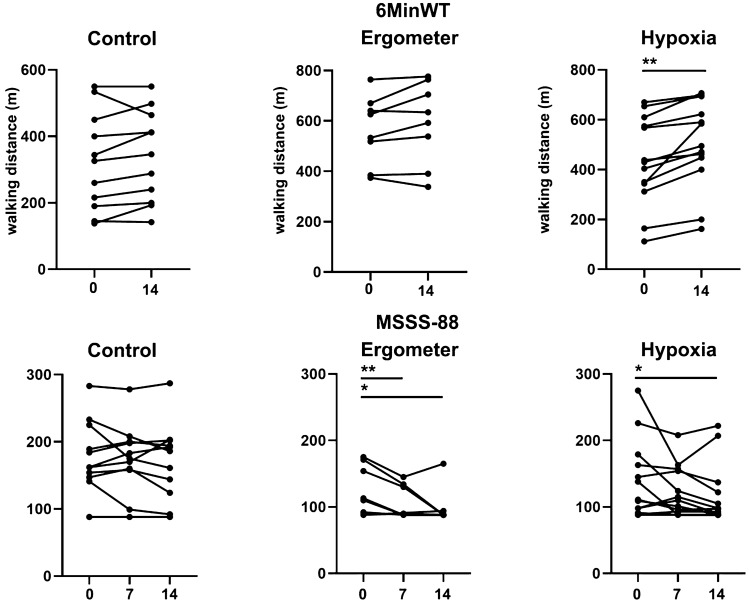
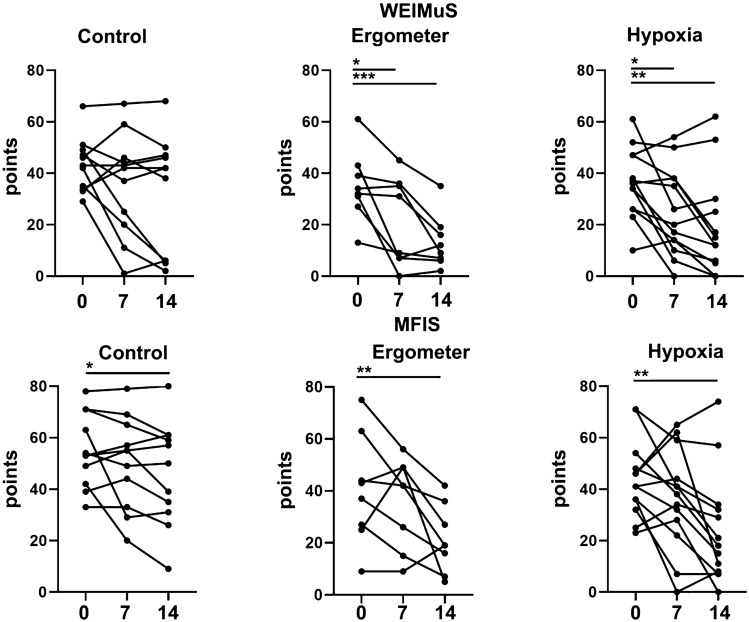
Fatigue scores improved significantly in all groups, but these improvements were reached faster in the groups which additionally received endurance training (normoxic p = 0.004; hypoxic p = 0.002). Spasticity scores were significantly lower in endurance training groups at the end of the study compared to baseline (normoxic p = 0.048, hypoxic p = 0.012), while only the hypoxic group increased significantly in 6MinWT (p = 0.001).
Our findings demonstrate that endurance training provides substantial benefit to neurological rehabilitation programs. Endurance training under hypoxic conditions could positively influence walking endurance within a 2-week training intervention and warrants further investigations.
疲劳是多发性硬化症(MS)患者最常见的症状之一,对生活质量造成重大影响。非药物干预策略包括体力活动,已证明其可减轻疲劳。在常压低氧条件下进行训练被认为可以改善对耐力训练的反应,因此在 MS 患者中,与常氧训练条件相比,可能具有额外的益处。
比较低氧和常氧条件下的耐力训练对住院康复期间 MS 患者疲劳、移动能力和痉挛的影响。
39 例 MS 患者在一项随机前瞻性纵向试点研究中被分配到以下组别:(1)常规临床康复计划;(2)常规临床康复计划+常氧耐力训练;(3)常规临床康复计划+低氧耐力训练,共 14 天。在第 0、7 和 14 天评估疲劳(WEIMuS 和 MFIS)、痉挛(MSSS-88)和步行耐力(6MinWT)。
所有组的疲劳评分均显著改善,但在接受耐力训练的组中,这些改善更快(常氧组 p=0.004;低氧组 p=0.002)。与基线相比,耐力训练组在研究结束时的痉挛评分显著降低(常氧组 p=0.048,低氧组 p=0.012),而只有低氧组在 6MinWT 中显著增加(p=0.001)。
我们的发现表明,耐力训练为神经康复计划提供了实质性的益处。低氧条件下的耐力训练可能会在 2 周的训练干预中对步行耐力产生积极影响,值得进一步研究。