Weill Cornell Medicine-Qatar, Research Division, Doha, Qatar.
Department of Neurology, University of Pittsburgh Medical Center, Pittsburgh, PA, USA.
Transl Vis Sci Technol. 2021 Apr 1;10(4):19. doi: 10.1167/tvst.10.4.19.
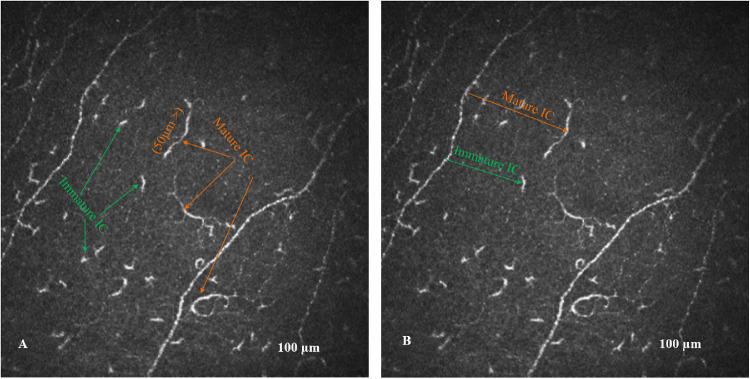
Corneal confocal microscopy (CCM) is an ophthalmic imaging technique that has been used to identify increased corneal immune cells in patients with immune-mediated peripheral neuropathy. Given that multiple sclerosis has an immune-mediated etiology, we have compared corneal immune cell (IC) density and near-nerve distance in different subtypes of patients with multiple sclerosis (MS) to controls.
This is a blinded, cross-sectional study conducted at a tertiary hospital. Patients with clinically isolated syndrome (CIS) (n = 9), relapsing-remitting multiple sclerosis (RRMS) (n = 43), secondary progressive multiple sclerosis (SPMS) (n = 22), and control subjects (n = 20) underwent CCM. The total, mature, and immature corneal IC density and their nearest nerve distance were quantified.
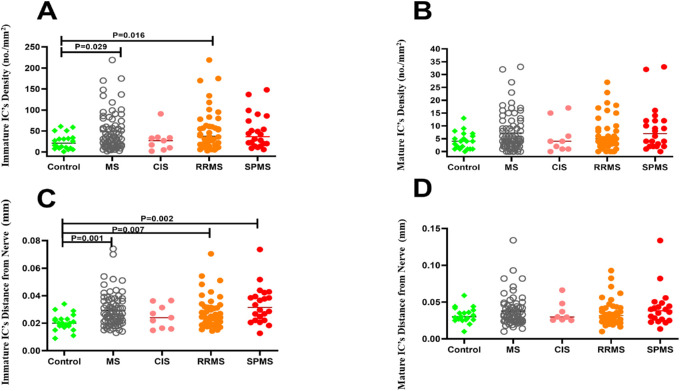
The total IC density was higher in patients with MS (P = 0.02), RRMS (P = 0.01), and SPMS (P = 0.04) but not CIS (P = 0.99) compared to controls. Immature IC density was higher in patients with MS (P = 0.03) and RRMS (P = 0.02) but not SPMS (P = 0.10) or CIS (P = 0.99) compared to controls. Mature IC density (P = 0.15) did not differ between patients with MS and controls. The immature IC near-nerve distance was significantly greater in patients with MS (P = 0.001), RRMS (P = 0.007), and SPMS (P = 0.002) compared to controls. Immature IC density correlated with the Symbol Digit Modalities Test (r = -0.281, P = 0.02) and near-nerve distance correlated with the Expanded Disability Status Scale (r = 0.289, P = 0.005).
In vivo CCM demonstrates an increase in immature IC density and the near-nerve distance in patients with MS. These observations merit further studies to assess the utility of CCM in assessing neuroimmune alterations in MS.
Multiple sclerosis is an immune-mediated neurodegenerative disease. Dendritic cells mediate communication between the innate and adaptive immune systems. We have used in vivo CCM to show increased corneal ICs and suggest it may act as an imaging biomarker for disease status in patients with MS.
角膜共聚焦显微镜(CCM)是一种眼科成像技术,已用于识别免疫介导的周围神经病患者中角膜免疫细胞的增加。鉴于多发性硬化症具有免疫介导的病因,我们比较了不同亚型多发性硬化症(MS)患者与对照组之间的角膜免疫细胞(IC)密度和近神经距离。
这是在一家三级医院进行的一项盲法、横断面研究。临床孤立综合征(CIS)患者(n=9)、复发缓解型多发性硬化症(RRMS)患者(n=43)、继发进展型多发性硬化症(SPMS)患者(n=22)和对照组(n=20)接受了 CCM。定量分析总、成熟和不成熟角膜 IC 密度及其最近神经距离。
与对照组相比,MS(P=0.02)、RRMS(P=0.01)和 SPMS(P=0.04)患者的总 IC 密度更高,但 CIS 患者(P=0.99)则不然。MS(P=0.03)和 RRMS(P=0.02)患者的不成熟 IC 密度更高,但 SPMS(P=0.10)或 CIS(P=0.99)患者则不然。MS 患者与对照组之间的成熟 IC 密度无差异(P=0.15)。MS(P=0.001)、RRMS(P=0.007)和 SPMS(P=0.002)患者的不成熟 IC 近神经距离明显大于对照组。不成熟 IC 密度与符号数字模态测试(r=-0.281,P=0.02)相关,近神经距离与扩展残疾状况量表(r=0.289,P=0.005)相关。
体内 CCM 显示 MS 患者不成熟 IC 密度和近神经距离增加。这些观察结果值得进一步研究,以评估 CCM 在评估 MS 神经免疫改变中的效用。
翻译的准确性和流畅度如何?如果有需要改进的地方,请提供具体建议。