Department of Global Health and Social Medicine, Harvard Medical School, 641 Huntington Avenue, Boston, MA, 02115, USA.
McGill International TB Centre, Research Institute of the McGill University Health Centre, 1001 rue Decarie, Montreal, Quebec, H4A 3J1, Canada.
BMC Infect Dis. 2021 May 18;21(1):449. doi: 10.1186/s12879-021-06136-1.
There is a need for innovative strategies to improve TB testing uptake and patient retention along the continuum of TB care early-on in treatment without burdening under-resourced health systems. We used a mixed methods approach to develop and pilot test a tuberculosis literacy and counselling intervention at an urban clinic in KwaZulu Natal, South Africa, to improve TB testing uptake and retention in tuberculosis care.
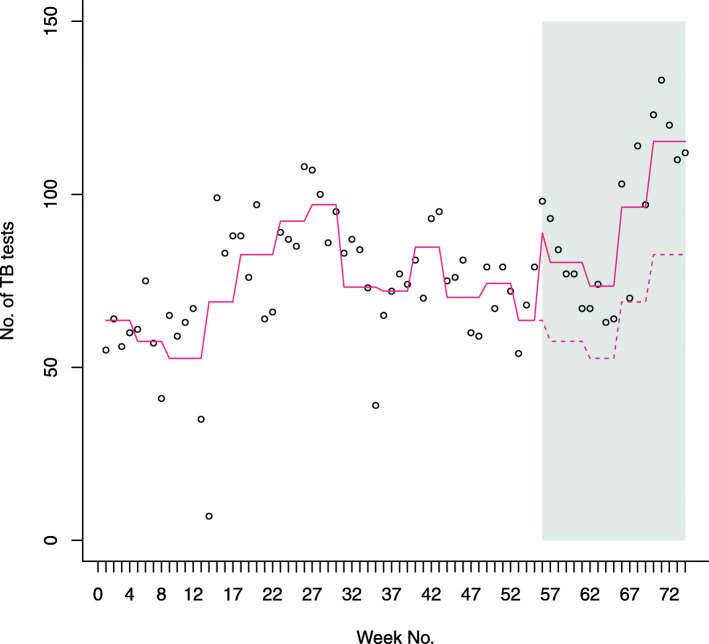
We engaged in discussions with clinic staff to plan and develop the intervention, which was delivered by senior social work students who received one-week training. The intervention included: 1) group health talks with all patients attending the primary clinic; and 2) individual counselling sessions, using motivational interviewing techniques, with newly diagnosed tuberculosis patients. We compared social work students' tuberculosis knowledge, attitudes, and practices before and after their training. We assessed the change in number of tuberculosis diagnostic tests performed after implementation via an interrupted time series analysis with a quasi-Poisson regression model. We compared pre- and post-intervention probabilities of treatment initiation and completion using regression analyses, adjusting for potential baseline confounders. We conducted focus groups with the students, as well as brief surveys and one-on-one interviews with patients, to assess acceptability, feasibility, and implementation.
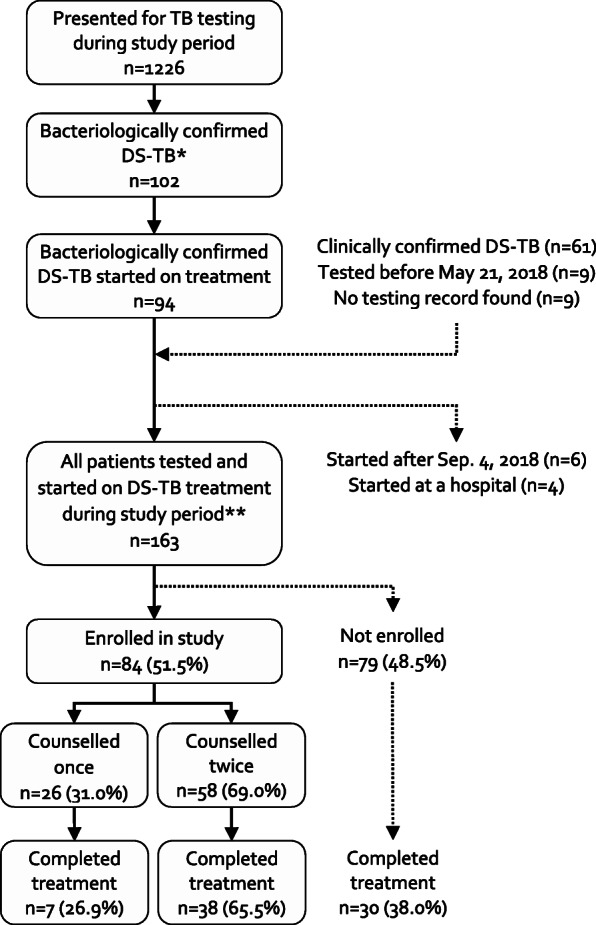
During the study period, 1226 individuals received tuberculosis diagnostic testing and 163 patients started tuberculosis treatment, of whom 84 (51.5%) received individual counselling. The number of diagnostic tuberculosis tests performed increased by 1.36 (95%CI 1.23-1.58) times post-intervention, adjusting for background calendar trend. Probabilities of TB treatment initiation and treatment completion increased by 10.1% (95%CI 1.5-21.3%) and 4.4% (95%CI -7.3-16.0%), respectively. Patients found the counselling sessions alleviated anxiety and increased treatment self-efficacy. Social work students felt the clinic staff were collaborative and highly supportive of the intervention, and that it improved patient engagement and adherence.
Engaging clinic staff in the development of an intervention ensures buy-in and collaboration. Education and counselling before and early-on in tuberculosis treatment can increase tuberculosis testing and treatment uptake. Training junior social workers can enable task-shifting in under-resourced settings, while addressing important service gaps in tuberculosis care.
需要创新策略来提高结核病检测的采用率,并在治疗早期保留患者,以改善结核病治疗的连续性,同时不增加资源匮乏的卫生系统的负担。我们采用混合方法,在南非夸祖鲁-纳塔尔省的一家城市诊所,开发并试点了结核病知识和咨询干预措施,以提高结核病检测的采用率和保留率。
我们与诊所工作人员进行了讨论,以规划和开发干预措施,由接受为期一周培训的高级社会工作学生实施。该干预措施包括:1)为所有初级诊所就诊的患者举办小组健康讲座;2)对新诊断的结核病患者进行个别咨询,使用动机访谈技术。我们比较了社会工作学生在培训前后的结核病知识、态度和实践。我们通过使用准泊松回归模型的中断时间序列分析,比较了实施后的结核病诊断测试数量的变化。我们使用回归分析比较了干预前后开始和完成治疗的概率,调整了潜在的基线混杂因素。我们与学生进行了焦点小组讨论,并对患者进行了简短的调查和一对一访谈,以评估可接受性、可行性和实施情况。
在研究期间,共有 1226 人接受了结核病诊断检测,163 人开始结核病治疗,其中 84 人(51.5%)接受了个别咨询。干预后,结核病诊断测试数量增加了 1.36 倍(95%CI 1.23-1.58),调整了背景日历趋势。结核病治疗开始和完成的概率分别增加了 10.1%(95%CI 1.5-21.3%)和 4.4%(95%CI -7.3-16.0%)。患者发现咨询减轻了焦虑,提高了治疗自我效能感。社会工作学生认为诊所工作人员具有合作精神,并非常支持干预措施,认为这提高了患者的参与度和依从性。
让诊所工作人员参与干预措施的开发可以确保获得认可和合作。在结核病治疗前和早期进行教育和咨询可以提高结核病检测和治疗的采用率。在资源匮乏的环境中培训初级社会工作者可以实现任务转移,同时解决结核病护理中的重要服务差距。