Yun Wingyan, Dan Wenchao, Liu Jinlei, Guo Xinyuan, Li Min, He Qingyong
Guang'anmen Hospital, China Academy of Chinese Medical Sciences, Beijing 100053, China.
Graduate School of Beijing University of Chinese Medicine, Beijing 100029, China.
Evid Based Complement Alternat Med. 2021 Apr 28;2021:5539970. doi: 10.1155/2021/5539970. eCollection 2021.
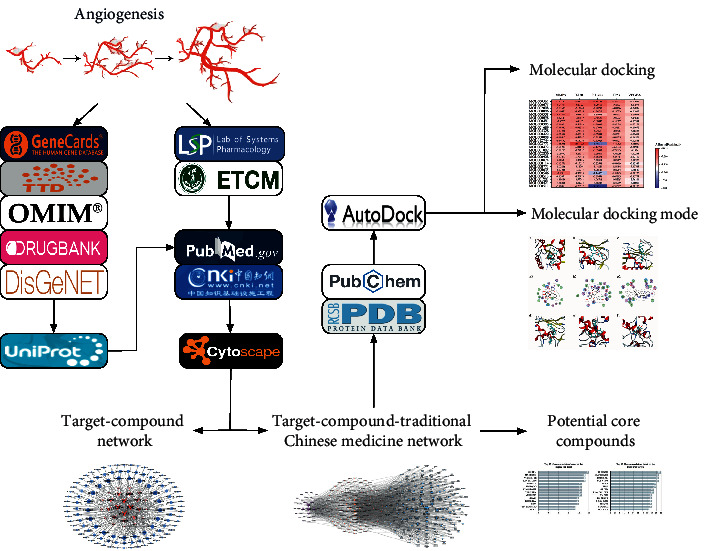
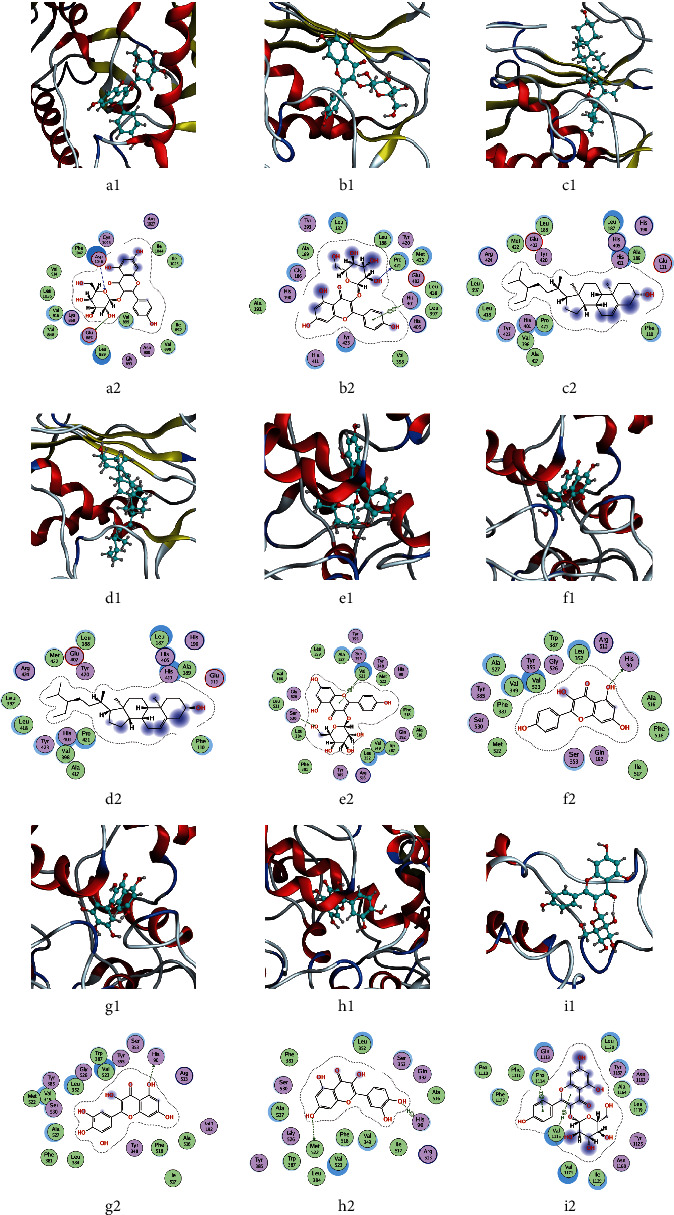
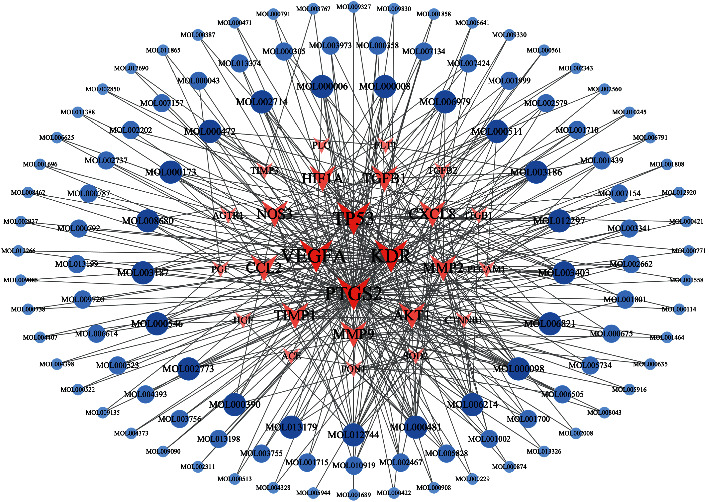
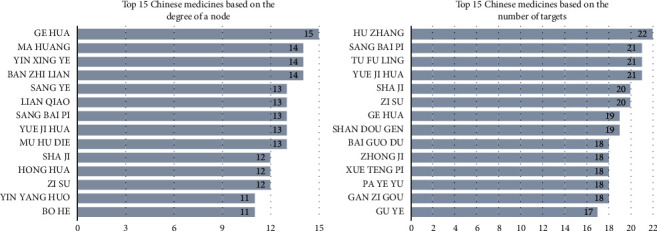
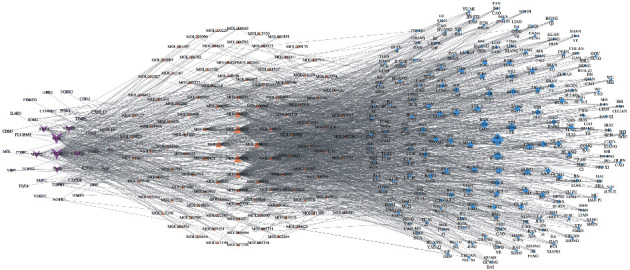
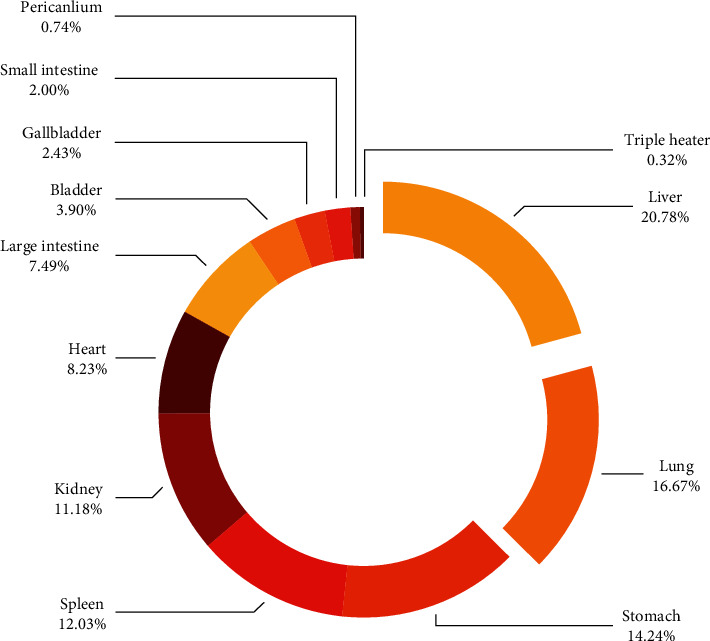
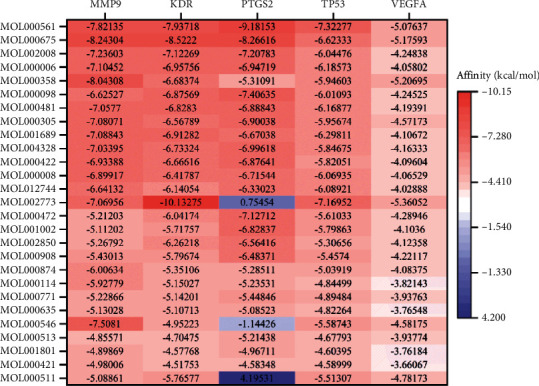
Although traditional Chinese medicine is effective and safe for the treatment of angiogenesis, the intervention mechanism is diverse, complex, and largely unknown. Therefore, we aimed to explore the active ingredients of traditional Chinese medicine and their mechanisms of action against angiogenesis. Data on angiogenesis-related targets were collected from GeneCards, Therapeutic Target Database, Online Mendelian Inheritance in Man, DrugBank, and DisGeNET. These were matched to related molecular compounds and ingredients in the traditional Chinese medicine system pharmacology platform. The data were integrated and based on the condition of degree > 1, and relevant literature, target-compound, compound-medicine, and target-compound-medicine networks were constructed using Cytoscape. Molecular docking was used to predict the predominant binding combination of core targets and components. We obtained 79 targets for angiogenesis; 41 targets were matched to 3839 compounds, of which 110 compounds were selected owing to their high correlation with angiogenesis. Fifty-five combinations in the network were obtained by molecular docking, among which PTGS2-astragalin (-9.18 kcal/mol), KDR-astragalin (-7.94 kcal/mol), PTGS2-quercetin (-7.41 kcal/mol), and PTGS2-myricetin (-7.21 kcal/mol) were top. These results indicated that the selected potential core compounds have good binding activity with the core targets. Eighty new combinations were obtained from the network, and the top combinations based on affinity were KDR-beta-carotene (-10.13 kcal/mol), MMP9-beta-sitosterol (-8.04 kcal/mol), MMP9-astragalin (-7.82 kcal/mol), and MMP9-diosgenin (-7.51 kcal/mol). The core targets included PTGS2, KDR, VEGFA, and MMP9. The essential components identified were astragalin, kaempferol, myricetin, quercetin, and -sitosterol. The crucial Chinese medicines identified included Polygoni Cuspidati Rhizoma et Radix, Root Bark, and Forsythiae Fructus. By systematically analysing the ingredients of traditional Chinese medicine and their targets, it is possible to determine their potential mechanisms of action against pathological angiogenesis. Our study provides a basis for further research and the development of new therapeutics for angiogenesis.
尽管传统中药在治疗血管生成方面有效且安全,但其干预机制多样、复杂且大多未知。因此,我们旨在探索中药的活性成分及其抗血管生成的作用机制。从基因卡片、治疗靶点数据库、人类孟德尔遗传在线、药物银行和疾病基因网络收集与血管生成相关的靶点数据。将这些数据与中药系统药理学平台中的相关分子化合物和成分进行匹配。对数据进行整合,并基于度>1的条件,使用Cytoscape构建相关文献、靶点-化合物、化合物-药物和靶点-化合物-药物网络。采用分子对接预测核心靶点与成分的主要结合组合。我们获得了79个血管生成靶点;41个靶点与3839种化合物匹配,其中110种化合物因其与血管生成的高度相关性而被选中。通过分子对接在网络中获得了55种组合,其中PTGS2-紫云英苷(-9.18kcal/mol)、KDR-紫云英苷(-7.94kcal/mol)、PTGS2-槲皮素(-7.41kcal/mol)和PTGS2-杨梅素(-7.21kcal/mol)位居前列。这些结果表明,所选的潜在核心化合物与核心靶点具有良好的结合活性。从网络中获得了80种新组合,基于亲和力的顶级组合为KDR-β-胡萝卜素(-10.13kcal/mol)、MMP9-β-谷甾醇(-8.04kcal/mol)、MMP9-紫云英苷(-7.82kcal/mol)和MMP9-薯蓣皂苷元(-7.51kcal/mol)。核心靶点包括PTGS2、KDR、VEGFA和MMP9。确定的关键成分包括紫云英苷、山柰酚、杨梅素、槲皮素和β-谷甾醇。确定的关键中药包括虎杖、桑白皮和连翘。通过系统分析中药成分及其靶点,有可能确定它们抗病理性血管生成的潜在作用机制。我们的研究为进一步研究和开发抗血管生成的新疗法提供了依据。