Institute for Advanced Study, Shenzhen University, Shenzhen 508060, China.
School of Biological Sciences, The University of Hong Kong, Pokfulam Road, Hong Kong, China.
Oxid Med Cell Longev. 2021 Apr 28;2021:6687386. doi: 10.1155/2021/6687386. eCollection 2021.
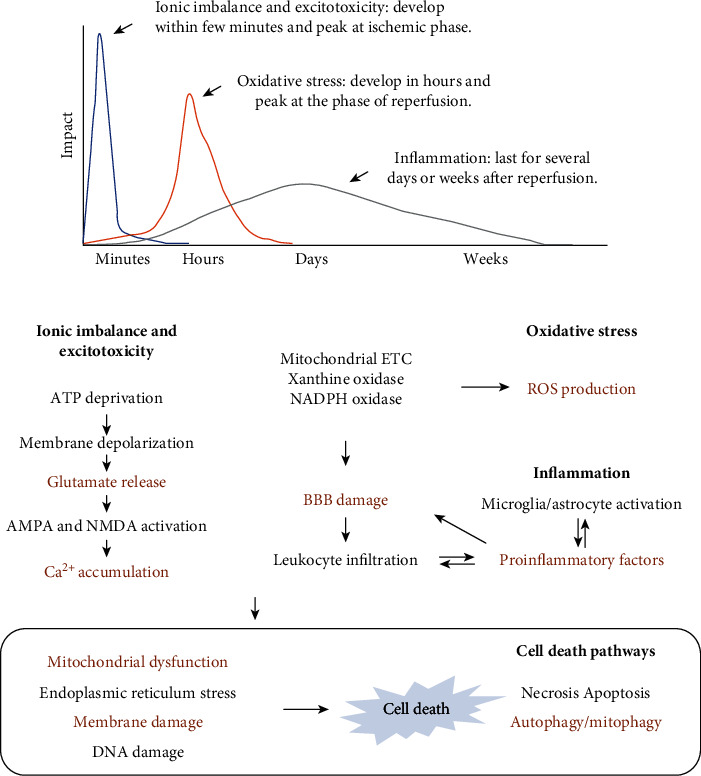
Ischemic stroke is a challenging disease with high mortality and disability rates, causing a great economic and social burden worldwide. During ischemic stroke, ionic imbalance and excitotoxicity, oxidative stress, and inflammation are developed in a relatively certain order, which then activate the cell death pathways directly or indirectly via the promotion of organelle dysfunction. Neuroprotection, a therapy that is aimed at inhibiting this damaging cascade, is therefore an important therapeutic strategy for ischemic stroke. Notably, phytochemicals showed great neuroprotective potential in preclinical research via various strategies including modulation of calcium levels and antiexcitotoxicity, antioxidation, anti-inflammation and BBB protection, mitochondrial protection and antiapoptosis, autophagy/mitophagy regulation, and regulation of neurotrophin release. In this review, we summarize the research works that report the neuroprotective activity of phytochemicals in the past 10 years and discuss the neuroprotective mechanisms and potential clinical applications of 148 phytochemicals that belong to the categories of flavonoids, stilbenoids, other phenols, terpenoids, and alkaloids. Among them, scutellarin, pinocembrin, puerarin, hydroxysafflor yellow A, salvianolic acids, rosmarinic acid, borneol, bilobalide, ginkgolides, ginsenoside Rd, and vinpocetine show great potential in clinical ischemic stroke treatment. This review will serve as a powerful reference for the screening of phytochemicals with potential clinical applications in ischemic stroke or the synthesis of new neuroprotective agents that take phytochemicals as leading compounds.
缺血性脑卒中是一种具有高死亡率和致残率的挑战性疾病,在全球范围内造成了巨大的经济和社会负担。在缺血性脑卒中发生过程中,离子失衡和兴奋性毒性、氧化应激和炎症会按相对确定的顺序发生,然后通过促进细胞器功能障碍直接或间接地激活细胞死亡途径。神经保护是一种旨在抑制这种损伤级联反应的治疗方法,因此是缺血性脑卒中的重要治疗策略。值得注意的是,植物化学物质通过调节钙水平和抗兴奋毒性、抗氧化、抗炎和 BBB 保护、线粒体保护和抗细胞凋亡、自噬/线粒体自噬调节以及神经营养因子释放的调节等多种策略,在临床前研究中显示出巨大的神经保护潜力。在这篇综述中,我们总结了过去 10 年报告植物化学物质具有神经保护活性的研究工作,并讨论了属于黄酮类、二苯乙烯类、其他酚类、萜类和生物碱类的 148 种植物化学物质的神经保护机制和潜在临床应用。其中,野黄芩苷、白杨素、葛根素、羟基红花黄色素 A、丹参酸、迷迭香酸、冰片、银杏内酯、人参皂苷 Rd 和长春西汀在临床缺血性脑卒中治疗中具有很大的潜力。这篇综述将为筛选具有潜在临床应用的缺血性脑卒中植物化学物质或合成以植物化学物质为先导化合物的新型神经保护剂提供有力参考。