Quest Diagnostics, San Juan Capistrano, California.
JAMA Netw Open. 2021 May 3;4(5):e2111634. doi: 10.1001/jamanetworkopen.2021.11634.
Low vitamin D levels have been reported to be associated with increased risk of SARS-CoV-2 infection. Independent, well-powered studies could further our understanding of this association.
To examine whether low levels of vitamin D are associated with SARS-CoV-2 seropositivity, an indicator of previous infection.
DESIGN, SETTING, AND PARTICIPANTS: This is a cohort study of employees and spouses who elected to be tested for SARS-CoV-2 IgG as part of an annual employer-sponsored health screening program conducted in August to November 2020. This program includes commonly assessed demographic, biometric, and laboratory variables, including total vitamin D measurement. Baseline (prepandemic) levels of vitamin D and potential confounders were obtained from screening results from the previous year (September 2019 to January 2020). Data analysis was performed from December 2020 to March 2021.
Low total serum 25-hydroxyvitamin D, defined as either less than 20 ng/mL or less than 30 ng/mL.
The main outcome was SARS-CoV-2 seropositivity, as determined with US Food and Drug Administration emergency use-authorized assays. The association of SARS-CoV-2 seropositivity with vitamin D levels was assessed by multivariable logistic regression analyses and propensity score analyses.
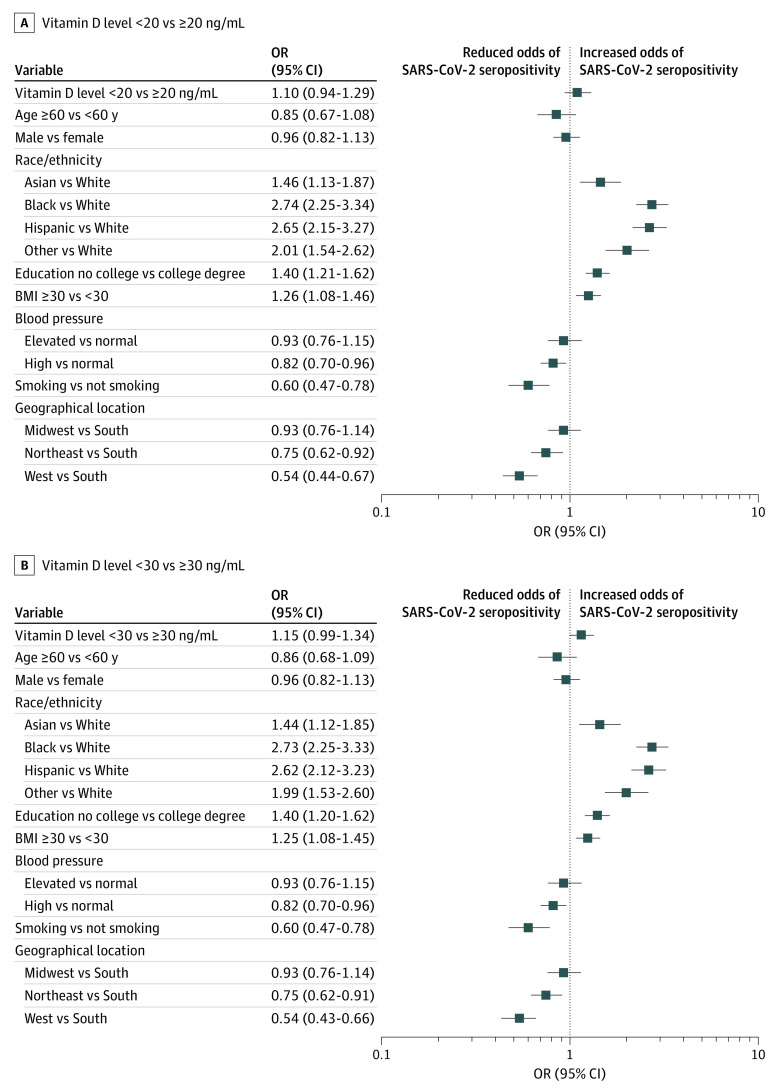
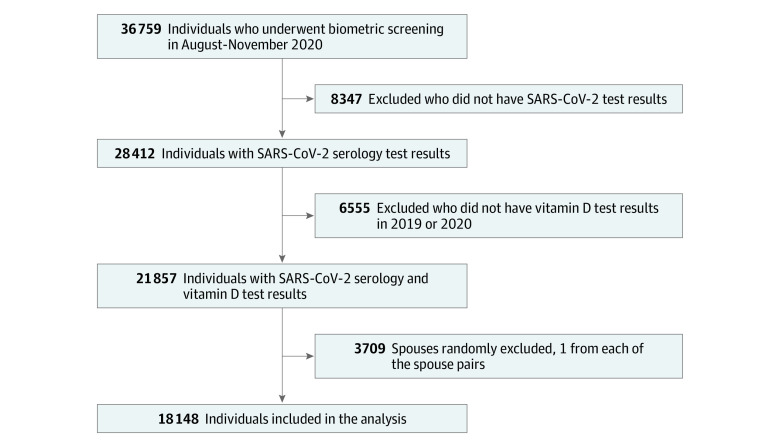
The 18 148 individuals included in this study had test results for SARS-CoV-2 IgG in 2020 and vitamin D levels from the prepandemic and pandemic periods. Their median (interquartile range) age was 47 (37-56) years, 12 170 (67.1%) were women, 900 (5.0%) were seropositive, 4498 (24.8%) had a vitamin D level less than 20 ng/mL, and 10 876 (59.9%) had a vitamin D level less than 30 ng/mL before the pandemic. In multivariable models adjusting for age, sex, race/ethnicity, education, body mass index, blood pressure, smoking status, and geographical location, SARS-CoV-2 seropositivity was not associated with having a vitamin D level less than 20 ng/mL before (odds ratio [OR], 1.04; 95% CI, 0.88-1.22) or during (OR, 0.93; 95% CI, 0.79-1.09) the pandemic; it was also not associated with having a vitamin D level less than 30 ng/mL before (OR, 1.09; 95% CI, 0.93-1.27) or during (OR, 1.05; 95% CI, 0.91-1.23) the pandemic. Similar results were observed in propensity score analyses. SARS-CoV-2 seropositivity was associated with obesity (OR, 1.26; 95% CI, 1.08-1.46), not having a college degree (OR, 1.40; 95% CI, 1.21-1.62), and Asian (OR, 1.46; 95% CI, 1.13-1.87), Black (OR, 2.74; 95% CI, 2.25-3.34), Hispanic (OR, 2.65; 95% CI, 2.15-3.27), American Indian or Alaska Native, and Native Hawaiian or other Pacific Islander (OR, 2.01; OR, 1.54-2.62) race/ethnicity, and was inversely associated with high blood pressure (OR, 0.82; 95% CI, 0.70-0.96), smoking (OR, 0.60; 95% CI, 0.47-0.78), and residing in the US Northeast (OR, 0.75; 95% CI, 0.62-0.92) and West (OR, 0.54; 95% CI, 0.44-0.67).
In this cohort study, SARS-CoV-2 seropositivity was not associated with low levels of vitamin D independently of other risk factors.
有报道称,低维生素 D 水平与 SARS-CoV-2 感染风险增加有关。独立、有力的研究可以进一步了解这种关联。
研究低水平的维生素 D 是否与 SARS-CoV-2 血清阳性有关,这是以前感染的一个指标。
设计、地点和参与者:这是一项队列研究,参与者为员工及其配偶,他们选择作为雇主赞助的年度健康筛查计划的一部分接受 SARS-CoV-2 IgG 检测。该计划包括通常评估的人口统计学、生物统计学和实验室变量,包括总维生素 D 测量。基线(大流行前)水平的维生素 D 和潜在的混杂因素是从前一年(2019 年 9 月至 2020 年 1 月)的筛查结果中获得的。数据分析于 2020 年 12 月至 2021 年 3 月进行。
血清 25-羟维生素 D 总量低,定义为低于 20ng/ml 或低于 30ng/ml。
主要结果是 SARS-CoV-2 血清阳性,这是通过美国食品和药物管理局紧急使用授权的检测方法确定的。通过多变量逻辑回归分析和倾向评分分析评估 SARS-CoV-2 血清阳性与维生素 D 水平的关系。
本研究纳入了 18148 名在 2020 年接受 SARS-CoV-2 IgG 检测且在大流行前和大流行期间有维生素 D 水平检测结果的个体。他们的中位(四分位间距)年龄为 47(37-56)岁,12170 名(67.1%)为女性,900 名(5.0%)为血清阳性,4498 名(24.8%)的维生素 D 水平低于 20ng/ml,10876 名(59.9%)的维生素 D 水平低于 30ng/ml。在调整年龄、性别、种族/民族、教育程度、体重指数、血压、吸烟状况和地理位置的多变量模型中,SARS-CoV-2 血清阳性与大流行前(比值比[OR],1.04;95%CI,0.88-1.22)或大流行期间(OR,0.93;95%CI,0.79-1.09)维生素 D 水平低于 20ng/ml 无关;与大流行前(OR,1.09;95%CI,0.93-1.27)或大流行期间(OR,1.05;95%CI,0.91-1.23)维生素 D 水平低于 30ng/ml 也无关。倾向评分分析也得到了类似的结果。SARS-CoV-2 血清阳性与肥胖(OR,1.26;95%CI,1.08-1.46)、未获得大学学位(OR,1.40;95%CI,1.21-1.62)、亚洲人(OR,1.46;95%CI,1.13-1.87)、黑人(OR,2.74;95%CI,2.25-3.34)、西班牙裔(OR,2.65;95%CI,2.15-3.27)、美国印第安人或阿拉斯加原住民、夏威夷原住民或其他太平洋岛民(OR,2.01;95%CI,1.54-2.62)、高血压(OR,0.82;95%CI,0.70-0.96)、吸烟(OR,0.60;95%CI,0.47-0.78)和居住在美国东北部(OR,0.75;95%CI,0.62-0.92)和西部(OR,0.54;95%CI,0.44-0.67)呈负相关。
在这项队列研究中,SARS-CoV-2 血清阳性与其他危险因素无关,与低水平的维生素 D 无关。