Insight SFI Research Centre for Data Analytics, School of Computer Science, University College Dublin, Dublin, Ireland.
PLoS One. 2021 May 19;16(5):e0251513. doi: 10.1371/journal.pone.0251513. eCollection 2021.
In the marathon, how runners pace and fuel their race can have a major impact on race outcome. The phenomenon known as hitting the wall (HTW) refers to the iconic hazard of the marathon distance, in which runners experience a significant slowing of pace late in the race, typically after the 20-mile mark, and usually because of a depletion of the body's energy stores.
This work investigates the occurrence of significant late-race slowing among recreational marathoners, as a proxy for runners hitting the wall, to better understand the likelihood and nature of such slowdowns, and their effect on race performance.
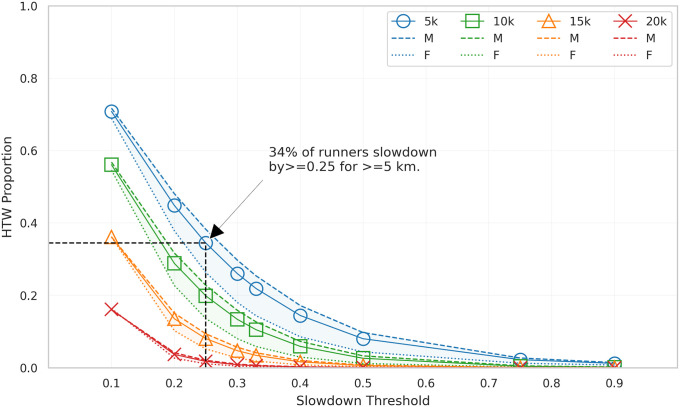
Using pacing data from more than 4 million race records, we develop a pacing-based definition of hitting the wall, by identifying runners who experience a sustained period of slowing during the latter stages of the marathon. We calculate the cost of these slowdowns relative to estimates of the recent personal-best times of runners and compare slowdowns according to runner sex, age, and ability.
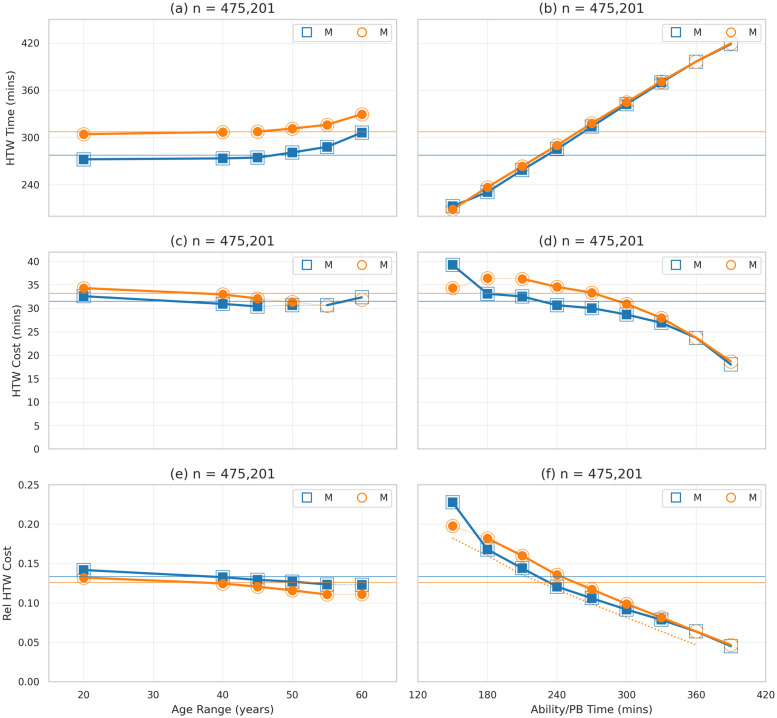
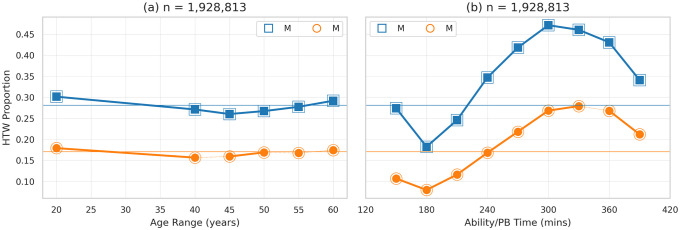
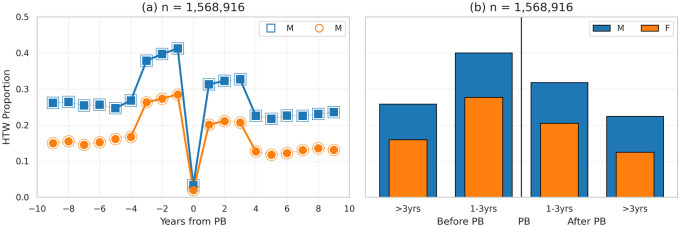
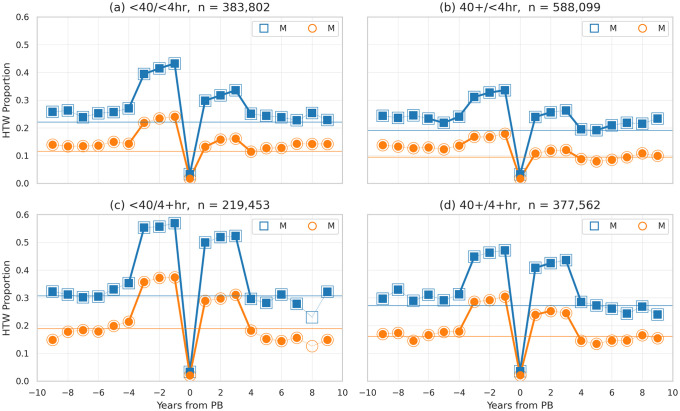
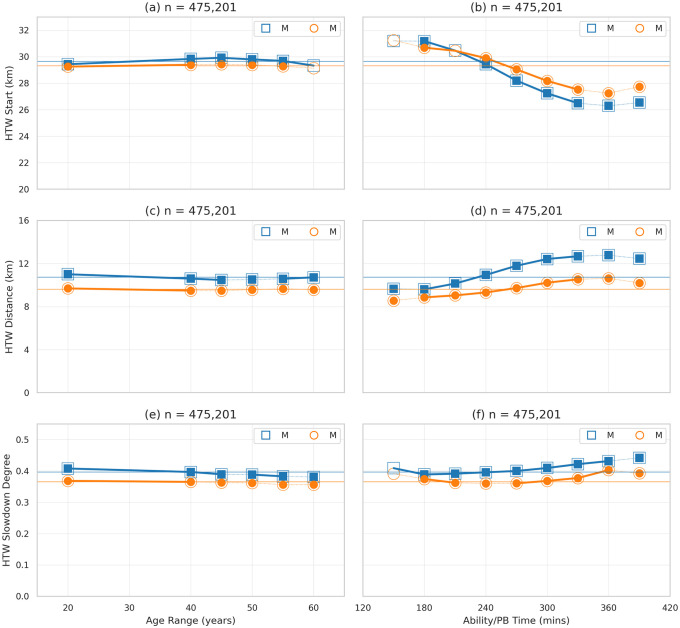
We find male runners more likely to slow significantly (hit the wall) than female runners; 28% of male runners hit the wall compared with 17% of female runners, χ2(1, N = 1, 928, 813) = 27, 693.35, p < 0.01, OR = 1.43. Such slowdowns are more frequent in the 3 years immediately before and after a recent personal-best (PB) time; for example, 36% of all runners hit the wall in the 3 years before a recent PB compared with just 23% in earlier years, χ2(1, N = 509, 444) = 8, 120.74, p < 0.01, OR = 1.31. When runners hit the wall, males slow more than females: a relative slowdown of 0.40 vs. 0.37 is noted, for male and female runners, when comparing their pace when they hit the wall to their earlier race (5km-20km) pace, with t(475, 199) = 60.19, p < 0.01, d = 0.15. And male runners slow over longer distances than female runners: 10.7km vs. 9.6km, respectively, t(475, 199) = 68.44, p < 0.01, d = 0.17. Although, notably the effect size of these differences is small. We also find the finish-time costs of hitting the wall (lost minutes) to increase with ability; r2(7) = 0.91, p < 0.01 r2(7) = 0.81, p < 0.01 for male and female runners, respectively.
While the findings from this study are consistent with qualitative results from earlier single-race or smaller-scale studies, the new insights into the risk and nature of slowdowns, based on the runner sex, age, and ability, have the potential to help runners and coaches to better understand and calibrate the risk/reward trade-offs that exist as they plan for future races.
在马拉松比赛中,跑者的配速和燃料选择对比赛结果有重大影响。“撞墙”(HTW)现象是马拉松比赛中标志性的危险,指跑者在比赛后期,通常是 20 英里标记后,显著减速,通常是因为身体能量储备耗尽。
本研究通过观察休闲马拉松跑者的比赛后期显著减速情况(作为跑者撞墙的代理指标),更好地了解这种减速的可能性和性质,以及其对比赛表现的影响。
我们利用超过 400 万场比赛记录中的配速数据,通过识别在马拉松比赛后期持续减速的跑者,制定了一种基于配速的撞墙定义。我们根据跑者最近的个人最佳成绩(PB)来计算这些减速的代价,并比较跑者性别、年龄和能力的减速情况。
我们发现男性跑者比女性跑者更容易显著减速(撞墙);男性跑者中 28%撞墙,而女性跑者中只有 17%,χ2(1, N = 1, 928, 813) = 27, 693.35, p < 0.01, OR = 1.43。这种减速在最近 PB 时间前后的 3 年内更为频繁;例如,所有跑者中 36%在最近 PB 前 3 年内撞墙,而前几年只有 23%,χ2(1, N = 509, 444) = 8, 120.74, p < 0.01, OR = 1.31。当跑者撞墙时,男性减速比女性更明显:男性和女性跑者在比较撞墙时的配速与早期比赛(5 公里至 20 公里)的配速时,相对减速分别为 0.40 和 0.37,t(475, 199) = 60.19, p < 0.01, d = 0.15。并且男性跑者减速的距离比女性跑者长:分别为 10.7 公里和 9.6 公里,t(475, 199) = 68.44, p < 0.01, d = 0.17。尽管这些差异的效应大小较小。我们还发现撞墙的完成时间成本(损失的时间)随着能力的提高而增加;r2(7) = 0.91, p < 0.01 r2(7) = 0.81, p < 0.01 分别适用于男性和女性跑者。
虽然这项研究的结果与早期单一比赛或小规模研究的定性结果一致,但根据跑者性别、年龄和能力对减速风险和性质的新见解,有可能帮助跑者和教练更好地理解和调整他们在规划未来比赛时存在的风险/回报权衡。