The Academic Unit of Child Health, Sheffield Children's NHS Foundation Trust, Sheffield, United Kingdom.
Adhera Health Inc, Palo Alto, CA, United States.
J Med Internet Res. 2021 May 20;23(5):e27446. doi: 10.2196/27446.
The use of technology to support health and health care has grown rapidly in the last decade across all ages and medical specialties. Newly developed eHealth tools are being implemented in long-term management of growth failure in children, a low prevalence pediatric endocrine disorder.
Our objective was to create a framework that can guide future implementation and research on the use of eHealth tools to support patients with growth disorders who require growth hormone therapy.
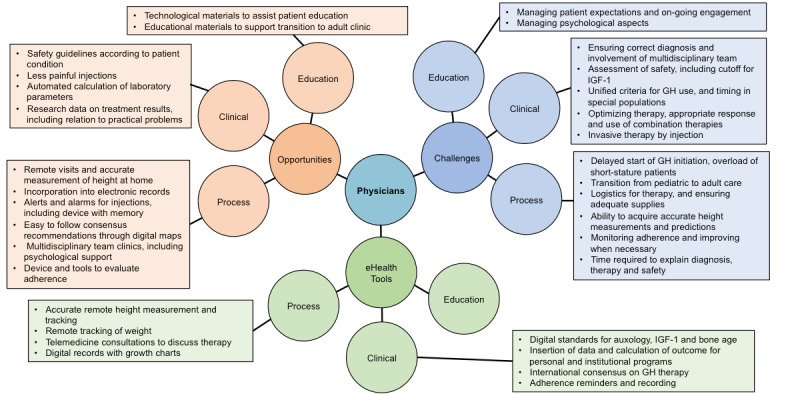
A total of 12 pediatric endocrinologists with experience in eHealth, from a wide geographical distribution, participated in a series of online discussions. We summarized the discussions of 3 workshops, conducted during 2020, on the use of eHealth in the management of growth disorders, which were structured to provide insights on existing challenges, opportunities, and solutions for the implementation of eHealth tools across the patient journey, from referral to the end of pediatric therapy.
A total of 815 responses were collected from 2 questionnaire-based activities covering referral and diagnosis of growth disorders, and subsequent growth hormone therapy stages of the patient pathway, relating to physicians, nurses, and patients, parents, or caregivers. We mapped the feedback from those discussions into a framework that we developed as a guide to integration of eHealth tools across the patient journey. Responses focused on improved clinical management, such as growth monitoring and automation of referral for early detection of growth disorders, which could trigger rapid evaluation and diagnosis. Patient support included the use of eHealth for enhanced patient and caregiver communication, better access to educational opportunities, and enhanced medical and psychological support during growth hormone therapy management. Given the potential availability of patient data from connected devices, artificial intelligence can be used to predict adherence and personalize patient support. Providing evidence to demonstrate the value and utility of eHealth tools will ensure that these tools are widely accepted, trusted, and used in clinical practice, but implementation issues (eg, adaptation to specific clinical settings) must be addressed.
The use of eHealth in growth hormone therapy has major potential to improve the management of growth disorders along the patient journey. Combining objective clinical information and patient adherence data is vital in supporting decision-making and the development of new eHealth tools. Involvement of clinicians and patients in the process of integrating such technologies into clinical practice is essential for implementation and developing evidence that eHealth tools can provide value across the patient pathway.
在过去十年中,无论年龄大小和医疗专业如何,使用技术来支持健康和医疗保健的做法都迅速增加。新开发的电子健康工具正在儿童生长障碍的长期管理中得到应用,这是一种罕见的儿科内分泌疾病。
我们的目标是创建一个框架,该框架可以指导未来使用电子健康工具来支持需要生长激素治疗的生长障碍患者的实施和研究。
来自广泛地理分布的 12 名具有电子健康经验的儿科内分泌学家参与了一系列在线讨论。我们总结了 2020 年期间进行的 3 次关于电子健康在生长障碍管理中的使用的研讨会的讨论,这些研讨会的结构旨在提供有关现有挑战、机遇和电子健康工具在患者旅程中的实施解决方案的见解,从转介到儿科治疗结束。
从涵盖生长障碍的转介和诊断以及后续生长激素治疗阶段的患者路径的 2 项基于问卷的活动中,共收集了 815 条来自医生、护士以及患者、父母或照顾者的回复。我们将这些讨论的反馈映射到我们开发的一个框架中,该框架是整合患者旅程中电子健康工具的指南。回复主要集中在改善临床管理方面,例如生长监测和自动转介以早期发现生长障碍,这可以触发快速评估和诊断。患者支持包括使用电子健康来增强患者和照顾者的沟通、更好地获得教育机会以及在生长激素治疗管理期间增强医疗和心理支持。鉴于来自连接设备的患者数据的潜在可用性,人工智能可用于预测依从性并个性化患者支持。提供证据证明电子健康工具的价值和实用性将确保这些工具在临床实践中得到广泛接受、信任和使用,但必须解决实施问题(例如,适应特定的临床环境)。
在生长激素治疗中使用电子健康技术有可能改善患者旅程中的生长障碍管理。结合客观的临床信息和患者依从性数据对于支持决策和开发新的电子健康工具至关重要。临床医生和患者参与将这些技术整合到临床实践中的过程对于实施和开发电子健康工具可以在整个患者路径中提供价值的证据至关重要。