Department of Gynecology, Obstetrics and Gynecology Hospital of Fudan University, Shanghai, China.
Mol Reprod Dev. 2021 Jun;88(6):379-394. doi: 10.1002/mrd.23476. Epub 2021 May 20.
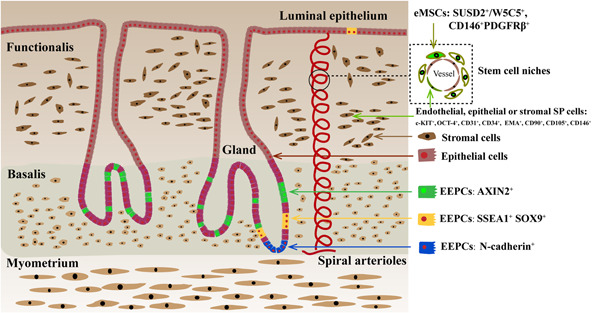
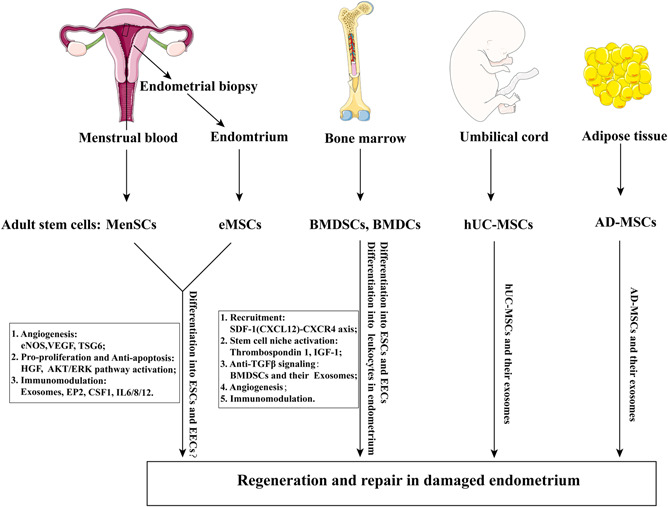
Endometrial damage is an important cause of female reproductive problems, manifested as menstrual abnormalities, infertility, recurrent pregnancy loss, and other complications. These conditions are collectively termed "Asherman syndrome" (AS) and are typically associated with recurrent induced pregnancy terminations, repeated diagnostic curettage and intrauterine infections. Cancer treatment also has unexpected detrimental side effects on endometrial function in survivors independently of ovarian effects. Endometrial stem cells act in the regeneration of the endometrium and in repair through direct differentiation or paracrine effects. Nonendometrial adult stem cells, such as bone marrow-derived mesenchymal stem cells and umbilical cord-derived mesenchymal stem cells, with autologous and allogenic applications, can also repair injured endometrial tissue in animal models of AS and in human studies. However, there remains a lack of research on the repair of the damaged endometrium after the reversal of tumors, especially endometrial cancers. Here, we review the biological mechanisms of endometrial regeneration, and research progress and challenges for adult stem cell therapy for damaged endometrium, and discuss the potential applications of their use for endometrial repair after cancer remission, especially in endometrial cancers. Successful application of such cells will improve reproductive parameters in patients with AS or cancer. Significance: The endometrium is the fertile ground for embryos, but damage to the endometrium will greatly impair female fertility. Adult stem cells combined with tissue engineering scaffold materials or not have made great progress in repairing the injured endometrium due to benign lesions. However, due to the lack of research on the repair of the damaged endometrium caused by malignant tumors or tumor therapies, the safety and effectiveness of such stem cell-based therapies need to be further explored. This review focuses on the molecular insights and clinical application potential of adult stem cells in endometrial regeneration and discusses the possible challenges or difficulties that need to be overcome in stem cell-based therapies for tumor survivors. The development of adult stem cell-related new programs will help repair damaged endometrium safely and effectively and meet fertility needs in tumor survivors.
子宫内膜损伤是女性生殖问题的一个重要原因,表现为月经异常、不孕、反复妊娠丢失等并发症。这些情况统称为“Asherman 综合征”(AS),通常与反复人工流产、刮宫术和宫腔内感染有关。癌症治疗也会对幸存者的子宫内膜功能产生意想不到的不利影响,而与卵巢功能无关。子宫内膜干细胞在子宫内膜的再生和修复中发挥作用,可通过直接分化或旁分泌作用发挥作用。非子宫内膜的成体干细胞,如骨髓间充质干细胞和脐带间充质干细胞,具有自体和同种异体应用的潜力,也可以在 AS 动物模型和人类研究中修复受损的子宫内膜组织。然而,对于肿瘤逆转后受损子宫内膜的修复,特别是子宫内膜癌,研究仍然缺乏。在这里,我们综述了子宫内膜再生的生物学机制,以及成体干细胞治疗受损子宫内膜的研究进展和挑战,并讨论了它们在癌症缓解后用于子宫内膜修复的潜在应用,特别是在子宫内膜癌中。这些细胞的成功应用将改善 AS 或癌症患者的生殖参数。意义:子宫内膜是胚胎的肥沃土壤,但子宫内膜损伤会极大地损害女性的生育能力。由于良性病变,成体干细胞结合组织工程支架材料在修复受损子宫内膜方面取得了很大进展。然而,由于缺乏对恶性肿瘤或肿瘤治疗引起的受损子宫内膜的修复研究,这种基于干细胞的治疗的安全性和有效性需要进一步探索。本综述重点介绍了成体干细胞在子宫内膜再生中的分子见解和临床应用潜力,并讨论了基于干细胞的治疗在肿瘤幸存者中可能需要克服的挑战或困难。成体干细胞相关新方案的发展将有助于安全有效地修复受损的子宫内膜,满足肿瘤幸存者的生育需求。