Department of Sociology.
Department of Mathematics and Statistics.
J Consult Clin Psychol. 2021 Apr;89(4):288-300. doi: 10.1037/ccp0000634.
Numerous behavioral treatments for alcohol use disorder (AUD) are effective, but there are substantial individual differences in treatment response. This study examines the potential use of new methods for personalized medicine to test for individual differences in the effects of cognitive behavioral therapy (CBT) versus motivational enhancement therapy (MET) and to provide predictions of which will work best for individuals with AUD. We highlight both the potential contribution and the limitations of these methods.
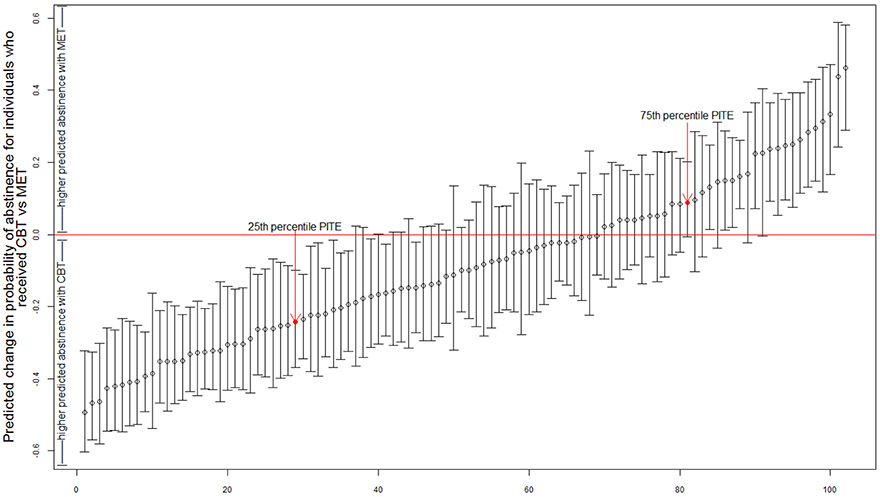
We performed secondary analyses of abstinence among 1,144 participants with AUD participating in either outpatient or aftercare treatment who were randomized to receive either CBT or MET in Project MATCH. We first obtained predicted individual treatment effects (PITEs), as a function of 19 baseline client characteristics identified a priori by MATCH investigators. Then, we tested for the significance of individual differences and examined the predicted individual differences in abstinence 1 year following treatment. Predictive intervals were estimated for each individual to determine if they were 80% more likely to achieve abstinence in one treatment versus the other.
Results indicated that individual differences in the likelihood of abstinence at 1 year following treatment were significant for those in the outpatient sample, but not for those in the aftercare sample. Individual predictive intervals showed that 37% had a better chance of abstinence with CBT than MET, and 16% had a better chance of abstinence with MET. Obtaining predictions for a new individual is demonstrated.
Personalized medicine methods, and PITE in particular, have the potential to identify individuals most likely to benefit from one versus another intervention. New personalized medicine methods play an important role in putting together differential effects due to previously identified variables into one prediction designed to be useful to clinicians and clients choosing between treatment options. (PsycInfo Database Record (c) 2021 APA, all rights reserved).
许多针对酒精使用障碍(AUD)的行为治疗方法是有效的,但在治疗反应方面存在很大的个体差异。本研究探讨了个性化医学新方法的潜在用途,以测试认知行为疗法(CBT)与动机增强疗法(MET)的效果在个体中的差异,并预测哪些方法对 AUD 患者最有效。我们强调了这些方法的潜在贡献和局限性。
我们对参加 MATCH 项目的 1144 名 AUD 患者进行了次要分析,这些患者接受门诊或康复后治疗,随机分配接受 CBT 或 MET。我们首先获得了个体治疗效果的预测值(PITE),这是基于 MATCH 研究人员预先确定的 19 项基线客户特征的函数。然后,我们测试了个体差异的显著性,并检查了治疗后 1 年时的 abstinence 个体差异预测值。为每个个体估计了预测区间,以确定他们在一种治疗方法中比另一种治疗方法更有可能达到 abstinence 的可能性是否达到 80%。
结果表明,治疗后 1 年 abstinence 的个体差异在门诊样本中是显著的,但在康复后样本中不显著。个体预测区间表明,37%的人使用 CBT 比 MET 更有可能 abstinence,16%的人使用 MET 比 CBT 更有可能 abstinence。展示了对新个体进行预测的过程。
个性化医学方法,特别是 PITE,有可能识别出最有可能从一种干预措施中受益的个体。新的个性化医学方法在将由于先前确定的变量而产生的差异效果组合成一个预测中发挥着重要作用,该预测旨在对在治疗方案之间进行选择的临床医生和患者有用。(PsycInfo 数据库记录(c)2021 APA,保留所有权利)。