Graduate Institute of Biomedical Sciences, China Medical University, Taichung, Taiwan.
Department of Psychiatry, Taipei City Psychiatric Center, Taipei City Hospital, Taipei, Taiwan.
Transl Psychiatry. 2021 May 20;11(1):301. doi: 10.1038/s41398-021-01407-6.
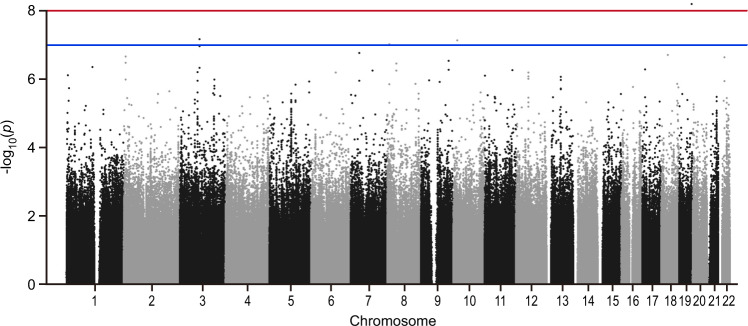
The search for susceptibility genes underlying the heterogeneous bipolar disorder has been inconclusive, often with irreproducible results. There is a hope that narrowing the phenotypes will increase the power of genetic analysis. Early-onset bipolar disorder is thought to be a genetically homogeneous subtype with greater symptom severity. We conducted a genome-wide association study (GWAS) for this subtype in bipolar I (BPI) disorder. Study participants included 1779 patients of Han Chinese descent with BPI disorder recruited by the Taiwan Bipolar Consortium. We conducted phenotype assessment using the Chinese version of the Schedules for Clinical Assessment in Neuropsychiatry and prepared a life chart with graphic depiction of lifetime clinical course for each of the BPI patient recruited. The assessment of onset age was based on this life chart with early onset defined as ≤20 years of age. We performed GWAS in a discovery group of 516 early-onset and 790 non-early-onset BPI patients, followed by a replication study in an independent group of 153 early-onset and 320 non-early-onset BPI patients and a meta-analysis with these two groups. The SNP rs11127876, located in the intron of CADM2, showed association with early-onset BPI in the discovery cohort (P = 7.04 × 10) and in the test of replication (P = 0.0354). After meta-analysis, this SNP was demonstrated to be a new genetic locus in CADM2 gene associated with early-onset BPI disorder (P = 5.19 × 10).
寻找导致异质性双相情感障碍的易感基因的研究一直没有定论,结果往往不可重复。人们希望缩小表型范围将提高遗传分析的效力。早发性双相情感障碍被认为是一种遗传上同质的亚型,其症状严重程度更高。我们针对这种亚型在双相 I 障碍(BPI)中进行了全基因组关联研究(GWAS)。研究参与者包括由台湾双相情感障碍联盟招募的 1779 名汉族 BPI 障碍患者。我们使用中文版的精神科临床评估时间表(Schedules for Clinical Assessment in Neuropsychiatry)进行表型评估,并为每位 BPI 患者制作了包含其一生临床过程的图形描述的生活图表。发病年龄的评估基于该生活图表,早发性定义为≤20 岁。我们在 516 名早发性和 790 名非早发性 BPI 患者的发现组中进行了 GWAS,随后在 153 名早发性和 320 名非早发性 BPI 患者的独立组中进行了复制研究,并对这两组进行了荟萃分析。位于 CADM2 内含子中的 SNP rs11127876 与发现队列中的早发性 BPI 相关(P=7.04×10),在复制检验中也具有相关性(P=0.0354)。经过荟萃分析,该 SNP 被证明是 CADM2 基因中与早发性 BPI 障碍相关的新遗传位点(P=5.19×10)。