León Antonella, Aparicio Gabriela I, Scorticati Camila
Instituto de Investigaciones Biotecnológicas "Rodolfo A. Ugalde", Universidad Nacional de San Martín and Consejo Nacional de Investigaciones Científicas y Técnicas (IIBio-UNSAM-CONICET), Buenos Aires, Argentina.
Front Synaptic Neurosci. 2021 May 4;13:661681. doi: 10.3389/fnsyn.2021.661681. eCollection 2021.
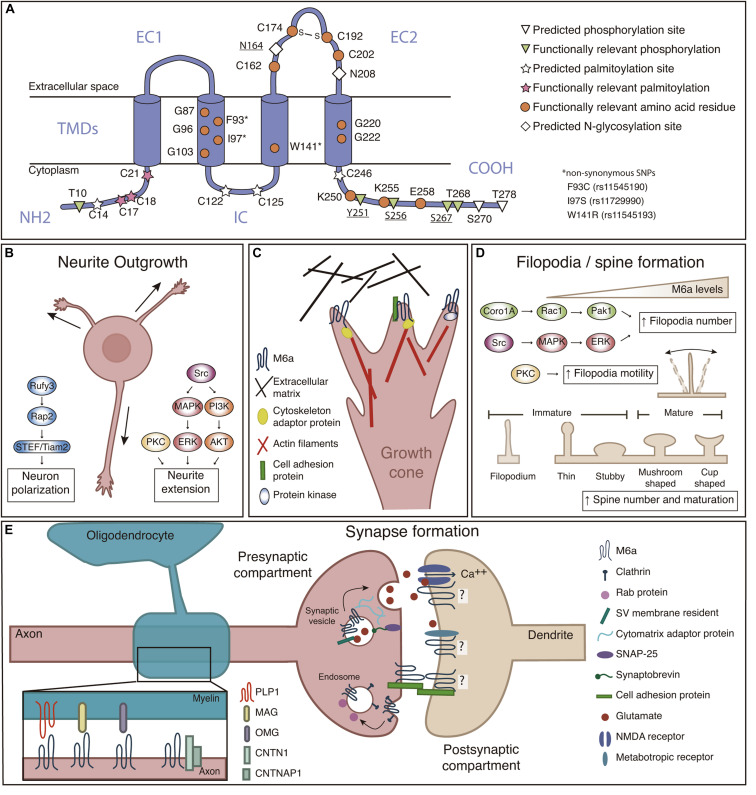
The cellular and molecular mechanisms underlying neuropsychiatric and neurodevelopmental disorders show that most of them can be categorized as synaptopathies-or damage of synaptic function and plasticity. Synaptic formation and maintenance are orchestrated by protein complexes that are in turn regulated in space and time during neuronal development allowing synaptic plasticity. However, the exact mechanisms by which these processes are managed remain unknown. Large-scale genomic and proteomic projects led to the discovery of new molecules and their associated variants as disease risk factors. Neuronal glycoprotein M6a, encoded by the gene is emerging as one of these molecules. M6a has been involved in neuron development and synapse formation and plasticity, and was also recently proposed as a gene-target in various neuropsychiatric disorders where it could also be used as a biomarker. In this review, we provide an overview of the structure and molecular mechanisms by which glycoprotein M6a participates in synapse formation and maintenance. We also review evidence collected from patients carrying mutations in the gene; animal models, and studies that together emphasize the relevance of M6a, particularly in synapses and in neurological conditions.
神经精神疾病和神经发育障碍背后的细胞和分子机制表明,其中大多数可归类为突触病,即突触功能和可塑性的损伤。突触的形成和维持由蛋白质复合物精心调控,而这些蛋白质复合物在神经元发育过程中又受到时空调节,从而实现突触可塑性。然而,这些过程的具体调控机制仍不清楚。大规模基因组和蛋白质组计划导致发现了新的分子及其相关变体作为疾病风险因素。由该基因编码的神经元糖蛋白M6a正成为其中之一。M6a参与了神经元发育、突触形成和可塑性,最近还被提议作为各种神经精神疾病的基因靶点,在这些疾病中它也可作为生物标志物。在本综述中,我们概述了糖蛋白M6a参与突触形成和维持的结构和分子机制。我们还回顾了从携带该基因突变的患者、动物模型以及相关研究中收集的证据,这些证据共同强调了M6a的相关性,特别是在突触和神经疾病中的相关性。