Deakin Health Economics, Institute for Health Transformation, Deakin University, Waurn Ponds, Vic., Australia.
Community Dental Program, Peninsula Health, Frankston, Vic., Australia.
Int J Dent Hyg. 2022 Nov;20(4):627-634. doi: 10.1111/idh.12523. Epub 2021 Jun 2.
To evaluate the impact of an intervention consisting of a 1-day continuing professional development (CPD) education programme on the International Caries Classification and Management System (ICCMS ), and monthly performance feedback, and to promote minimally invasive dentistry (MID) for children aged under 12 years in an Australian community dental agency. The a priori hypotheses assumed the intervention would increase preventive services, and treatment demand was met.
A quasi non-randomized controlled trial with convenience sampling method was adopted. Fourteen dental practitioners received the intervention. The prevalence of dental caries and gingivitis in Australian children was used to determine the treatment demand and used as the performance benchmark. Ten types of preventive and non-preventive dental services were examined. A Difference-in-Differences (DiD) of 12-month pre- (baseline) and post-intervention analysis was performed.
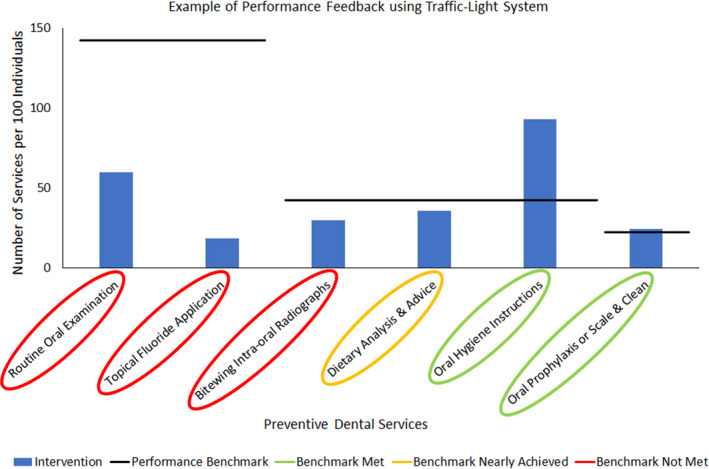
The intervention group demonstrated increases in topical fluoride application and dietary analysis and advice services. The standard care group had increases in oral prophylaxis or scale and clean, topical fluoride application and oral hygiene instructions (p-value <0.05). The DiD analysis confirmed the above findings in the intervention group, while other preventive services declined. In the intervention group, the performance benchmark for oral prophylaxis or scale and clean and oral hygiene instructions was met at baseline and post-intervention.
Only a few preventive services had already met the performance benchmark. The intervention was associated with varied changes to preventive and non-preventive dental services. More robust study design addressing the study limitations and validating the performance benchmark is required.
评估由为期 1 天的继续教育(CPD)教育计划、每月绩效反馈组成的干预措施对国际龋病分类和管理系统(ICCMS)的影响,并在澳大利亚社区牙科机构中推广针对 12 岁以下儿童的微创牙科(MID)。先验假设认为该干预措施将增加预防服务,并满足治疗需求。
采用准非随机对照试验和便利抽样方法。14 名牙医接受了干预措施。使用澳大利亚儿童龋齿和牙龈炎的患病率来确定治疗需求,并将其作为绩效基准。检查了 10 种预防和非预防牙科服务。采用 12 个月前(基线)和后干预分析的差异(DiD)。
干预组在局部氟化物应用和饮食分析及建议服务方面有所增加。对照组在口腔卫生防护或刮治和清洁、局部氟化物应用和口腔卫生指导方面有所增加(p 值<0.05)。差异分析证实了干预组的上述发现,而其他预防服务则下降。在干预组中,口腔卫生防护或刮治和清洁以及口腔卫生指导的绩效基准在基线和干预后均得到满足。
只有少数预防服务已经达到了绩效基准。干预措施与预防和非预防牙科服务的各种变化有关。需要更严格的研究设计来解决研究限制并验证绩效基准。